
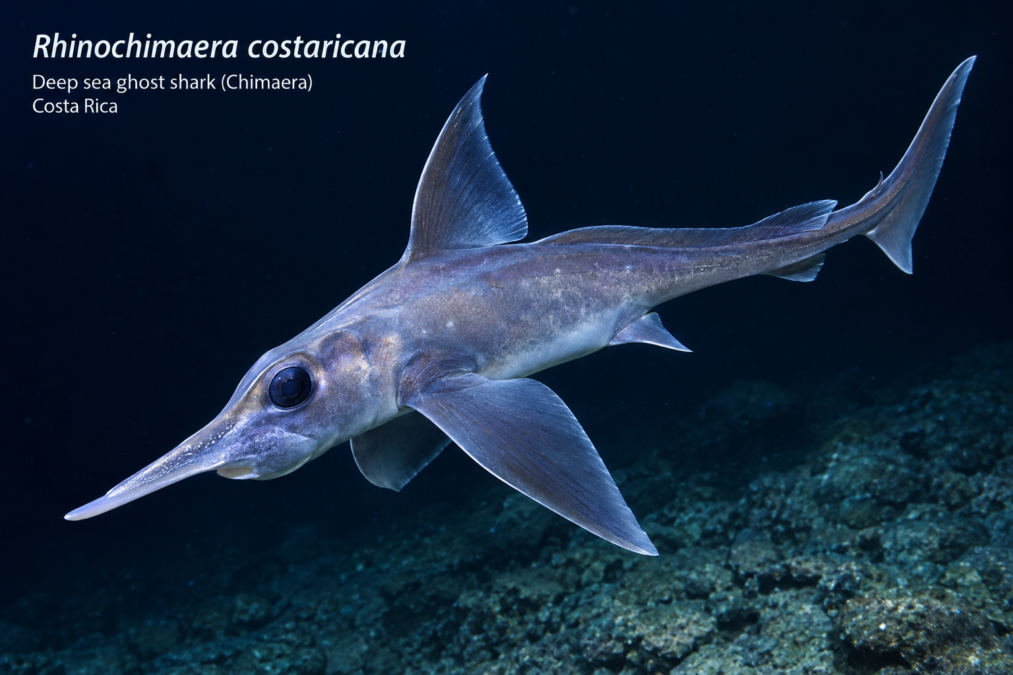

The deep sea ghost shark costa rica discovery has brought fresh attention to the mysterious world beneath the Pacific Ocean. In June 2026, scientists formally described a new species of deep-sea chimaera from waters off Costa Rica. Its scientific name is Rhinochimaera costaricana, and it belongs to a remarkable group of cartilaginous fishes commonly called ghost sharks. Despite the name, it isn’t actually a true shark. Instead, it is a distant relative of sharks and rays.
The discovery is especially interesting because the deep ocean remains one of Earth’s least explored environments. Far below the bright surface waters, conditions become dark, cold, and difficult to study. Yet, life continues to thrive there in surprising forms.
The newly described species was based on three specimens collected from the Pacific coast of Costa Rica. Researchers from the University of Costa Rica, Costa Rica’s fisheries institute, and the Federal University of Pará in Brazil contributed to the study. The species was formally described in the scientific journal Zootaxa on June 10, 2026.
This article explores what scientists know about this unusual animal, why it matters, where it lives, and what its discovery tells us about Costa Rica’s deep marine biodiversity.
What Is the Deep Sea Ghost Shark Costa Rica Discovery?
The phrase deep sea ghost shark costa rica refers to the newly described Rhinochimaera costaricana, a deep-water chimaera found off Costa Rica’s Pacific coast.
Chimaeras are unusual cartilaginous fishes. They share an ancient evolutionary relationship with sharks and rays, but they belong to a separate group known as Holocephali. Their bodies contain cartilage rather than the hard bones found in most modern fish.
Ghost sharks received their popular name because many have unusual appearances and are rarely seen alive. Their long bodies, large fins, strange snouts, and deep-sea lifestyles can make them look almost otherworldly.
However, there’s nothing supernatural about them. Their unusual appearance is the result of millions of years of adaptation to life in the deep ocean.
The 2026 scientific paper describes Rhinochimaera costaricana as a new species within the genus Rhinochimaera. The researchers identified it through a combination of physical characteristics and molecular evidence.
The Scientific Name Rhinochimaera costaricana
Scientific names may seem complicated at first glance, but they help researchers identify species accurately around the world.
The new ghost shark is called Rhinochimaera costaricana.
The first part, Rhinochimaera, identifies its genus. The second part, costaricana, refers to Costa Rica and recognizes the country’s connection to the discovery.
The species belongs to the following broad classification:
| Classification | Group |
|---|---|
| Kingdom | Animalia |
| Phylum | Chordata |
| Class | Chondrichthyes |
| Subclass | Holocephali |
| Order | Chimaeriformes |
| Family | Rhinochimaeridae |
| Genus | Rhinochimaera |
| Species | Rhinochimaera costaricana |
The formal description was published by Naidely Valeria Vidaurre-Quesada and colleagues in Zootaxa, volume 5828, issue 3, pages 535–548. The publication date was June 10, 2026.
Where Does This Ghost Shark Live?
The deep sea ghost shark costa rica species has been recorded from the Pacific waters off Costa Rica.
According to taxonomic records, Rhinochimaera costaricana occurs at depths of approximately 390 to 787 meters. That’s far below the normal recreational diving zone and well into the deep-water environment.
One important specimen was collected approximately 25 kilometers southwest of Cabo Blanco in Puntarenas, Costa Rica. The type locality listed by the Catalog of Fishes places the collection area in the Pacific waters of Costa Rica at depths of about 390–420 meters.
At these depths, sunlight is extremely limited or absent. Pressure is also much greater than at the surface. In other words, this isn’t an easy place for humans to visit, let alone conduct regular wildlife observations.
That’s one reason why deep-sea animals can remain unknown for so long.
Why Is It Called a Ghost Shark?
The term “ghost shark” is a common name for many chimaeras. It doesn’t mean that these animals are ghosts or mysterious creatures in a supernatural sense.
Instead, the name reflects their unusual appearance and elusive lifestyle.
Ghost sharks can have:
- Long, tapered bodies
- Large pectoral fins
- Unusual snouts
- Smooth-looking skin
- Large eyes in some species
- Specialized tooth plates
- Long tails
- Deep-sea adaptations
Unlike many familiar sharks, chimaeras don’t have the classic streamlined body that people usually imagine when they hear the word “shark.”
They also have distinctive feeding structures. Their tooth plates are adapted for processing food on the seafloor, where they can encounter crustaceans and other small marine organisms.
So, while the name sounds dramatic, the animal is simply an extraordinary member of the deep-sea fish community.
How Is Rhinochimaera costaricana Different?
Scientists don’t name a new species merely because an animal looks a little different. Formal species descriptions require detailed examination.
The researchers identified Rhinochimaera costaricana through a particular combination of anatomical characteristics and molecular evidence. This combination helps separate it from related species.
Some of the distinguishing features include:
- A distinctive head and snout shape
- A mouth positioned well forward in relation to the eyes
- Narrow and elongated tooth plates
- An absence of an anal fin
- Narrow pectoral fins
- Distinctive structures along the upper part of the tail
- A particular arrangement of sensory canals around the head
These features help researchers distinguish the Costa Rican species from other members of the same family.
The largest type specimen reported in taxonomic records is about 820 millimeters in total length.
That’s a useful reminder that even deep-sea animals can have very different body plans from the fish we commonly see near shore.
How Was the New Species Discovered?
One of the most fascinating parts of the story is that discovering a new species doesn’t always mean scientists encountered a completely unknown animal yesterday.
In this case, researchers examined specimens that had been collected from Costa Rican waters. Three adult male specimens became the basis for recognizing and formally describing the new species.
The research involved specialists from several institutions. The authors included scientists connected with the University of Costa Rica, Costa Rica’s Instituto Costarricense de Pesca y Acuacultura, and the Federal University of Pará in Brazil.
Scientists studied the animals’ physical structures and used molecular evidence to support the identification. This combination is increasingly important in modern taxonomy.
After careful comparison, the researchers concluded that the specimens represented a species that had not previously been formally described.
And there you have it: sometimes a scientific breakthrough begins not with a dramatic expedition, but with careful examination of specimens and a question that doesn’t quite have an answer yet.
The Importance of Museum and Research Collections
Scientific collections play a huge role in biodiversity research.
When an unusual animal is collected, researchers can preserve it and store it in a museum or institutional collection. Years later, another scientist may examine the specimen with new techniques.
This can lead to discoveries that weren’t possible when the specimen was first collected.
For deep-sea animals, this is particularly valuable. Scientists can’t easily return to every location where a specimen was found. Deep-sea research requires specialized vessels, equipment, trained crews, and considerable resources.
A preserved specimen, however, can continue providing information for decades.
Researchers can study:
- Body structure
- Fin shape
- Skull and jaw features
- Tooth plates
- Sensory systems
- Reproductive structures
- Genetic information
- Relationships with other species
The deep sea ghost shark costa rica discovery therefore demonstrates how important scientific collections can be. What might look like an ordinary preserved fish to an untrained observer can actually contain clues about Earth’s hidden biodiversity.
Life in the Deep Pacific Ocean
The Pacific waters around Costa Rica are biologically rich, and the deep areas are no exception.
The deep sea is challenging for living organisms because sunlight becomes unavailable, pressure increases, and food can be less predictable than in shallow waters.
Yet animals have evolved remarkable strategies to survive.
Deep-sea fishes may rely on:
- Sensitive sensory systems
- Specialized feeding structures
- Slow energy use
- Adapted vision
- Camouflage
- Chemical sensing
- Powerful or efficient swimming abilities
Chimaeras are particularly interesting because their evolutionary history stretches far back into the past.
The Smithsonian explains that chimaeras are cartilaginous animals related to sharks and that their evolutionary line separated from sharks roughly 400 million years ago.
That means modern ghost sharks represent a very old branch of vertebrate evolutionary history.
Costa Rica and Deep-Sea Biodiversity
Costa Rica is famous around the world for its forests, national parks, birds, monkeys, reptiles, and other wildlife. However, its marine biodiversity deserves just as much attention.
Research on Costa Rican chondrichthyans has documented sharks, rays, and chimaeras in both Pacific and Caribbean waters.
A major review of Costa Rica’s chondrichthyan diversity reported seven chimaeroid species in the country’s Pacific records and emphasized that many deep-water species have only been formally reported relatively recently.
This is significant because it shows that the country’s biodiversity isn’t limited to places people can easily see.
Some of the most unusual animals may be living hundreds or thousands of meters below the ocean surface.
The discovery of Rhinochimaera costaricana adds another piece to that larger biological picture.
Earlier Ghost Shark Discoveries in Costa Rica
The 2026 discovery wasn’t the first time scientists found a chimaera associated with Costa Rican waters.
In 2014, researchers described Chimaera orientalis, a species collected from the Pacific coasts of Costa Rica and Peru. The study also documented records of several other chimaeroid fishes from Costa Rican and Central American waters.
The discovery of Chimaera orientalis was important because it was the first species of the genus Chimaera described from the eastern Pacific Ocean.
Its reported depth range extends into deep water, with records associated with depths of roughly 560 to 1,138 meters.
This history makes the latest discovery even more interesting. Costa Rica’s Pacific waters continue to reveal species that help scientists understand the diversity of deep-sea chimaeras.
How Do Ghost Sharks Feed?
Ghost sharks aren’t typically active predators in the same way people might imagine a great white shark hunting prey.
Many chimaeras are associated with the seafloor and have specialized tooth plates that help them crush or process food.
Their diets can include bottom-dwelling organisms such as:
- Small crustaceans
- Shrimp
- Crabs
- Mollusks
- Other small marine animals
For Chimaera orientalis, available fish database information lists mobile benthic crustaceans and gastropods or bivalves among its recorded dietary categories.
For Rhinochimaera costaricana, however, scientists still have much to learn about its exact diet and behavior.
That’s an important distinction. Scientists can make reasonable comparisons with related species, but they shouldn’t automatically assume every chimaera behaves in exactly the same way.
What Makes the Deep Sea Difficult to Study?
Studying the deep sea is no walk in the park.
Several factors make research challenging.
Extreme Pressure
Water pressure increases rapidly with depth. Equipment must be specially designed to work safely in these conditions.
Darkness
Sunlight doesn’t penetrate indefinitely into the ocean. Deep-sea habitats can be almost completely dark.
Distance From Shore
Deep habitats can be far from ports and research facilities. Reaching them requires ships and specialized equipment.
High Research Costs
Oceanographic expeditions require vessels, fuel, scientific instruments, crew members, and researchers.
Rare Encounters
Many deep-sea animals are not abundant in easily accessible locations. Researchers may need considerable time to find and collect specimens.
Because of these challenges, every properly documented deep-sea species can provide valuable information.
What Does This Discovery Tell Us About Evolution?
The deep sea ghost shark costa rica discovery also has an evolutionary importance.
Chimaeras are part of an ancient lineage of cartilaginous fishes. Their bodies have evolved along a different path from modern sharks and rays.
Studying them can help scientists understand how different groups of vertebrates adapted to changing ocean environments over extremely long periods.
The new species also provides evidence that the eastern Pacific still contains organisms that scientists haven’t fully documented.
That doesn’t mean scientists know nothing about the region. Quite the opposite. Costa Rica has a strong history of marine research.
But the discovery shows that even well-studied countries can have hidden biodiversity beneath their waters.
Why New Species Matter to Science
Finding a new species isn’t simply about adding another name to a scientific list.
Each species can provide information about:
- Evolution
- Ecosystem relationships
- Geographic distribution
- Marine food webs
- Environmental adaptation
- Genetic diversity
- Conservation needs
If researchers don’t know an animal exists, they can’t properly study its population or assess its environmental importance.
This is particularly important for deep-sea species because changes in ocean conditions, fishing activity, pollution, and other pressures can affect habitats that are difficult to monitor.
A new species description is therefore the beginning of research, not the end.
Is the Costa Rican Ghost Shark Dangerous?
There is no reason to think that Rhinochimaera costaricana poses a significant threat to people.
The species lives hundreds of meters below the surface, far beyond ordinary swimming and recreational diving areas. It also has a lifestyle very different from the large predatory sharks that receive most public attention.
The nickname “ghost shark” can make the animal sound frightening, but the name shouldn’t be confused with dangerous behavior.
In fact, these animals are better understood as specialized deep-sea fishes that are difficult to encounter.
Their strange appearance is fascinating rather than a reason for fear.
Conservation and the Need for More Research
The conservation status and biology of newly described species can be difficult to determine because scientists often have limited information.
For Rhinochimaera costaricana, the available records are based on a small number of specimens. That means scientists still need more information about its population size, reproduction, geographic range, diet, behavior, and potential threats.
This is one reason continued marine research is so important.
Deep-sea ecosystems can be affected by human activities even when those ecosystems seem far removed from everyday life.
Responsible fisheries management, scientific monitoring, habitat research, and careful documentation can all contribute to better understanding.
Rather than assuming that an unfamiliar species is rare or endangered immediately, researchers need evidence. More surveys and observations can gradually fill those gaps.
How Scientists Can Learn More About This Species
Future research could investigate several important questions.
For example:
- How widely does Rhinochimaera costaricana occur?
- Is it restricted to Costa Rican waters?
- Does its range extend farther south toward Peru?
- What does it eat?
- How does it reproduce?
- How long does it live?
- How large can adults become?
- Does its population vary with depth?
- What environmental conditions does it prefer?
- What role does it play in the deep-sea food web?
The answers won’t appear overnight. Deep-sea research takes patience.
However, modern technology is making exploration easier. Remotely operated vehicles, autonomous underwater vehicles, improved cameras, environmental sensors, and genetic tools can all help researchers study animals without relying entirely on traditional collection methods.
The Broader Meaning of the Costa Rican Discovery
The story of the deep sea ghost shark costa rica is bigger than one unusual fish.
It reminds us that the ocean still contains many unanswered questions.
Even in a country with a long history of environmental research, new species can emerge from scientific collections and deep-water investigations.
The discovery also highlights the importance of collaboration. The 2026 study involved researchers from Costa Rican and Brazilian institutions, showing how modern taxonomy often brings together expertise from different countries and scientific fields.
This type of cooperation can make marine science stronger because different researchers contribute different skills.
One scientist may specialize in anatomy, another in taxonomy, another in genetics, and another in fisheries research.
Put it all together, and a much clearer picture begins to emerge.
Deep Sea Ghost Shark Costa Rica: What Readers Should Remember
The deep sea ghost shark costa rica story is a fascinating example of how much remains to be discovered beneath the ocean surface.
The newly described Rhinochimaera costaricana is a chimaera, not a true shark. It lives in deep Pacific waters off Costa Rica and has been documented at depths of roughly 390–787 meters. Scientists recognized it as a new species through detailed anatomical examination supported by molecular evidence.
Its discovery adds to a growing record of chimaeroid diversity in Costa Rica. Earlier research had already documented several chimaera species in the country’s Pacific waters, including Chimaera orientalis.
Most importantly, this discovery demonstrates why deep-sea exploration matters. The ocean may look familiar from the shore, but hundreds of meters below the surface, an entirely different world exists.
Final Thoughts on Deep Sea Ghost Shark Costa Rica
The deep sea ghost shark costa rica discovery offers a remarkable glimpse into the hidden biodiversity of the eastern Pacific. Rhinochimaera costaricana may look strange, but its unusual form is a product of natural evolution and life in a challenging deep-sea environment. As researchers continue studying Costa Rica’s waters, more discoveries may help explain how these ancient relatives of sharks and rays survive, evolve, and interact with their surroundings.
For now, this ghost shark serves as a powerful reminder that our oceans still hold countless scientific stories. And, perhaps most exciting of all, the next surprising discovery could already be waiting in the darkness below.
Deep Sea Ghost Shark Costa Rica — Part 2
The Ancient Family Behind the Deep Sea Ghost Shark Costa Rica
The deep sea ghost shark costa rica discovery becomes even more fascinating when we look at the animal’s evolutionary background. Ghost sharks, also called chimaeras, belong to an ancient group of cartilaginous fishes. They’re related to sharks and rays, but they represent a different evolutionary branch.
Unlike most familiar bony fish, chimaeras have skeletons made mainly of cartilage. Their lineage goes back hundreds of millions of years, making them valuable animals for scientists studying the history of vertebrate life.
Their unusual body shape isn’t accidental, either. Living in deep water has influenced how these animals move, feed, sense their surroundings, and conserve energy.
A Strange Body Built for Deep Water
At first glance, Rhinochimaera costaricana may look almost imaginary. Its elongated body and unusual snout give it an appearance that’s quite different from common coastal fish.
Several physical characteristics help scientists identify members of the Rhinochimaera group.
These include:
- A long, pointed snout
- A slender body
- Large pectoral fins
- Specialized tooth plates
- A long tail
- Cartilaginous skeletal structures
- Sensory canals around the head
These features are particularly useful in a dark environment where vision isn’t always enough.
The long snout may help the animal detect information from its surroundings, while specialized sensory systems can assist with locating food and navigating the seafloor.
How Does a Ghost Shark Find Food in Darkness?
Imagine trying to find dinner in a place where there’s almost no sunlight. Sounds difficult, right?
For deep-sea animals, this is simply everyday life.
Chimaeras have sensory systems that help them detect their surroundings. Like other cartilaginous fishes, they possess electroreceptive abilities that can help detect weak electrical signals produced by living organisms.
This can be useful when prey is hidden in sediment or when visibility is extremely poor.
Instead of depending entirely on eyesight, a ghost shark can use several senses together.
Its feeding strategy may involve searching along or near the seafloor for small organisms. Researchers know that related chimaeras can feed on bottom-dwelling animals, although the precise diet of Rhinochimaera costaricana requires further study.
The Role of the Snout
One of the most noticeable characteristics of a rhinochimaerid is its extended snout.
The name Rhinochimaera itself reflects this unusual feature. “Rhino” refers to the nose or snout, while “chimaera” refers to the animal group.
The elongated snout may help the animal investigate the seafloor.
In a deep environment, small movements, electrical signals, vibrations, and chemical traces can provide useful information. So, what may look strange to us could actually be highly practical for the animal.
Nature has a habit of producing designs that seem unusual until we understand the environment in which they evolved.
Why Costa Rica Is Important for Marine Research
Costa Rica is often recognized for its forests and terrestrial wildlife, but its Pacific coastline is equally important from a biodiversity perspective.
The country’s Pacific waters include continental shelf areas, slopes, submarine features, and much deeper habitats.
These environments create different living conditions for marine organisms.
Shallow coastal ecosystems may support completely different communities from deep-water habitats.
That means a single coastline can contain many ecological zones.
The discovery of Rhinochimaera costaricana demonstrates why scientists shouldn’t focus only on easily accessible marine environments. Important biodiversity can exist far beneath the surface.
Deep-Sea Habitats Are Not Empty
For many years, people sometimes imagined the deep ocean as a vast, lifeless space.
Modern research has shown otherwise.
The deep ocean contains an enormous variety of organisms, including:
- Fish
- Crustaceans
- Mollusks
- Worms
- Corals
- Jellyfish
- Sponges
- Microorganisms
Many species have developed special adaptations for deep-water conditions.
Some use bioluminescence. Others have sensitive sensory organs, flexible bodies, slow metabolisms, or specialized feeding structures.
The ghost shark is one more example of how life can adapt to environments that seem extremely difficult from a human perspective.
What Scientists Still Don’t Know
Even though Rhinochimaera costaricana has now been formally described, many questions remain unanswered.
This is normal when a species is newly recognized.
Scientists still need more information about:
| Research Question | Why It Matters |
|---|---|
| Geographic range | Shows where the species lives |
| Population size | Helps understand its abundance |
| Diet | Explains its role in the food web |
| Reproduction | Reveals how populations continue |
| Growth rate | Helps understand its life history |
| Lifespan | Provides information about survival |
| Habitat preference | Identifies important deep-sea environments |
| Human impacts | Helps identify possible threats |
A scientific name is therefore only the beginning of the story.
More specimens, underwater observations, genetic studies, and ecological research could reveal much more.
Why DNA Evidence Is Valuable
Modern taxonomy doesn’t rely only on appearance.
Two species can sometimes look very similar while having important genetic differences. On the other hand, animals from the same species can look slightly different because of age, sex, or environmental conditions.
DNA analysis gives researchers another way to investigate relationships.
When molecular information is combined with physical characteristics, scientists can build a stronger case for identifying a species.
This approach is especially useful for groups containing several closely related deep-water animals.
For the deep sea ghost shark costa rica, combining anatomical and molecular information helped researchers establish its identity as a distinct species.
Male Specimens and What They Tell Scientists
The original description of Rhinochimaera costaricana was based on three adult male specimens.
That provides important information, but it also leaves gaps.
For example, researchers need female specimens and younger individuals to understand whether the species changes significantly as it grows.
Scientists may eventually discover differences between males and females in:
- Body size
- Reproductive structures
- Snout proportions
- Fin development
- Coloration
- Growth patterns
Finding additional specimens could therefore add considerably to what is currently known.
Could More Ghost Sharks Be Found?
Absolutely, further research could reveal additional records.
This doesn’t necessarily mean scientists expect many completely new species. Rather, previously collected specimens may sometimes turn out to represent species that haven’t been properly recognized, while new surveys can expand knowledge of known species.
Deep-sea exploration remains challenging, so scientific knowledge often grows gradually.
A specimen collected today might even be studied years later using improved genetic or imaging technology.
That’s one of the exciting things about marine biology: discoveries don’t always happen in a straight line.
The Connection Between Taxonomy and Conservation
Taxonomy might sound like a purely academic subject, but it has practical value.
Before scientists can properly monitor a species, they need to know what the species is.
Correct identification allows researchers to track:
- Distribution
- Population changes
- Habitat use
- Fishing interactions
- Environmental pressures
- Genetic diversity
Without accurate identification, different species can sometimes be grouped together incorrectly.
That can make conservation planning more difficult.
Therefore, describing a new deep-sea animal is an important first step toward understanding its place in the marine ecosystem.
Deep-Sea Fishing and Scientific Monitoring
Deep-water fisheries can provide valuable food and economic opportunities, but fishing activity can also interact with species that live near the seafloor.
For deep-sea chimaeras, scientists need reliable information about where these animals occur and how often they interact with fishing operations.
That doesn’t automatically mean every deep-sea fishery is harmful. The effects depend on fishing methods, location, intensity, species, and management practices.
Good scientific monitoring helps decision-makers understand those relationships.
The more researchers learn about species such as Rhinochimaera costaricana, the more information becomes available for responsible marine management.
Why Every Specimen Can Matter
It might be tempting to think that three specimens aren’t enough to tell us much.
But in taxonomy, even a small number of well-preserved specimens can be extremely valuable.
A specimen can reveal:
- Exact anatomical structures
- Tooth arrangement
- Fin shape
- Head proportions
- Skeletal characteristics
- Reproductive features
- Genetic information
Scientists can also compare new specimens with older museum collections.
Sometimes a previously unidentified specimen can suddenly become important when a new species is described.
In other words, one scientific discovery can make researchers look at old collections with fresh eyes.
The Educational Value of the Ghost Shark
The deep sea ghost shark costa rica story is also useful for education.
It shows students that science isn’t only about famous animals such as lions, elephants, dolphins, or great white sharks.
Thousands of less familiar organisms contribute to Earth’s biodiversity.
A strange deep-sea fish can teach lessons about:
- Evolution
- Classification
- Oceanography
- Adaptation
- Marine ecology
- Genetics
- Scientific investigation
And honestly, that’s pretty cool.
An animal that most people will never see alive can still help us understand the natural world.
How Deep-Sea Technology Is Changing Exploration
Technology is opening new doors for marine scientists.
Modern equipment can reach places that would be extremely difficult or dangerous for humans to explore directly.
Researchers can use remotely operated vehicles, autonomous underwater vehicles, deep-sea cameras, sonar systems, and specialized sampling equipment.
These tools can provide:
- Photographs
- Video recordings
- Environmental measurements
- Biological samples
- Temperature data
- Depth information
- Habitat observations
As these technologies improve, scientists may be able to study deep-sea animals without collecting as many specimens.
That could provide a more complete picture of how animals behave in their natural environments.
The Importance of Responsible Ocean Exploration
Exploration should be conducted carefully.
Deep-sea habitats can be fragile, and scientists need to consider how equipment, sampling, and other activities affect marine environments.
Responsible research aims to collect enough information while minimizing unnecessary disturbance.
This balance is especially important because deep-sea ecosystems may recover differently from shallow-water environments.
Understanding an ecosystem first can help researchers develop better methods for studying it.
What Makes the Ghost Shark So Fascinating?
The deep sea ghost shark costa rica is fascinating for several reasons.
First, it belongs to an ancient evolutionary group.
Second, it lives in a difficult environment hundreds of meters below the surface.
Third, its physical structure is highly specialized.
Fourth, its formal scientific description adds to our knowledge of Costa Rica’s marine biodiversity.
And finally, scientists still have many questions about it.
That last point is perhaps the most exciting.
Science doesn’t end when a species receives a scientific name. A new name can actually open the door to dozens of new research questions.
A Window Into the Hidden Pacific
The Pacific Ocean is enormous, and even well-researched regions can contain biological surprises.
Costa Rica’s deep waters are part of this larger story.
A newly recognized species like Rhinochimaera costaricana shows that biodiversity surveys remain important.
The discovery also encourages scientists to look more closely at existing collections and unexplored habitats.
One unusual specimen can sometimes change our understanding of an entire group.
Deep Sea Ghost Shark Costa Rica and the Future of Marine Science
The future of research into the deep sea ghost shark costa rica species will likely depend on continued exploration and collaboration.
Scientists could use future specimens and underwater observations to determine the animal’s true geographic range, feeding habits, reproductive biology, and population structure.
Genetic research could also help establish relationships between Rhinochimaera costaricana and other rhinochimaerid species.
Meanwhile, improved underwater cameras may eventually allow researchers to observe these animals in their natural habitat rather than relying mainly on specimens.
Each new piece of evidence can make the picture clearer.
Final Takeaway
The deep sea ghost shark costa rica discovery is a reminder that the ocean still contains remarkable organisms that are poorly known to the public. Rhinochimaera costaricana is an ancient-looking deep-water chimaera formally described from Costa Rican Pacific waters in 2026. Its unusual body, deep-sea habitat, and evolutionary history make it an important subject for continued research.
Most of all, this discovery shows why exploring and documenting marine biodiversity matters. The deep ocean isn’t an empty place beneath the waves. It’s a living environment filled with specialized organisms, fascinating adaptations, and scientific questions waiting to be answered.ChatGPT
Option 2
Deep Sea Ghost Shark Costa Rica — Part 2
Deep Sea Ghost Shark Costa Rica: More Facts About This Rare Deep-Sea Fish
The deep sea ghost shark costa rica story becomes even more interesting when we look beyond the basic discovery. Deep-sea chimaeras are among the ocean’s most unusual animals, and their biology can teach scientists valuable lessons about evolution, marine ecosystems, and biodiversity.
Although ghost sharks have a mysterious appearance, they’re not supernatural creatures. They’re real animals that have survived through an extremely long evolutionary history. Living far below the surface, they have developed body structures that help them find food and move through dark waters.
The Ancient Family Behind the Ghost Shark
Ghost sharks belong to the group called chimaeras, which are part of the cartilaginous fishes. Their distant relatives include modern sharks and rays.
However, chimaeras have followed their own evolutionary path for hundreds of millions of years. This makes them especially useful to scientists who study the history of vertebrates.
Unlike most bony fishes, chimaeras have skeletons made largely from cartilage. Their bodies also contain specialized structures that aren’t commonly seen in familiar coastal fish.
This ancient history makes every newly described species scientifically valuable.
The Costa Rican species, Rhinochimaera costaricana, adds another branch to the known diversity of these remarkable animals.
A Strange Snout With a Purpose
One of the first things people notice about a rhinochimaera is its long, pointed snout.
At first glance, it might look unusual or even a little strange. But in nature, unusual structures usually have a practical purpose.
The snout contains sensory structures that can help the animal detect information about its surroundings. In the dark deep sea, ordinary vision isn’t always enough.
A specialized sensory system can help a fish locate prey, recognize nearby objects, and navigate its environment.
That’s a clever solution to a difficult problem: how do you find food when sunlight is almost completely absent?
The answer, in part, is to become extremely good at sensing the world around you.
How the Ghost Shark Finds Food in Darkness
Deep-sea animals can’t depend on sunlight to locate food in the same way many shallow-water animals do.
Instead, they can use several senses and physical adaptations.
A ghost shark may use sensory structures around its head to detect changes in the environment. These systems can provide information about nearby organisms and objects.
Its tooth plates also have an important role. Rather than relying on rows of sharp teeth like many familiar sharks, chimaeras have flattened tooth plates adapted for crushing and processing food.
Depending on the species, chimaeras may consume bottom-dwelling animals such as crustaceans and mollusks.
However, scientists still need more direct observations to fully understand the feeding behavior of Rhinochimaera costaricana.
That’s an important point: related species can provide clues, but researchers shouldn’t automatically treat those clues as confirmed facts about the Costa Rican species.
Why Its Habitat Matters
The deep sea ghost shark costa rica species has been recorded at several hundred meters below the ocean surface.
At such depths, conditions are very different from those experienced near beaches.
The environment can include:
- Very low light
- High water pressure
- Cold temperatures
- Limited food availability
- Soft sediment
- Rocky seafloor habitats
- Slow-moving water conditions
Animals living there need special adaptations.
For humans, descending hundreds of meters into the ocean requires specialized equipment. For a ghost shark, however, these conditions are simply home.
That’s one of the most fascinating aspects of marine biology: an environment that appears extremely hostile to us can support a complete community of life.
Why Costa Rica Is Important for Marine Research
Costa Rica is internationally known for its terrestrial biodiversity, but its surrounding waters are also biologically important.
The country’s Pacific coastline connects to a large marine environment containing shallow reefs, coastal ecosystems, continental slopes, and deeper habitats.
Scientists have documented many species of sharks, rays, and chimaeras in Costa Rican waters.
Deep-water research is especially valuable because some species may never be encountered by ordinary divers, fishermen working near shore, or tourists.
The discovery of Rhinochimaera costaricana shows how research can reveal species that remain hidden from everyday observation.
The Difference Between a Shark and a Ghost Shark
The common name can cause confusion.
A ghost shark isn’t actually a shark in the strict scientific sense.
Both sharks and chimaeras are cartilaginous fishes, but they belong to different evolutionary groups.
| Feature | Typical Shark | Ghost Shark / Chimaera |
|---|---|---|
| Main skeleton | Cartilage | Cartilage |
| Group | Elasmobranch | Holocephali |
| Teeth | Usually individual teeth | Tooth plates |
| Head structure | Separate jaw arrangement | Distinctive chimaera anatomy |
| Typical habitat | Many environments | Many species prefer deep water |
| Tail | Often muscular and strong | Often long and slender |
| Common name | Shark | Ghost shark |
The comparison helps explain why scientists don’t simply call Rhinochimaera costaricana another shark species.
It has its own evolutionary identity.
The Role of Scientific Names
Scientific names may sound difficult, but they prevent confusion.
Common names can vary between countries and languages. One animal may have several local names, while two completely different animals may share a similar common name.
A scientific name provides a standardized way for researchers around the world to discuss the same species.
In this case, Rhinochimaera costaricana tells scientists exactly which animal they’re discussing.
The species name also connects the animal to Costa Rica, where the known specimens were collected.
Why Three Specimens Can Be Important
It might seem surprising that scientists can formally describe a species using a relatively small number of specimens.
But species descriptions don’t depend only on quantity.
Researchers carefully examine physical characteristics, compare specimens with related species, review existing scientific literature, and may analyze DNA.
A small collection can reveal a consistent combination of features that distinguishes one species from another.
Of course, more specimens are always useful.
Future collections could help scientists understand how much variation exists within the species. They might also reveal differences between males and females, younger and older animals, or populations living in different locations.
What We Still Don’t Know
Despite the excitement surrounding the discovery, many questions remain unanswered.
Scientists don’t yet have a complete picture of the animal’s life.
Important questions include:
- What exactly does it eat?
- How often does it reproduce?
- Where does it lay eggs?
- How long does it live?
- How far does it travel?
- What predators hunt it?
- How large is its population?
- Is it found outside Costa Rica?
- Does it prefer particular types of seafloor?
- How might environmental changes affect it?
These questions demonstrate why discovering a species is only the first step.
After naming an animal, researchers can begin studying its biology in greater detail.
Deep-Sea Animals and Human Curiosity
People have always been fascinated by creatures from the deep ocean.
Stories about mysterious sea animals appear in cultures around the world. Modern science, however, gives us a way to investigate these creatures without relying on myths.
Ghost sharks are a perfect example.
Their unusual bodies might look like something from a science-fiction movie, but every feature has a biological explanation.
Their long snouts, tooth plates, fins, and sensory systems are products of evolution.
In other words, nature doesn’t need to invent monsters. Sometimes real animals are already strange enough.
Technology Is Changing Ocean Exploration
Deep-sea exploration has improved greatly over the years.
Researchers now have access to sophisticated equipment that can operate in environments where humans can’t safely remain for long periods.
Useful technologies include:
- Remotely operated vehicles
- Autonomous underwater vehicles
- Deep-sea cameras
- Sonar systems
- Environmental sensors
- DNA analysis
- Digital mapping systems
- Specialized sampling equipment
These tools can help researchers observe animals in their natural habitats.
For a species like Rhinochimaera costaricana, direct observations could provide information that preserved specimens alone cannot show.
Scientists could potentially learn how the fish moves, feeds, interacts with other animals, and responds to its environment.
Why Deep-Sea Biodiversity Should Be Documented
The ocean covers most of Earth’s surface, yet many marine habitats remain poorly documented.
This creates a basic scientific challenge.
If researchers don’t know what species exist in a particular area, they can’t fully understand the ecosystem.
Species documentation can help establish a baseline.
Later, scientists can compare new observations with older records and identify changes.
For example, if a species once appeared regularly in a certain depth range but later became difficult to find, researchers could investigate possible explanations.
Those explanations might include environmental changes, fishing pressure, food availability, or natural population variation.
Without early records, such comparisons become much harder.
Could the Species Be Found Elsewhere?
It’s possible that future research could expand the known range of Rhinochimaera costaricana, but this remains a question for scientists rather than an established fact.
Deep-sea animals can have wider geographic ranges than currently documented because their habitats are difficult to sample.
The opposite can also happen.
A species may turn out to have a relatively restricted range because it depends on specific environmental conditions.
More sampling along the eastern Pacific would help researchers understand the species’ actual distribution.
Until then, the documented Costa Rican records provide the strongest foundation for what scientists currently know.
The Importance of Accurate Marine Information
Articles about unusual animals can easily become exaggerated.
A strange-looking fish may quickly be described online as a “monster,” “sea alien,” or “dangerous creature.”
Those descriptions can attract attention, but they don’t necessarily provide useful scientific information.
A better approach is to focus on verified details.
For the Costa Rican ghost shark, readers should pay attention to:
- Its scientific name
- Its documented location
- Its recorded depth range
- Its physical characteristics
- The scientific publication describing it
- What researchers know and don’t yet know
This approach makes marine information more trustworthy.
Ghost Sharks and the Future of Marine Science
The discovery of a new chimaera shows that marine science still has plenty of room for exciting discoveries.
Young researchers entering fields such as marine biology, taxonomy, genetics, oceanography, and environmental science may contribute to future discoveries.
Some may study specimens in laboratories.
Others may operate underwater robots.
Some may analyze DNA, while others may create maps of deep-sea habitats.
All these areas work together.
That’s the beauty of modern science: a discovery rarely belongs to just one field.
How Readers Can Support Ocean Knowledge
People don’t need to travel to the deep Pacific to contribute to ocean awareness.
They can start by learning from reliable scientific sources and supporting responsible environmental practices.
Simple actions include:
- Learning about marine ecosystems
- Avoiding the spread of unverified wildlife claims
- Supporting responsible seafood choices
- Reducing plastic waste
- Following credible marine research
- Encouraging ocean education
- Respecting protected marine environments
Small actions may not seem dramatic, but collectively they can help build greater public awareness.
A Broader Lesson From the Costa Rican Ghost Shark
There is a valuable lesson hidden inside this unusual fish story.
The natural world isn’t limited to what we see every day.
A forest can contain insects that people rarely notice. A mountain can hide specialized plants. And the ocean can contain fishes living hundreds of meters below the surface.
The deep sea ghost shark costa rica discovery demonstrates that biodiversity research is still uncovering pieces of Earth’s natural history.
It also shows why scientists must remain curious.
Sometimes the most important discovery begins with a simple question:
“What exactly is this animal?”
Final Thoughts on Deep Sea Ghost Shark Costa Rica
The deep sea ghost shark costa rica discovery provides an exciting look into the hidden biodiversity of the Pacific Ocean. Rhinochimaera costaricana is a newly described chimaera with distinctive physical characteristics and a deep-water lifestyle. Although it shares an ancient relationship with sharks, it isn’t a true shark.
Much remains to be learned about this remarkable species. Future research may reveal more about its distribution, diet, reproduction, behavior, and ecological role. New technology could also allow scientists to observe these animals in their natural environment instead of studying them only through collected specimens.
For now, the deep sea ghost shark costa rica story is a powerful reminder that Earth’s oceans still hold many scientific mysteries. Far below the waves, unusual animals continue to live quietly in an environment most people will never see—and every careful discovery helps us understand our planet a little better.
Discover more insightful articles, helpful updates, and engaging stories on Leo ART New, and stay connected with the latest information. For more details, Contact Us.