
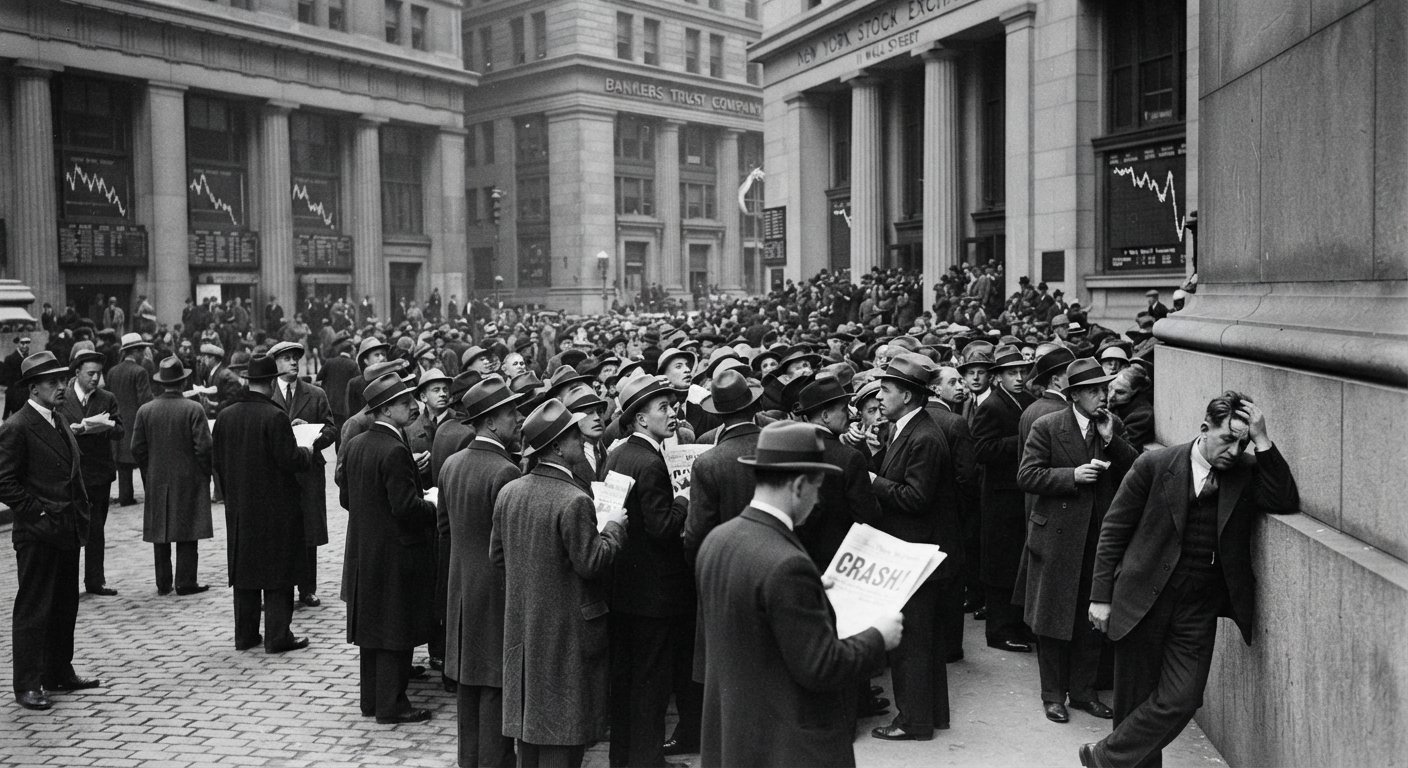

Introduction: When Did the Stock Market Crash?
When did the stock market crash? The answer depends on which market crash you’re asking about because stock markets have experienced several major declines throughout history. However, two of the most famous crashes occurred in 1929 and 1987, while the financial crisis of 2008 and the market collapse in March 2020 also had a major impact on investors around the world.
A stock market crash happens when share prices fall sharply over a short period. It can cause investors to lose money, reduce confidence in businesses, and create serious problems for the wider economy. Sometimes, a crash develops because stock prices have risen too far above the value of the companies behind them. In other cases, economic trouble, financial system failures, or unexpected world events trigger a sudden sell-off.
Understanding when the stock market crashed is important for students, investors, business owners, and anyone interested in the economy. History shows that markets can experience painful losses, but it also teaches us valuable lessons about patience, risk management, and long-term financial planning.
In this guide, we’ll explore the most important stock market crashes, explain what caused them, compare their effects, and discuss how investors can learn from these events.
What Is a Stock Market Crash?
A stock market crash is a sudden and significant fall in the prices of stocks across a market or a large part of it. Stocks represent ownership in companies, so a major decline can reduce the value of investment accounts and retirement savings.
There’s no single official percentage that defines every stock market crash. However, a rapid market decline of around 10% or more is often described as a correction or a sharp sell-off, while a drop of 20% or more from a recent peak is commonly called a bear market. A crash usually refers to a particularly sudden and severe decline.
For example, imagine that someone invests $10,000 in a collection of stocks. If those investments lose 20% of their value, the account would fall to $8,000, assuming no other changes. That’s a loss of $2,000 on paper.
A market decline can affect people in several ways:
- Individual investors: Their investment portfolios may lose value.
- Businesses: Companies may find it harder to raise money by selling shares.
- Workers: Businesses facing financial pressure may reduce hiring or cut jobs.
- Consumers: Falling wealth and uncertainty may lead people to spend less.
- The economy: Lower spending and investment can contribute to slower economic growth.
Still, a stock market crash doesn’t automatically mean the entire economy will collapse. The effects depend on the cause of the decline, the condition of banks and businesses, and the response of governments and central banks.
When Did the Stock Market Crash in 1929?
The 1929 stock market crash is one of the most famous financial events in American history. It took place in late October 1929 and marked a major turning point in the period leading into the Great Depression.
The crash is especially associated with three trading days: Black Thursday, Black Monday, and Black Tuesday.
Black Thursday: October 24, 1929
On October 24, 1929, investors began selling stocks rapidly as fear spread through the market. Trading volume became extremely high, and share prices fell sharply during the day.
Major financial leaders attempted to calm the market, but confidence remained weak. Although prices recovered from some of their losses before the closing bell, the panic had already shaken investors.
Black Monday: October 28, 1929
The market suffered another major decline on October 28. Selling pressure increased, and the Dow Jones Industrial Average fell by approximately 13% in one day.
Investors who had hoped for a quick recovery became more worried. Many began selling their shares to avoid further losses.
Black Tuesday: October 29, 1929
Black Tuesday, October 29, 1929, is often remembered as the most famous day of the crash. Investors rushed to sell their stocks, and prices dropped dramatically.
The Dow Jones Industrial Average lost approximately 12% that day. The panic damaged confidence in financial markets and became a lasting symbol of the dangers of speculation and excessive borrowing.
However, the crash didn’t cause the Great Depression by itself. Other problems, including banking failures, reduced spending, falling production, and policy mistakes, helped turn the financial disaster into a prolonged economic crisis.
What Caused the 1929 Stock Market Crash?
Several factors made the American stock market vulnerable in 1929.
Excessive speculation
During the 1920s, many people bought stocks because they expected prices to keep rising. Some investors paid much more for shares than the companies’ earnings could reasonably support.
Buying stocks with borrowed money
Investors could buy shares using borrowed funds, a practice known as buying on margin. This allowed people to control larger investments with relatively little money of their own. Unfortunately, falling prices could leave them unable to repay their loans.
Overconfidence in rising prices
As stock prices increased, some investors believed the market would continue moving upward. This confidence encouraged risky decisions and made the market more vulnerable to sudden changes.
Weaknesses in the financial system
Banks and other financial institutions faced serious problems during the wider economic downturn. Banking failures and a reduction in lending made it harder for families and businesses to obtain money.
Declining economic conditions
Parts of the economy were already experiencing difficulties. When financial panic spread, existing weaknesses made the situation worse.
The lesson is clear: when investors become too confident, borrow heavily, and ignore underlying risks, a market can become unstable.
When Did the Stock Market Crash in 1987?
Another major event occurred on October 19, 1987, a day known as Black Monday. On that date, the Dow Jones Industrial Average fell by approximately 22.6% in a single trading session.
This remains one of the largest one-day percentage declines in the history of the Dow.
Unlike the 1929 crash, the 1987 decline wasn’t followed by a decade-long depression. Financial markets eventually recovered, although the sudden drop caused considerable fear and uncertainty.
Why Did Black Monday Happen?
Several factors contributed to the 1987 crash:
- Investor anxiety: Concerns about economic conditions and stock valuations weakened confidence.
- Program trading: Computer-based trading strategies increased selling pressure as prices fell.
- Portfolio insurance: Some investment strategies automatically sold stocks or stock-index futures to limit losses. When many investors followed similar approaches, selling could intensify.
- Market connections: Financial markets had become increasingly linked, allowing pressure in one area to spread to others.
- Panic selling: As prices fell, some investors rushed to sell before losses became even larger.
Black Monday demonstrated how quickly market conditions can change. It also encouraged regulators and exchanges to improve market safeguards, including mechanisms designed to pause trading during periods of extreme volatility.
When Did the Stock Market Crash During the 2008 Financial Crisis?
The global financial crisis reached a critical point in 2008, although its roots developed over several years. It was one of the most serious financial crises since the Great Depression.
The crisis was closely linked to risky mortgage lending, rising housing prices, complicated financial products, and excessive borrowing across parts of the financial system.
How the Housing Market Created Trouble
Before the crisis, many American homebuyers took out mortgages that they later struggled to repay. Some lenders approved loans for borrowers who had limited ability to manage higher payments.
Financial institutions also packaged mortgages into investment products and sold them to investors. When home prices began falling and mortgage defaults increased, the value of these products became uncertain.
Banks and investors faced large losses. Lending slowed, financial institutions came under severe pressure, and confidence weakened across the global economy.
Major Events During the 2008 Crisis
| Event | Date | Why it mattered |
|---|---|---|
| Bear Stearns rescue | March 2008 | Raised concerns about financial stability |
| Lehman Brothers bankruptcy | September 15, 2008 | Deepened panic in global financial markets |
| Major market declines | September–October 2008 | Investors rushed to reduce risk |
| U.S. stock market low during the crisis | March 2009 | The Dow reached its closing low for the bear market |
The financial crisis caused widespread job losses, home foreclosures, and economic hardship. Governments and central banks introduced emergency measures to stabilize the financial system and support economic activity.
The experience showed that financial problems can spread quickly when banks, investors, and businesses depend heavily on borrowed money and complex financial arrangements.
When Did the Stock Market Crash in 2020?
The stock market experienced another historic decline in February and March 2020 as the COVID-19 pandemic spread around the world.
The outbreak led governments to introduce travel restrictions, close many businesses temporarily, and limit public gatherings. Investors worried about falling company earnings, disrupted supply chains, and the possibility of a global recession.
The March 2020 Market Crash
The S&P 500, a major index tracking large American companies, entered a bear market in March 2020 after falling more than 20% from its February peak.
The Dow Jones Industrial Average also experienced several historic daily declines. Trading was temporarily halted on multiple occasions when market losses reached preset thresholds.
Investors faced uncertainty on an enormous scale. Airlines, hotels, restaurants, entertainment companies, and many small businesses were especially affected by restrictions and reduced travel.
How Markets Responded
Governments introduced financial support programs, while central banks lowered interest rates and took steps to support lending and financial stability.
Stock prices began recovering in the spring of 2020, although the recovery varied across industries and companies. Technology firms and businesses that benefited from remote work performed differently from companies that depended on travel and in-person services.
The pandemic crash demonstrated that unexpected health emergencies can create financial shocks. It also showed that markets can recover before every part of the economy has returned to normal.
Other Important Stock Market Crashes in History
Although the crashes of 1929, 1987, 2008, and 2020 receive considerable attention, other market declines have also influenced investors.
The 1973–1974 Bear Market
During the 1970s, high inflation, economic weakness, and the oil crisis placed pressure on stock prices. The 1973–1974 bear market caused major losses in American and international markets.
The period showed how rising costs and weak economic growth can damage business profits and investor confidence.
The Dot-Com Crash of 2000–2002
In the late 1990s, investors became excited about internet companies and the future of digital technology. Many businesses received high stock valuations even when they had limited profits or unproven business models.
When expectations became unrealistic, technology stocks began falling.
The Nasdaq Composite, which had risen dramatically during the dot-com boom, lost roughly 78% of its value from its March 2000 peak to its October 2002 low.
However, the decline didn’t mean that the internet had no future. Instead, it showed that a powerful technology can transform society while some investments built around it remain overpriced or unsuccessful.
The 2022 Bear Market
In 2022, higher inflation and rising interest rates placed pressure on stock and bond markets. Central banks increased interest rates to control inflation, making borrowing more expensive and reducing the present value investors assigned to future company earnings.
The Nasdaq and S&P 500 experienced substantial declines. The period reminded investors that markets can fall even without a sudden banking collapse or a major public health emergency.
Each episode had different causes, but all demonstrate the importance of understanding economic conditions rather than assuming stock prices will always rise.
How Did Previous Stock Market Crashes Change the Financial World?
Understanding when did the stock market crash is only the beginning. To understand why these events matter today, we also need to look at how they changed financial rules, investor behavior, and the way governments respond to economic trouble.
Major crashes have often exposed weaknesses that were difficult to notice when stock prices were rising. Afterward, regulators, banks, and investors have worked to improve financial systems and reduce certain risks.
The 1929 crash helped lead to major changes in American financial regulation. These included stronger oversight of securities markets and the creation of the Securities and Exchange Commission in 1934. The goal was to improve transparency, discourage fraud, and give investors better information.
The 1987 crash highlighted the risks of automated trading strategies and the speed at which financial markets could fall. Market operators later developed safeguards, including circuit breakers, that can temporarily pause trading during severe declines.
The 2008 financial crisis led to further reforms aimed at improving bank supervision, managing financial risks, and increasing transparency in important areas of the financial system.
These changes haven’t eliminated crashes. However, they demonstrate that financial crises can encourage improvements and provide valuable lessons for future generations.
What Are Stock Market Circuit Breakers?
Stock market circuit breakers are temporary trading pauses designed to help markets manage extreme price movements. They give investors time to process information and can help reduce the pressure created by rapid selling.
In the United States, market-wide circuit breakers are linked to declines in the S&P 500 from its previous closing level.
The main thresholds are:
- Level One: A 7% decline triggers a trading halt.
- Level Two: A 13% decline triggers another trading halt.
- Level Three: A 20% decline stops trading for the remainder of the regular session.
The first two thresholds generally lead to a 15-minute pause when reached before the final 35 minutes of regular trading. Timing rules and other conditions apply.
These mechanisms are intended to give market participants a chance to absorb information and make more orderly decisions. They don’t guarantee that stock prices will recover once trading resumes.
Circuit breakers are an important example of how markets have changed in response to past crashes. Still, investors should remember that a trading pause is a safety mechanism, not insurance against losses.
Why Do Investors Panic During a Stock Market Crash?
Fear is a natural response when people see the value of their savings falling. During a stock market crash, that fear can spread quickly through financial news, social media, and conversations with friends or family.
Several psychological factors can influence investor decisions.
Fear of Losing Money
People often feel the pain of losing money more strongly than the pleasure of gaining the same amount. This tendency, commonly known as loss aversion, may lead investors to sell stocks quickly when prices fall.
Following the Crowd
When investors see others selling, they may believe that selling must be the safest choice. This behavior can create a chain reaction in which more people sell simply because everyone else appears to be doing so.
Expecting the Worst
After several days of falling prices, investors may begin to assume that losses will continue indefinitely. However, markets don’t move in a straight line, and a decline doesn’t always predict the next movement.
Trusting Headlines Too Much
Dramatic headlines can make financial events appear even more frightening. Although financial news can provide useful information, making major decisions based on one headline may lead to unnecessary risks.
A sensible approach is to separate facts from predictions, review reliable information, and consider how a decision fits your financial goals.
How Do Interest Rates Affect a Stock Market Crash?
Interest rates can play an important role in stock market performance. Central banks use monetary policy to influence borrowing costs, credit conditions, and economic activity.
When interest rates rise, companies may have to pay more to borrow money. Consumers may also face higher costs for mortgages, car loans, and other forms of credit. These changes can reduce spending and place pressure on business earnings.
Higher interest rates can also make bonds and savings products more attractive compared with stocks. As a result, some investors may decide to move part of their money into other investments.
On the other hand, lower interest rates can support borrowing and investment. They may also increase the value investors place on future company earnings.
However, lower rates don’t automatically cause stocks to rise, and higher rates don’t always cause a crash. Investors consider many factors, including inflation, economic growth, company profits, and future expectations.
The relationship between interest rates and stock prices is complex. That’s why it is important to understand the wider economic picture rather than focusing on one indicator.
How Can Beginners Invest More Safely During Market Uncertainty?
New investors may feel overwhelmed when financial markets become unstable. Fortunately, learning a few basic principles can help them make more informed decisions.
Start With a Clear Goal
Before investing, decide what the money is for. Saving for retirement over several decades is different from saving for a purchase you expect to make next year.
Your investment timeline helps determine how much risk may be appropriate.
Understand What You Own
Don’t buy a stock simply because it is popular online. Learn about the company’s business, financial condition, earnings, competition, and potential risks.
If you don’t understand an investment, take time to research it before committing your money.
Consider Broad Diversification
Some investors use diversified funds that hold shares in many companies rather than choosing individual stocks. Broad funds can reduce company-specific risk, although they can still fall significantly when the overall market declines.
Invest Within Your Means
Avoid investing money needed for rent, food, essential bills, or emergency expenses. Money needed soon generally shouldn’t be exposed to substantial stock market risk.
Be Careful With Online Predictions
Claims that a market will definitely crash on a particular date should be treated cautiously. Even experienced professionals can get market forecasts wrong.
Instead of relying on predictions, develop a plan that considers several possible outcomes.
What Is the Difference Between a Stock Market Crash and a Financial Crisis?
Although the terms are related, they don’t mean exactly the same thing.
A stock market crash is a sharp decline in share prices. A financial crisis is a broader breakdown in the financial system that may involve banks, lenders, credit markets, and other institutions.
For example, the 2008 crisis included a major stock market decline, but it also involved banking problems, mortgage defaults, credit disruptions, and failures of important financial institutions.
A stock market crash can happen without a full financial crisis. Likewise, serious financial stress can develop in particular institutions or markets before it becomes visible in stock prices.
Understanding the difference helps explain why some market declines have limited economic effects while others lead to deep recessions.
Could Technology Cause Another Stock Market Crash?
Technology has changed how investors buy and sell stocks. Online trading platforms, automated systems, artificial intelligence, and high-speed trading can process enormous amounts of information within seconds.
These tools can improve efficiency, but they may also create new challenges.
For example, automated trading systems can respond to similar signals at nearly the same time. Under certain conditions, this may increase selling pressure or cause prices to move rapidly.
Artificial intelligence may help financial firms study market information, but it cannot remove uncertainty from investing. Models can rely on incomplete information, make incorrect assumptions, or react poorly to conditions they weren’t designed to handle.
Cybersecurity problems and technology failures may also disrupt financial services.
However, technology isn’t automatically dangerous. Better monitoring systems, improved data analysis, and stronger security measures can help institutions identify and manage certain risks.
The important point is that financial innovation brings both opportunities and responsibilities.
What Should Retirees Know About a Stock Market Crash?
A market crash can be especially stressful for people who depend on investments to support retirement spending.
Someone who is still working may have many years to wait for a recovery. A retiree who needs to withdraw money regularly may have less flexibility.
One concern is known as sequence-of-returns risk. This occurs when poor investment returns happen early in retirement while withdrawals continue. Selling investments after a decline can leave fewer assets available to benefit from a later recovery.
Retirees can discuss several planning strategies with a qualified financial adviser:
- Keeping an appropriate amount of accessible cash for near-term expenses.
- Reviewing the balance between stocks, bonds, and other assets.
- Avoiding unnecessary withdrawals during periods of market stress when practical.
- Checking whether expected retirement income can cover essential costs.
- Reviewing the plan as spending needs and market conditions change.
No single retirement strategy works for everyone. Age, health, income sources, taxes, and personal circumstances all matter.
The aim isn’t to avoid every market decline. It’s to build a financial plan that can withstand a range of economic conditions.
Important Lessons From Stock Market History
The history of stock market crashes provides lessons that remain useful today.
Markets can become overvalued. When investors pay too much for expected future profits, disappointment can lead to significant losses.
Borrowing increases risk. Debt can make an investment strategy more vulnerable when prices fall.
Diversification matters. Holding different investments can reduce dependence on a single company or industry.
Recovery takes time. Some markets recover quickly, while others need years. There is no guaranteed timetable.
Economic conditions matter. Inflation, interest rates, company earnings, and employment can influence stock prices.
Emotions can lead to poor decisions. Fear and excitement may encourage investors to buy or sell without carefully considering the consequences.
Preparation is better than prediction. An emergency fund, a suitable investment plan, and realistic expectations can help people manage uncertainty.
These lessons don’t guarantee investment success, but they can help people avoid common mistakes and approach financial decisions more carefully.
Final Thoughts: When Did the Stock Market Crash?
When did the stock market crash? Some of the most important dates in history are October 29, 1929; October 19, 1987; the financial crisis of 2008; and the sharp decline in February and March 2020.
Each episode shows that stock prices can fall because of different combinations of speculation, financial weaknesses, economic pressure, and unexpected events.
For investors, the key lesson is not to fear every market decline. Instead, learn how markets work, understand the risks involved, and prepare for uncertainty with a realistic financial plan.
No one knows the exact date of the next stock market crash. However, history provides valuable information about the conditions that can make markets vulnerable and the steps that may help people respond more wisely.
By understanding when did the stock market crash, investors can learn from the past, make better-informed choices, and approach the future with greater confidence.
Discover more insightful articles, helpful updates, and engaging stories on Leo ART News, and stay connected with the latest information. For more details, Contact Us.