
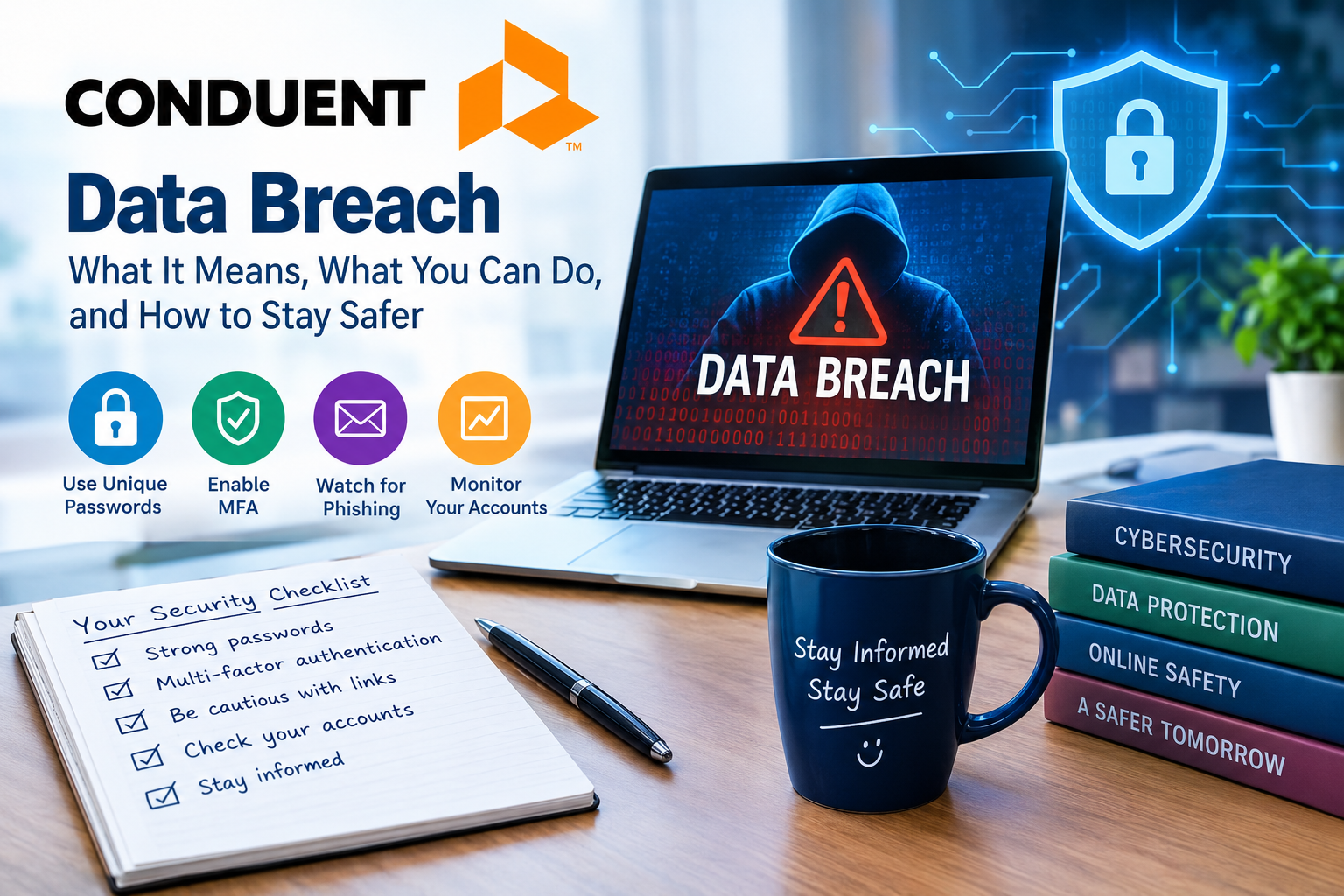

The conduent data breach has become an important cybersecurity topic because Conduent provides business and technology services to organizations that may handle large amounts of personal information. A cyber incident involving a company like this can raise understandable questions: What happened? When did it happen? What information was exposed? Who could be affected? And what should people do if they receive a notification?
According to Conduent’s public filings, the company experienced a January 2025 Cyber Event. Conduent says it activated its cybersecurity response plan, worked with outside cybersecurity experts, contained and investigated the incident, and restored affected systems. The company also reported that a threat actor exfiltrated a set of files associated with a subset of its clients. A later review found that those files contained personal information connected with a significant number of individuals who were end-users of those clients.
That distinction matters. A cybersecurity incident doesn’t automatically mean that every Conduent customer was affected. It also doesn’t mean that every type of personal information held by the company was taken. The actual impact can depend on which client systems or files were involved.
This article explains the conduent data breach in clear language, discusses the known timeline, possible risks, consumer safety steps, and what businesses can learn from the incident.
What Is the Conduent Data Breach?
The term conduent data breach generally refers to the cyber event disclosed by Conduent involving unauthorized access to its systems and the exfiltration of certain files.
In simple terms, exfiltration means that information was taken from a computer system by an unauthorized party. Think of it like someone getting into a locked filing room and removing copies of selected documents. The important point is that the available public information describes a specific set of files rather than saying that every file in the company’s environment was stolen.
Conduent’s 2026 annual filing explains that the company detected the incident and activated its cybersecurity response plan. External cybersecurity professionals were brought in to help contain, assess, and remediate the event. The company reported that affected systems were restored and normal operations resumed within days, and in some cases within hours.
However, determining exactly what information appeared in the affected files took much longer.
The company stated that the files were complex and required detailed analysis. Conduent engaged cybersecurity data-mining specialists to examine the information and identify the personal data contained in the affected files. After that process, Conduent notified clients whose end-users were affected.
When Did the Conduent Cyber Event Happen?
Understanding the timeline is useful because a cyberattack can occur long before people receive a notification.
Conduent’s public disclosures refer to the incident as the January 2025 Cyber Event. The company has continued to discuss the incident in later regulatory filings, including disclosures made during 2026.
A public filing from the Maine Attorney General also records a Conduent Business Services breach involving an external system breach or hacking. That record states that the breach period was listed as October 21, 2024, through January 13, 2025, with discovery on January 13, 2025. It reported 374 affected Maine residents and indicated that written notifications were sent on October 24, 2025.
Another Maine filing for Conduent State & Local Solutions records the same incident period and discovery date and identifies 25 Maine residents. Written notifications in that record were dated November 19, 2025.
These state records demonstrate an important feature of large data incidents: notifications can occur months after an organization first discovers suspicious activity. Investigators may need significant time to determine whose information was involved.
How Did Conduent Respond?
When a major cyber incident is discovered, the first priority is usually containment. In other words, the organization tries to stop unauthorized activity and prevent the incident from spreading.
Conduent says it took several steps after discovering the January 2025 event. Its public filing states that the company:
- Activated its cybersecurity response plan.
- Worked with external cybersecurity experts.
- Took steps to contain the incident.
- Investigated the affected environment.
- Remediated impacted systems.
- Restored affected systems.
- Returned to normal operations.
- Conducted additional analysis of potentially affected files.
- Notified impacted clients after identifying affected personal information.
The company reported that the operational disruption was not material to its overall operations.
Still, restoring systems is only one part of a data-security investigation. Finding out exactly whose information was involved can be much harder.
That’s where the detailed file analysis became important.
What Information Could Be Involved?
One of the most common questions about the conduent data breach is what personal information may have been exposed.
The answer can vary depending on the particular Conduent client and the files involved. Conduent’s public filing says the affected data sets contained personal information associated with end-users of some clients.
Therefore, readers shouldn’t assume that everyone affected had exactly the same information exposed.
Depending on the services provided to a particular client, potentially sensitive records can include categories such as:
- Names
- Contact information
- Identification information
- Account-related information
- Government-issued identification details
- Financial-related information
- Employment information
- Healthcare-related information
- Other personal information maintained for a client
The exact categories should be confirmed from an individual’s official notification rather than guessed from general reports.
This is an important cybersecurity lesson: the presence of a breach doesn’t automatically tell you which data was exposed. The notification sent to the affected person or organization is generally the most useful source for determining the specific information involved.
Why Can a Data Breach Investigation Take So Long?
At first glance, it may seem strange that a company can discover an incident in January and continue analyzing affected information months later.
In reality, large organizations can have extremely complicated information environments.
A single file may contain information from multiple people, clients, systems, or business processes. Some records may also be stored in formats that require specialized tools to review.
Conduent specifically said that the complexity of the files required a detailed analysis by cybersecurity data-mining experts. The purpose was to identify the personal information contained within the affected data sets.
Imagine opening a giant box containing thousands of mixed documents. The first job is knowing that the box is there. The next job is determining which documents are important, whose documents they are, and what sensitive information each one contains.
That’s why there can be a difference between:
Incident discovered → systems secured → data investigated → affected people identified → notifications sent.
Each stage serves a different purpose.
Who Could Be Affected by the Conduent Data Breach?
The conduent data breach doesn’t necessarily affect every person who has ever interacted with Conduent.
Conduent provides services to clients, meaning that personal information may be processed on behalf of other organizations. The company stated that the affected files were associated with a subset of its clients and that the personal information belonged to those clients’ end-users.
As a result, someone may receive a notification from Conduent even if they don’t remember having a direct relationship with the company.
For example, a person might have interacted with a government agency, healthcare organization, insurance company, employer, transportation service, or another organization that used a third-party service provider.
That’s one reason third-party cybersecurity is such a big deal.
When an organization gives a service provider access to personal data, the security of that information depends on more than one company. A weakness in a service provider’s environment can potentially affect people who have never heard of that provider.
What Does a Breach Notification Mean?
Receiving a breach notification can be unsettling. However, it doesn’t necessarily mean that someone has already stolen money from you or committed identity theft in your name.
A breach notification generally means that an organization has determined that certain personal information may have been affected by a security incident.
The notification may explain:
- When the incident happened.
- When it was discovered.
- What information was involved.
- Why the organization believes the information may have been affected.
- What steps the organization has taken.
- What protective services may be available.
- What actions the recipient should consider taking.
Read the notice carefully before clicking links or providing additional information.
If you’re unsure whether a notification is genuine, contact the organization through a trusted website or phone number rather than using contact details contained in a suspicious message.
How to Protect Yourself After a Data Breach
If you’ve received a legitimate notice connected to the conduent data breach, don’t panic. A few sensible steps can reduce potential risk.
Review the Notification Carefully
Start by determining exactly what information the notice says may have been involved.
Don’t rely on social-media posts or random websites for this detail. Your individual notification may contain information that isn’t included in general news reports.
Change Reused Passwords
If an exposed account involved a password, change it immediately.
Even if the affected service doesn’t appear to be important, password reuse can create a chain reaction. Someone who obtains one password may try it on email, shopping, banking, social-media, or other accounts.
Use unique passwords for important accounts.
Turn On Multi-Factor Authentication
Multi-factor authentication, often called MFA, adds another layer of protection.
Instead of relying only on a password, MFA may require a verification code, security key, authentication app, or another approved method.
It’s not perfect, but it can make unauthorized account access much harder.
Monitor Financial Accounts
Keep an eye on bank and payment accounts for unfamiliar activity.
Look for transactions you don’t recognize, new account notifications, or other unusual changes.
If something seems wrong, contact the financial institution through its official customer-service channel.
Watch for Phishing
After a breach, scammers may use public information to create convincing messages.
You could receive an email or text claiming to offer:
- Credit monitoring
- Account recovery
- Refunds
- Identity protection
- Security verification
- Password resets
Be careful.
When in doubt, go directly to the organization’s official website instead of clicking a message link.
Credit Monitoring and Identity Protection
Some data-breach notifications offer credit monitoring or identity-restoration services. Whether such services are available depends on the specific notification.
A Maine Attorney General record concerning Conduent Business Services, for example, states that identity-theft protection services were not offered for the 374 Maine residents listed in that filing.
That doesn’t necessarily mean every affected person in every jurisdiction received the same type of assistance. Different notifications can relate to different clients, populations, or legal requirements.
If your notice offers monitoring, read the instructions carefully and check:
- The name of the service provider.
- The enrollment deadline.
- How long the service lasts.
- What services are included.
- Whether you need to activate the service yourself.
Don’t assume that a service is active automatically.
Why Third-Party Data Security Matters
The conduent data breach also highlights a broader issue: organizations need to manage cybersecurity risks across their entire supply chain.
Many companies don’t keep every piece of data inside their own systems. They work with outside providers for payroll, customer support, healthcare administration, transportation, technology, payment processing, document management, and other services.
This can improve efficiency, but it creates additional security relationships.
A company should therefore ask:
- Which vendors can access sensitive data?
- What information does each vendor receive?
- Is access limited to what is necessary?
- How quickly can access be removed?
- Does the vendor use strong authentication?
- How are security incidents reported?
- Are vendors regularly assessed?
- Is sensitive information encrypted?
- How long is information retained?
In other words, cybersecurity isn’t only about protecting the front door. Organizations also need to understand who has keys to the side doors.
Legal and Regulatory Developments
The incident has also resulted in legal activity.
Conduent’s May 2026 filing stated that the company and Conduent Business Services were parties to several U.S. lawsuits brought by individuals who allegedly received notification letters saying their personal information may have been affected by the January 2025 Cyber Event. The filing said most of those lawsuits had been consolidated into a single action in the U.S. District Court for the District of New Jersey, titled In re: Conduent Business Services Data Breach Litigation.
Conduent said it denies the plaintiffs’ allegations, believes it has strong defenses, and intends to defend the litigation.
It’s important to distinguish allegations from established findings. A lawsuit represents claims made by plaintiffs; it isn’t, by itself, proof that every allegation has been legally established.
The company also reported responding to subpoenas, information requests, and investigations from certain government agencies.
What Conduent Says About Data Protection
Conduent publishes data-protection notices explaining how it handles personal information.
Its global data-protection materials include notices covering candidates, employees, third parties, and other categories of people. The company’s third-party notice says it provides information to business partners, clients, and third-party suppliers about how their personal data is collected, stored, and used.
These documents can help readers understand the broader privacy framework around information handled by the company.
However, privacy notices and breach notifications serve different purposes.
A privacy notice explains ordinary data handling practices. A breach notification concerns a particular security event and potentially affected information.
What Businesses Can Learn From the Incident
The conduent data breach provides useful lessons for organizations of every size.
Know Where Sensitive Data Lives
A company can’t protect information effectively if it doesn’t know where that information is stored.
Organizations should maintain an accurate inventory of sensitive data and understand which systems and vendors can access it.
Limit Access
Employees and vendors shouldn’t automatically receive broad access to everything.
Access should generally be based on business need.
Use Strong Authentication
MFA should be considered for important administrative systems, remote access, cloud platforms, and other sensitive environments.
Monitor Unusual Activity
Security teams need visibility into unusual login behavior, suspicious file access, large transfers, and other warning signs.
Prepare an Incident Response Plan
A written plan can help organizations react faster when something goes wrong.
The plan should identify responsibilities, communication procedures, technical response steps, legal considerations, and customer-notification processes.
Test the Plan
A plan sitting in a folder isn’t enough.
Organizations can conduct exercises that simulate ransomware, unauthorized access, data theft, or other incidents. These exercises can reveal weaknesses before a real emergency occurs.
Key Facts About the Conduent Data Breach
| Topic | Available information |
|---|---|
| Incident name | January 2025 Cyber Event |
| Organization | Conduent |
| Type of event | Cybersecurity incident involving unauthorized activity |
| Discovery | January 13, 2025, according to Maine records |
| Reported breach period in Maine records | October 21, 2024 to January 13, 2025 |
| Data involved | Files associated with a subset of clients |
| Personal information | Conduent said affected data sets contained personal information connected with client end-users |
| Response | Cybersecurity response plan, outside experts, containment, investigation and remediation |
| System recovery | Conduent reported restoring affected systems and returning to normal operations |
| Legal developments | Data-breach litigation and government inquiries have been disclosed |
| Consumer action | Review the individual notification and monitor relevant accounts |
The exact details can differ between affected groups, so readers should use their own official notification as the primary source for personal-impact information.
Common Misunderstandings About the Incident
Several misconceptions can make breach situations more confusing.
A breach doesn’t always mean every customer was affected. Conduent has described the affected information as belonging to a subset of clients.
A notification doesn’t automatically mean identity theft occurred. A notification can mean that personal information was potentially affected.
A company discovering an incident isn’t necessarily the same as completing the investigation. Identifying affected people and data can take much longer.
A third-party service provider can matter even when you never directly used it. Organizations often rely on vendors to process information on their behalf.
Online rumors aren’t a substitute for official notices. The details in your personal notification should carry more weight than generalized claims posted online.
How Individuals Can Build Better Digital Security Habits
A data breach is a useful reminder to improve everyday online security.
Consider making these habits part of your normal routine:
- Use unique passwords for important accounts.
- Store passwords in a reputable password manager.
- Enable multi-factor authentication.
- Keep phones and computers updated.
- Don’t open unexpected attachments.
- Check website addresses before entering sensitive information.
- Review bank and credit-account activity.
- Be cautious with urgent messages.
- Don’t share verification codes with callers or strangers.
- Keep recovery information current.
- Back up important files.
- Learn how to recognize phishing attempts.
None of these steps can guarantee complete protection. Still, they can reduce exposure and make it harder for criminals to turn stolen information into successful account takeovers or fraud.
The Importance of Staying Calm and Informed
News about a conduent data breach can sound alarming, especially when personal information is involved. But panic rarely helps.
The most useful response is practical:
First, determine whether you were actually notified. Then read the notice carefully. Identify what information may have been involved. Follow the recommended protective steps. Change reused passwords. Enable MFA. Watch accounts for suspicious activity and remain alert for phishing.
If you don’t receive an official notification, don’t assume that every online claim applies to you.
At the same time, don’t ignore a legitimate notice. Even when there is no evidence of immediate fraud, keeping an eye on important accounts is a sensible precaution.
Looking Ahead After the Conduent Data Breach
Cybersecurity incidents can have effects long after computer systems are restored.
Organizations may face investigations, customer questions, legal proceedings, regulatory requests, and the difficult task of improving security controls. Conduent’s later filings show that the January 2025 event continued to have legal and regulatory implications into 2026.
For individuals, the lesson is equally straightforward: personal data should be treated as something valuable.
A name or email address may seem harmless on its own. But when combined with other information, personal details can sometimes be used for phishing, impersonation, account takeover, or identity fraud.
That’s why good digital hygiene matters even when nothing suspicious has happened yet.
The good news is that consumers aren’t powerless. Strong passwords, MFA, careful communication habits, account monitoring, and awareness can make a meaningful difference.
Final Thoughts on the Conduent Data Breach
The conduent data breach is a significant cybersecurity event involving a January 2025 cyber incident that Conduent says resulted in the exfiltration of certain files associated with a subset of its clients. The company reported activating its cybersecurity response process, working with outside experts, restoring systems, and conducting a detailed analysis to identify personal information contained in the affected files.
Public records also show that affected individuals were notified in some jurisdictions, while later company filings document continuing litigation and government inquiries connected with the incident.
For readers, the most important takeaway is simple: don’t panic, but don’t ignore a legitimate notification either. Read your notice carefully, determine what information may have been involved, protect your accounts, and stay alert for suspicious activity.
Cyber threats continue to evolve, but so do security practices. By staying informed and taking sensible precautions, individuals and organizations can respond to incidents more effectively and build stronger defenses for the future. The conduent data breach ultimately serves as another reminder that protecting personal information requires constant attention, responsible data management, and practical cybersecurity habits.
Conduent Data Breach: Understanding the Wider Cybersecurity Impact
The conduent data breach is more than a story about unauthorized access to computer systems. It also shows how modern organizations depend on complex digital networks to process information for customers, government agencies, businesses, and other institutions.
When personal information moves through several organizations, protecting it becomes a shared responsibility. A company may have strong security controls, yet a weakness involving a connected service provider can still create risks.
That’s why the incident offers useful lessons for ordinary internet users, businesses, technology teams, and organizations that manage sensitive records.
Why the Conduent Data Breach Matters
The conduent data breach matters because Conduent operates in areas where organizations may depend on technology and business-processing services.
A company working with large amounts of information can potentially have access to records belonging to many different groups. This makes cybersecurity especially important.
A breach involving a service provider can create a ripple effect:
- One organization experiences a security incident.
- A connected client may have information involved.
- Individuals may receive notification letters.
- Businesses may need to investigate their own systems.
- Regulators may request information.
- Legal proceedings may follow.
- Security teams may introduce additional controls.
In other words, the effects of a cyber incident aren’t always limited to the company where the unauthorized activity occurred.
Understanding Data Exfiltration
One important term connected with the incident is data exfiltration.
Data exfiltration means unauthorized removal or transfer of information from a computer environment.
It can happen in different ways. For example, an attacker might obtain access to an account and then copy files. In another situation, malicious software could help transfer information outside an organization’s network.
The important question isn’t simply whether information existed inside a system. Security investigators also need to determine whether unauthorized individuals actually accessed or removed it.
That’s often a complicated process.
Large organizations can maintain enormous quantities of files. Some information may belong to customers, clients, employees, contractors, or other groups. As a result, investigators may need specialized tools to determine what was affected.
The Difference Between a Cyber Incident and Identity Theft
People sometimes use the terms “data breach” and “identity theft” as if they mean the same thing. They don’t.
A cyber incident can involve unauthorized access to information.
Identity theft involves someone using another person’s identifying information without authorization, typically for fraudulent purposes.
So, if personal information is involved in a breach, it doesn’t automatically mean that the affected person has become a victim of identity theft.
However, exposed information can create risks. That’s why people should take reasonable precautions after receiving a legitimate breach notification.
Why Personal Information Has Value
Personal information can be valuable because criminals may combine different pieces of information.
For example, a person’s name alone might not provide much opportunity for fraud. But a collection of information could potentially make a phishing attempt more convincing.
Information can sometimes be used to:
- Create believable scam messages.
- Attempt account recovery.
- Impersonate another person.
- Target individuals with fraudulent phone calls.
- Attempt unauthorized financial activity.
- Build profiles for future scams.
Fortunately, awareness can reduce some of these risks.
If someone suddenly contacts you and already knows your name or other basic information, don’t automatically assume the caller is legitimate.
Be Careful With Follow-Up Messages
After a widely reported breach, scammers may attempt to take advantage of public concern.
For example, someone could send a message claiming:
“Your information was exposed. Click here to secure your account.”
It may look official, but the link could lead to a fraudulent website.
A safer approach is to avoid clicking unexpected links.
Instead:
- Open your browser manually.
- Visit the organization’s official website.
- Locate the relevant security or customer-support section.
- Contact the organization through an independently verified channel.
- Follow only instructions that you can confirm are genuine.
This simple habit can prevent one security problem from becoming another.
Password Security After a Breach
Passwords remain one of the most important parts of digital security.
If you use the same password on several websites, one compromised account could potentially expose other accounts.
For example, imagine using the same password for:
- Social media
- Online shopping
- Cloud storage
- A financial service
If that password becomes known to an attacker, they may try it elsewhere.
That’s why unique passwords are so important.
A password manager can make this easier by generating and storing different passwords for different services.
Multi-Factor Authentication Adds Another Layer
Multi-factor authentication, or MFA, can provide an additional security barrier.
With MFA enabled, logging in may require:
- A password.
- A code from an authentication app.
- A security key.
- A biometric confirmation.
- Another approved verification method.
Even if someone obtains a password, they may still be unable to access the account without the additional authentication factor.
MFA isn’t a magic shield, of course. But it’s an important layer in a broader security strategy.
How Phishing Can Follow a Data Breach
Phishing is one of the biggest concerns following many cybersecurity incidents.
A phishing attack attempts to trick a person into revealing information, clicking a malicious link, downloading harmful software, or sending money.
After a breach, people may already be worried about their accounts. Attackers can try to exploit that fear.
A message might say:
- “Your account has been compromised.”
- “Confirm your identity.”
- “Your payment has failed.”
- “Your credit-monitoring service is ready.”
- “Complete your security verification.”
The wording may sound urgent.
That’s the trick.
Before taking action, stop and verify the message.
Signs of a Suspicious Message
Watch for warning signs such as:
- Unexpected urgency.
- Threats that an account will immediately close.
- Strange website addresses.
- Spelling or grammar problems.
- Requests for passwords.
- Requests for authentication codes.
- Requests for payment.
- Unknown attachments.
- Unusual sender addresses.
- Instructions to bypass normal security procedures.
Even professionally written messages can be fraudulent, so don’t rely only on grammar as your test.
Protecting Your Email Account
Your email account deserves special attention because it can often be used to reset passwords for other services.
If an attacker gains access to your email, they may attempt to reset other accounts.
Consider protecting your email with:
- A unique password.
- Multi-factor authentication.
- Updated recovery information.
- Security notifications.
- Regular review of login activity.
Also check whether unfamiliar forwarding rules or recovery addresses have been added to the account.
Financial Monitoring Can Be Helpful
If your personal or financial information may have been involved, monitor your financial accounts carefully.
Look for:
- Unknown transactions.
- New payment methods.
- Unrecognized account changes.
- Unexpected verification messages.
- Strange login alerts.
Don’t wait for a problem to become serious before reporting it.
If you see something you don’t recognize, contact your financial institution using the phone number or website you already trust.
What Organizations Should Do Differently
The conduent data breach also provides lessons for companies.
Organizations should think about cybersecurity as an ongoing process rather than a one-time project.
Security teams should regularly review:
Access Controls
Only authorized users should have access to sensitive information.
Vendor Security
Companies should understand the security practices of third-party providers that handle their information.
Data Minimization
Organizations should avoid collecting or retaining information that isn’t necessary.
Encryption
Sensitive information should receive appropriate protection both during transmission and while stored.
Security Monitoring
Organizations need systems capable of identifying suspicious activity.
Incident Response
A tested response plan can help teams react more efficiently.
Data Minimization Can Reduce Risk
One useful principle is simple: don’t keep unnecessary information.
If a company doesn’t need a particular piece of personal information, retaining it indefinitely can create unnecessary risk.
Data minimization can involve:
- Collecting only necessary information.
- Removing outdated records.
- Establishing retention periods.
- Limiting employee access.
- Reviewing old databases.
- Securely deleting information when appropriate.
Less unnecessary data can mean less information available to an attacker if a security incident occurs.
The Role of Cybersecurity Employees
Cybersecurity isn’t only about software.
People play a major role.
Security professionals may monitor systems, investigate suspicious activity, respond to alerts, analyze logs, review vulnerabilities, and coordinate incident response.
Employees across an organization also matter.
A single careless click can sometimes create an opportunity for attackers. That’s why security awareness training remains important.
Training should be practical rather than frightening.
Employees should know:
- How to recognize suspicious emails.
- How to report security concerns.
- Why MFA matters.
- How to handle sensitive information.
- What to do if they accidentally click something suspicious.
Why Regular Security Testing Matters
Organizations can’t simply assume their systems are secure.
Security testing can help identify weaknesses before criminals exploit them.
Testing may include:
- Vulnerability assessments.
- Penetration testing.
- Phishing simulations.
- Access reviews.
- Security audits.
- Incident-response exercises.
The goal isn’t to achieve perfect security. No system can promise that.
Instead, the goal is to continuously reduce risk and improve the ability to detect and respond to threats.
How Consumers Can Create a Personal Security Checklist
A simple checklist can make digital security easier.
Every Month
Review important account activity.
Every Few Months
Check important passwords and account-recovery settings.
Regularly
Install software and operating-system updates.
Whenever Available
Enable MFA on important accounts.
After a Breach Notification
Read the notice carefully and follow verified instructions.
When Something Looks Strange
Stop before clicking, downloading, paying, or sharing information.
These habits don’t require advanced technical knowledge.
That’s the good news.
Don’t Believe Every Online Claim
When a major cybersecurity story appears online, social media can quickly fill with claims about what happened.
Some information may be accurate. Some may be incomplete. Some may be speculation.
Readers should therefore look for primary or authoritative sources whenever possible.
Useful sources can include:
- Company regulatory filings.
- Official breach notifications.
- Government regulatory records.
- Court documents.
- Official cybersecurity advisories.
A random social-media post shouldn’t automatically be treated as evidence.
Why Official Notifications Are Important
An individual notification can provide details that broad articles don’t.
For example, the notice may identify:
- The specific organization involved.
- The type of information concerned.
- The relevant date.
- Available assistance.
- Contact information.
- Recommended actions.
If you’ve received a notification related to the conduent data breach, keep a copy for your records.
You may need the information later if you contact a service provider, financial institution, or government agency.
Keeping Records After a Breach
Create a simple record containing:
- Date you received the notice.
- Organization that sent it.
- Incident reference information.
- Type of information mentioned.
- Services offered.
- Enrollment deadline, if applicable.
- Steps you’ve completed.
- Any suspicious activity you’ve reported.
This can make the situation easier to manage.
It also prevents the classic “Where did I put that email?” problem later.
What Parents and Families Should Know
Families should also discuss basic digital safety.
Children and teenagers may receive phishing messages through email, gaming platforms, social media, or messaging applications.
Teach family members not to share:
- Passwords.
- Authentication codes.
- Banking information.
- Government identification details.
- Private account-recovery information.
They should also know that legitimate organizations generally won’t ask people to disclose passwords or one-time security codes through unexpected messages.
Cybersecurity Is a Shared Responsibility
One of the biggest lessons from the conduent data breach is that cybersecurity can’t be handled by one department alone.
Technology teams have responsibilities.
Company leadership has responsibilities.
Vendors have responsibilities.
Employees have responsibilities.
Consumers also have responsibilities.
When everyone takes reasonable precautions, the overall security environment becomes stronger.
What the Future of Data Protection May Look Like
Cybersecurity is constantly changing.
Organizations are increasingly using:
- Artificial intelligence for security monitoring.
- Automated threat detection.
- Zero-trust security models.
- Stronger authentication.
- Encryption.
- Continuous monitoring.
- Behavioral analysis.
- Automated vulnerability management.
At the same time, attackers are also developing new techniques.
This creates an ongoing cycle of improvement.
Organizations need to keep learning, testing, and updating their defenses rather than assuming yesterday’s security controls will always be enough.
Important Questions Readers May Have
Was every Conduent customer affected?
No conclusion like that should be made from the general incident alone. Conduent has described the affected information as being associated with a subset of clients.
Does a breach mean identity theft happened?
No. Exposure of personal information and confirmed identity theft are different things.
Should I change my password?
If a password may have been involved, changing it is sensible. Reused passwords should especially be replaced with unique ones.
Should I enable MFA?
Yes, where available, MFA provides an additional layer of protection.
What if I receive a suspicious notification?
Don’t click unexpected links. Verify the message independently through an official website or trusted contact method.
How can I know whether I’m affected?
Check for an official notification from the relevant organization or client. Your individual notice should explain what information was involved.
A Practical Response Plan
If you believe you may be affected, use this straightforward approach:
First: Find the original notification.
Next: Identify what information it says was involved.
Then: Change relevant passwords, especially reused passwords.
After that: Enable MFA.
Continue: Monitor financial and important online accounts.
Finally: Watch for suspicious emails, calls, and texts.
There’s no need to panic. Taking calm, organized steps is usually more useful than reacting to every message that appears online.
Lessons for the Cybersecurity Industry
The conduent data breach also demonstrates why cybersecurity professionals need to think beyond simple perimeter protection.
Modern businesses operate interconnected environments.
Cloud services, contractors, software providers, remote employees, APIs, databases, and external partners can all become part of the security picture.
Therefore, security programs should consider the entire ecosystem.
A strong approach includes:
- Risk assessment.
- Vendor management.
- Data classification.
- Identity management.
- Network monitoring.
- Incident response.
- Employee training.
- Regular testing.
- Continuous improvement.
No single tool can provide complete protection.
Final Perspective on the Conduent Data Breach
The conduent data breach demonstrates how complicated modern data-security incidents can become. Detecting unauthorized activity is only the beginning. Organizations may then need to contain systems, investigate files, identify affected information, notify clients and individuals, cooperate with regulators, and address legal issues.
For consumers, the most valuable lesson is straightforward: stay informed and take practical security measures.
Use unique passwords. Enable MFA. Monitor important accounts. Treat unexpected messages carefully. Keep records of legitimate notifications. Most importantly, verify information before taking action.
Cybersecurity can sometimes seem overwhelming, but basic habits still matter. Small improvements, repeated consistently, can create a much stronger digital safety routine.
As organizations continue improving their defenses and consumers become more aware of online risks, the lessons from the conduent data breach can help encourage better data protection, stronger vendor security, and more responsible handling of personal information.
Discover more insightful articles, helpful updates, and engaging stories on Leo ART New, and stay connected with the latest information. For more details, Contact Us.