
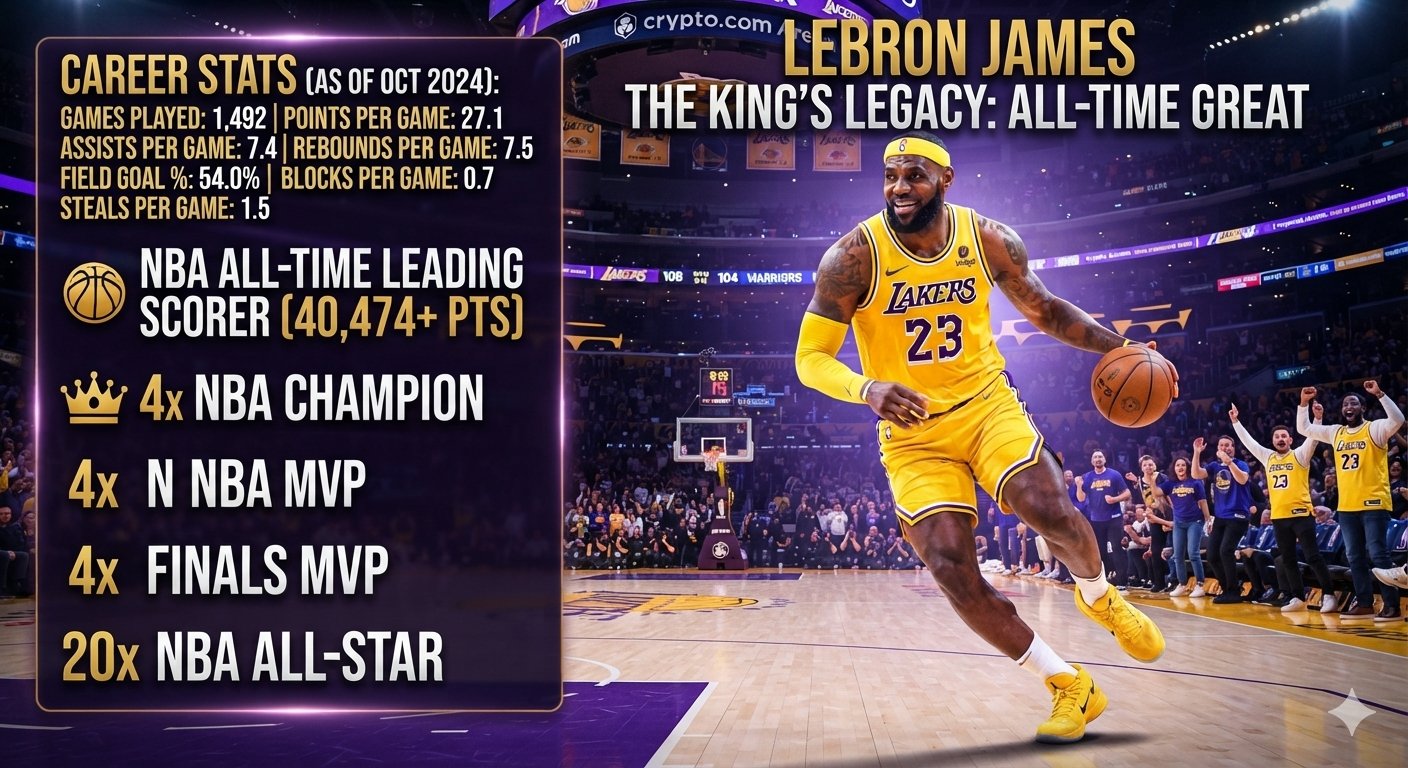

Introduction to lebron james stats
lebron james stats tell the story of one of the longest and most productive careers in modern NBA history. From his first season with the Cleveland Cavaliers in 2003 to his 23rd NBA season in 2025–26, LeBron James has collected remarkable numbers in scoring, rebounding, assists, steals, games played, minutes, and playoff performance. His statistics also show how his role has changed over more than two decades while he has continued to contribute in several areas of the game.
According to NBA records through the end of the 2025–26 regular season, James finished that campaign with 43,440 regular-season points, 12,095 rebounds, and 12,016 assists across 1,622 games. He is the NBA’s all-time regular-season scoring leader and became the league’s all-time leader in regular-season games played during the 2025–26 season.
His latest season was also significant because he continued playing at age 41. In 2025–26, James averaged 20.9 points, 6.1 rebounds, and 7.2 assists in 60 games for the Los Angeles Lakers, shooting 51.5% from the field.
These numbers are more than a collection of statistics. They provide a useful way to understand his career, his consistency, and the different ways he has helped his teams. From scoring records to passing milestones, LeBron’s statistical profile is unusually broad.
LeBron James career stats at a glance
The easiest way to understand lebron james stats is to begin with his career totals.
| Statistical category | Career regular-season total |
|---|---|
| Games played | 1,622 |
| Points | 43,440 |
| Rebounds | 12,095 |
| Assists | 12,016 |
| Steals | 2,417 |
| Blocks | 1,185 |
| Field goals made | 15,961 |
| Three-pointers made | 2,636 |
| Free throws made | 8,882 |
| Career scoring average | 26.8 PPG |
| Career rebounding average | 7.5 RPG |
| Career assists average | 7.4 APG |
| Career field-goal percentage | 50.7% |
These figures cover the regular season through the end of 2025–26.
One thing immediately stands out: James has reached at least 10,000 points, 10,000 rebounds, and 10,000 assists during his career. NBA.com identifies him as the only player in NBA history to reach all three of those 10,000 marks.
That’s an extraordinary combination because scoring, rebounding, and playmaking require different skills.
LeBron James 2025–26 season statistics
The 2025–26 season provided another important chapter in LeBron’s statistical history.
Playing for the Lakers, James appeared in 60 regular-season games and averaged:
- 20.9 points per game
- 6.1 rebounds per game
- 7.2 assists per game
- 1.2 steals per game
- 0.6 blocks per game
- 33.2 minutes per game
- 51.5% field-goal shooting
- 31.7% three-point shooting
- 73.7% free-throw shooting
- 59.4% true shooting percentage
He also recorded 1,256 points, 364 rebounds, and 432 assists during the regular season.
Those numbers show a player whose role was no longer based only on scoring. At this stage of his career, his passing remained a major part of his value.
In fact, his 7.2 assists per game were higher than his 6.1 rebounds per game in 2025–26, showing how much his offensive responsibilities included creating opportunities for teammates.
How LeBron’s scoring numbers developed
Scoring has always been one of the most visible parts of LeBron James’ game.
He entered the NBA as the first overall pick in the 2003 NBA Draft and quickly became a major offensive contributor. Over the years, his scoring style changed.
Early in his career, James relied heavily on athletic drives, transition attacks, and physical finishes around the basket. As he became more experienced, he developed a broader offensive game that included post play, mid-range shots, three-pointers, and improved passing.
By the end of the 2025–26 season, he had accumulated 43,440 regular-season points, the highest total in NBA history.
His career scoring average was 26.8 points per game after 1,622 regular-season appearances.
That average is particularly notable because his career covers 23 seasons. A player can score heavily for a short period, but maintaining a high scoring average across more than two decades is a different challenge.
LeBron James and the 40,000-point milestone
One of the biggest milestones in recent NBA history occurred when James became the first player to reach 40,000 regular-season points.
He later extended that record.
By the end of 2025–26, he had reached 43,440 points, giving him a substantial lead over the 40,000-point mark. NBA.com notes that he is the only player to have scored more than 40,000 regular-season points.
This achievement is especially significant because scoring totals depend on both productivity and longevity.
A player needs to score at a high level, stay healthy enough to appear in many games, and remain productive as the years pass.
LeBron has managed all three for a remarkably long period.
LeBron James stats and his passing ability
Although LeBron is best known for scoring, his passing statistics are equally important.
He finished the 2025–26 regular season with 12,016 assists. NBA.com lists him fourth all-time in career assists at that point, behind John Stockton, Jason Kidd, and Chris Paul.
His career average of 7.4 assists per game is unusual for a player of his size and scoring responsibility.
LeBron has frequently operated as a primary ball-handler. He can bring the ball up the court, read defensive coverage, and create shots for teammates.
This ability helps explain why his statistical profile looks different from that of many traditional forwards.
He’s not simply a scorer who occasionally passes.
Instead, playmaking has been a central part of his game for much of his career.
Rebounding numbers throughout his career
Rebounding is another important part of lebron james stats.
Through 2025–26, James had collected 12,095 regular-season rebounds, including offensive and defensive rebounds. His career average was 7.5 rebounds per game.
His rebounding numbers have remained useful even as his athletic style has changed.
Earlier in his career, James often used speed and strength to attack the boards and immediately start fast breaks. Later, he became more selective about where he positioned himself and how he used his energy.
His total of more than 12,000 rebounds also contributed to his unique 10,000-point, 10,000-rebound, and 10,000-assist statistical milestone.
LeBron’s defensive statistics
LeBron’s offensive numbers receive most of the attention, but his defensive statistics are also worth examining.
By the end of the 2025–26 regular season, he had recorded:
- 2,417 steals
- 1,185 blocks
- 12,095 rebounds
His career averages were approximately 1.5 steals and 0.7 blocks per game.
During different periods of his career, James defended guards, wings, forwards, and centers.
His combination of size, speed, and basketball awareness allowed him to switch between different defensive assignments.
Of course, statistics don’t capture every defensive action. A player can influence a possession without recording a steal or block.
That’s why traditional numbers should be viewed alongside game film and other defensive measurements.
LeBron James playoff stats
Regular-season statistics tell only part of LeBron’s story.
His playoff numbers are also enormous because he has appeared in the postseason more than almost any player in NBA history.
By the end of the 2025–26 playoffs, James had played 302 postseason games and accumulated approximately:
| Playoff category | Career total through 2025–26 |
|---|---|
| Games | 302 |
| Points | 8,521 |
| Rebounds | 2,695 |
| Assists | 2,168 |
| Steals | 506 |
| Blocks | 287 |
His playoff totals through 2025–26 are reported in historical NBA statistical databases, while NBA.com confirms his extensive postseason records and 19 playoff appearances.
Before the 2026 playoffs began, NBA.com reported that James had 8,289 playoff points and 292 playoff games at that point in the season’s historical tracking; he then added another postseason run with the Lakers.
His ability to maintain high-level production during the postseason is one of the defining features of his career.
LeBron’s 2026 playoff performance
In the 2026 postseason, James played 10 games for the Lakers.
He averaged:
- 23.2 points
- 6.7 rebounds
- 7.3 assists
- 1.3 steals
- 0.3 blocks
- 38.4 minutes
- 45.9% field-goal shooting
- 32.7% three-point shooting
- 74.6% free-throw shooting
Those numbers show that his postseason role remained broad. He wasn’t simply asked to score. He also created shots, collected rebounds, and helped organize the offense.
The Lakers defeated Houston in the first round of the 2026 playoffs, winning the series 4–2.
LeBron James’ playoff scoring record
LeBron’s postseason scoring numbers are among the most notable parts of his career.
NBA.com identifies him as the NBA’s all-time playoff scoring leader. Before the 2026 postseason, he had already accumulated 8,289 playoff points.
He also entered the 2026 postseason with records for playoff games scoring:
- 20 or more points
- 30 or more points
- 40 or more points
- Double-digit scoring performances
NBA.com reported that he had scored in double figures in 290 playoff games before the 2026 postseason and had 123 playoff games with at least 30 points.
These figures demonstrate his combination of postseason longevity and scoring consistency.
LeBron James’ triple-doubles
Triple-doubles are another useful way to understand LeBron’s all-around game.
A triple-double happens when a player reaches double figures in three statistical categories during a game, usually points, rebounds, and assists.
By the end of the 2025–26 regular season, James had recorded 125 regular-season triple-doubles, according to NBA.com.
He also had 28 playoff triple-doubles, placing him second in NBA playoff history at that time.
Triple-doubles are valuable because they show production across multiple parts of the game.
For James, they’re especially fitting because his career has been built around scoring, passing, rebounding, and creating opportunities for teammates.
LeBron’s games played record
Longevity is one of the most important parts of lebron james stats.
During the 2025–26 season, James passed Robert Parish for the NBA’s all-time regular-season games-played record.
He finished the season with 1,622 regular-season games. NBA.com confirmed that he passed Parish’s previous mark of 1,611 appearances.
Playing that many games requires much more than talent.
It requires:
- Long-term conditioning
- Recovery
- Preparation
- Adaptability
- Consistency
- The ability to adjust to changing roles
LeBron has played against thousands of NBA players during his career, spanning multiple generations.
That’s one reason his statistics are so unusual.
LeBron James’ minutes played
Games played tell us how often a player appeared. Minutes tell us how much time he actually spent on the court.
By the end of the 2025–26 regular season, James had played more than 61,000 regular-season minutes. NBA.com lists him as the NBA’s all-time leader in regular-season minutes played, with approximately 61,029 minutes in its end-of-season statistical review.
His workload becomes even more impressive when playoff minutes are included.
NBA.com reported that James had already accumulated more than 12,000 playoff minutes entering the 2026 postseason.
Minutes are an important longevity statistic because they show how much time a player has actually spent competing at the highest level.
LeBron’s shooting statistics
LeBron’s career shooting numbers have changed as his game has developed.
Through 2025–26, he had a career field-goal percentage of 50.7%.
His career three-point percentage was 34.8%, while his free-throw percentage was 73.7%.
During the 2025–26 regular season, he shot:
- 51.5% from the field
- 31.7% from three-point range
- 73.7% from the free-throw line
His field-goal percentage that season was actually above his career average.
This illustrates why career averages shouldn’t be confused with a player’s current-season performance.
A veteran player’s role, shot selection, teammates, minutes, and offensive system can all affect shooting statistics.
LeBron James’ awards connected to his statistics
Statistics have supported many of LeBron’s major achievements.
His career résumé through the end of 2025–26 included:
- 4 NBA championships
- 4 NBA MVP awards
- 4 NBA Finals MVP awards
- 22 All-Star selections
- 21 All-NBA selections
- 6 All-Defensive selections
- 2003 Rookie of the Year
- 3 All-Star Game MVP awards
- 2024 Olympic gold medal
- 2024 Olympic MVP
- 2023–24 NBA In-Season Tournament MVP
The NBA and Philadelphia 76ers confirmed his four championships, four MVP awards, four Finals MVP awards, and 22 All-Star selections when Philadelphia signed him in July 2026.
These awards don’t replace statistical analysis, but they provide useful context for understanding how his production has been recognized throughout his career.
LeBron’s four championship seasons
LeBron has won four NBA championships during his career.
His championship seasons were:
| Year | Team | Finals MVP |
|---|---|---|
| 2012 | Miami Heat | LeBron James |
| 2013 | Miami Heat | LeBron James |
| 2016 | Cleveland Cavaliers | LeBron James |
| 2020 | Los Angeles Lakers | LeBron James |
NBA.com notes that James is the only player to win Finals MVP while playing for three different franchises: Miami, Cleveland, and Los Angeles.
The 2016 championship is especially notable statistically because Cleveland overcame a 3–1 deficit against Golden State in the NBA Finals.
The 2020 title came with the Lakers during the season played under unusual conditions caused by the COVID-19 pandemic.
LeBron’s career across three NBA franchises
LeBron’s career has included three previous NBA franchises before his 2026 move to Philadelphia.
He played for:
Cleveland Cavaliers
2003–2010 and 2014–2018
Miami Heat
2010–2014
Los Angeles Lakers
2018–2026
In July 2026, the Philadelphia 76ers announced that they had signed James for the 2026–27 season.
His movement between teams also makes his statistics interesting because his role has changed with each organization.
In Cleveland, he was often the primary scorer and creator.
In Miami, he played alongside Dwyane Wade and Chris Bosh in a star-heavy lineup.
During his second Cleveland stint, he returned with a more complete game and eventually helped the franchise win its first NBA championship.
With the Lakers, he became an experienced veteran leader and eventually played alongside younger stars.
Why LeBron James stats are unusual
When all the numbers are considered together, LeBron’s statistical profile becomes unusual.
He isn’t only a high scorer.
He isn’t only a strong rebounder.
He isn’t only a great passer.
He has produced at a high level in all three categories for a very long time.
By the end of 2025–26, he had:
- More than 43,000 regular-season points
- More than 12,000 regular-season rebounds
- More than 12,000 regular-season assists
- More than 2,400 steals
- More than 1,100 blocks
- More than 1,600 regular-season games
- More than 61,000 regular-season minutes
That combination explains why his statistics are often discussed separately from simple scoring totals.
The importance of context when reading LeBron James stats
Numbers are powerful, but context matters.
For example, a player’s points per game can change because of minutes, teammates, age, injuries, coaching decisions, or offensive strategy.
LeBron’s 2025–26 average of 20.9 points was lower than his career average of 26.8.
That doesn’t tell the entire story.
His 7.2 assists per game showed that he continued to have a major playmaking role. His 51.5% field-goal percentage was also above his career mark.
So, rather than looking at one number alone, it makes sense to consider several statistics together.
This is particularly important when comparing players from different eras.
LeBron James stats and longevity
Perhaps the biggest lesson from LeBron’s statistical record is longevity.
A player can have an outstanding peak, but maintaining a high level over 20-plus seasons is extremely difficult.
LeBron entered the NBA in 2003 and remained an important contributor through the 2025–26 season.
During that period, the NBA changed dramatically.
The league became more three-point oriented. Offensive strategies changed. Training methods evolved. Younger generations of players entered the league.
Yet LeBron adapted.
His numbers also changed as his role changed.
Earlier in his career, athleticism was a major part of his game.
Later, experience, passing, positioning, strength, and basketball intelligence became increasingly important.
That’s why his statistics should be viewed as a career timeline rather than just a collection of totals.
Final thoughts on lebron james stats
The story told by lebron james stats is one of scoring, passing, rebounding, durability, and remarkable longevity. By the end of the 2025–26 regular season, LeBron James had reached 43,440 points, 12,095 rebounds, and 12,016 assists in 1,622 games, while continuing to produce across several statistical categories at age 41.
His 2025–26 season added another chapter, with averages of 20.9 points, 6.1 rebounds, and 7.2 assists in 60 games. His postseason career also remained historic, with more than 8,500 playoff points and more than 300 playoff appearances by the end of the 2026 postseason.
Ultimately, lebron james stats are most meaningful when viewed as a complete picture. His scoring record is extraordinary, but his assists, rebounds, defensive numbers, games played, minutes, playoff production, and ability to adapt across 23 NBA seasons make his statistical career especially distinctive.
lebron james stats: Understanding the Numbers Behind a Historic Career
A closer look at lebron james stats
The numbers behind LeBron James’ career become even more interesting when they’re viewed as a complete statistical profile. His career isn’t defined by one category alone. Instead, lebron james stats show a player who has consistently contributed as a scorer, rebounder, passer, defender, and ball-handler.
By the end of the 2025–26 regular season, James had accumulated 43,440 points, 12,095 rebounds, and 12,016 assists. He had also appeared in 1,622 regular-season games, making him the NBA’s all-time leader in games played. NBA.com also identifies him as the league’s all-time regular-season scoring leader and the only player to reach at least 10,000 points, 10,000 rebounds, and 10,000 assists.
These figures are especially notable because they were achieved across 23 completed NBA seasons.
Rather than remaining the same type of player throughout his career, James adapted. His scoring role, shooting selection, passing responsibilities, and defensive workload changed as he moved from his early twenties into his forties.
LeBron James’ 2025–26 numbers in context
The 2025–26 season was different from many of LeBron’s earlier campaigns.
He averaged 20.9 points, 6.1 rebounds, and 7.2 assists while playing 60 regular-season games. NBA.com lists those figures as his 2025–26 season averages.
His scoring average was the lowest of his NBA career, according to NBA.com’s statistical review.
At first glance, that might appear surprising. After all, James spent much of his career averaging well above 20 points per game.
However, statistics need context.
At age 41, his role was no longer exactly the same as it had been when he entered the NBA in 2003. He continued to create offense, but his workload and scoring responsibility could be managed differently.
His 7.2 assists per game also demonstrate that scoring wasn’t his only offensive responsibility.
LeBron’s passing remains a major part of his game
One of the most interesting aspects of lebron james stats is his assist total.
By the end of 2025–26, James had recorded 12,016 regular-season assists. NBA.com identifies him as the NBA’s all-time leader in assists among frontcourt players.
That distinction is important because LeBron has spent much of his career playing forward while also functioning as a primary creator.
Traditional basketball positions often separate guards from forwards and centers.
Guards are usually expected to handle the ball and create plays, while forwards are often expected to score, rebound, and defend.
James has frequently combined those responsibilities.
He can initiate an offense, attract defenders, make a pass to an open shooter, drive toward the basket, or post up against a smaller defender.
As a result, his assist numbers have remained unusually high for a player listed primarily as a forward.
The 10,000-10,000-10,000 achievement
Perhaps the most unusual statistical milestone in LeBron’s career is his membership in the 10K-10K-10K club.
James became the first player in NBA history to record at least:
- 10,000 points
- 10,000 rebounds
- 10,000 assists
He finished 2025–26 with all three totals comfortably above those marks. NBA.com confirms that no other NBA player has reached all three thresholds.
This achievement matters because it combines three very different aspects of basketball.
Scoring requires creating and converting offensive opportunities.
Rebounding requires positioning, timing, and physical play.
Assists require passing and creating opportunities for teammates.
Reaching 10,000 in each category therefore requires both versatility and exceptional longevity.
LeBron’s regular-season scoring record
Scoring remains the largest numerical part of LeBron’s statistical résumé.
His 43,440 regular-season points at the end of 2025–26 put him at the top of the NBA’s all-time scoring list. NBA.com also identifies him as the first player to surpass 40,000 regular-season points.
That record was built gradually.
James scored more than 20 points per game in each of his first several seasons and became a consistent high-volume scorer while also developing his passing.
Over time, he added different scoring methods to his game.
His offensive toolkit has included:
- Driving to the basket
- Finishing through contact
- Transition scoring
- Post-up opportunities
- Mid-range jump shots
- Three-point shooting
- Free throws
- Offensive rebounds
- Cuts without the ball
That variety helped him remain productive as his athletic profile changed with age.
Field goals made and LeBron’s shooting volume
Another major part of lebron james stats is his field-goal total.
NBA.com reported that James ended the 2025–26 regular season with 15,961 field goals made, the most in NBA history.
Field goals made provide a different perspective from points.
A player can score many points through three-pointers and free throws, while another player might accumulate more field goals through two-point baskets.
LeBron’s record shows not only scoring efficiency but also the enormous number of shots he has successfully converted during a career spanning more than two decades.
He reached the top of the field-goal list after passing Kareem Abdul-Jabbar’s previous mark.
LeBron’s three-point development
Three-point shooting wasn’t the defining feature of LeBron’s earliest NBA seasons.
However, the three-point shot became a more important part of his offensive game as his career developed.
By the end of 2025–26, NBA.com listed James with 2,636 regular-season three-pointers made.
That total is another reminder of how his game evolved.
Early in his career, opponents often focused heavily on his ability to attack the basket.
As the league became increasingly dependent on three-point shooting, James expanded his perimeter game.
His three-point shooting has never been the only part of his offensive approach. Instead, it became another tool that defenses had to respect.
LeBron’s free-throw statistics
Free throws are another important component of scoring statistics.
James had made 8,882 regular-season free throws by the end of 2025–26.
Free throws can be particularly important during close games because they provide scoring opportunities without the need for a field goal.
LeBron’s ability to draw fouls during his drives has contributed to his large free-throw total.
His career free-throw percentage has been lower than his field-goal percentage, but the huge number of attempts across his career has still produced thousands of points.
LeBron’s rebounding consistency
Although James is primarily discussed as an offensive superstar, his rebounding numbers shouldn’t be overlooked.
He finished the 2025–26 regular season with 12,095 rebounds.
Rebounding has been useful in several ways throughout his career.
A defensive rebound ends an opponent’s possession.
An offensive rebound can create another scoring opportunity.
James has also been able to use defensive rebounds to immediately begin transition offense.
Instead of waiting for a traditional point guard to bring the ball forward, he has often pushed the ball himself.
That ability can quickly turn defense into offense.
LeBron’s defensive statistics
James’ defensive statistics include thousands of rebounds, steals, and more than 1,000 blocks.
By the end of 2025–26, his regular-season career totals included 2,417 steals and 1,185 blocks.
These numbers show that his statistical impact has never been limited to offense.
Earlier in his career, his defensive activity was particularly noticeable because of his speed and physical strength.
He could defend multiple positions and use his length to disrupt passing lanes.
As with any basketball statistic, though, steals and blocks don’t tell the entire defensive story.
A defender can make an important contribution simply by forcing an opponent away from a preferred shooting location or preventing a passing option.
LeBron James playoff statistics
Regular-season totals are only one side of the story.
LeBron’s postseason numbers are also historic.
NBA.com reported that before the 2026 playoffs, James had accumulated:
- 8,289 playoff points
- 292 playoff games
- 184 playoff wins
- 41 playoff series victories
- 8,229 playoff field goals
He was also the NBA’s all-time playoff leader in several categories.
His postseason experience is extraordinary because most NBA players do not appear in hundreds of playoff games.
The playoffs are also more physically demanding because every series can involve repeated games against the same opponent.
Teams have more time to study one another, and defensive strategies can become increasingly specific.
LeBron’s ability to maintain a major statistical role in that environment is a significant part of his career record.
LeBron’s playoff scoring consistency
James entered the 2026 postseason as the NBA’s all-time playoff scoring leader.
NBA.com reported that he had scored at least 10 points in 290 playoff games, at least 20 points in 261 playoff games, and at least 30 points in 123 playoff games before the 2026 postseason.
He had also recorded 29 playoff games with at least 40 points and one playoff game with 50 or more points.
These numbers help demonstrate his postseason consistency.
Scoring 30 points once is difficult.
Doing it repeatedly over hundreds of playoff games is an entirely different statistical challenge.
LeBron’s Finals appearances
James has reached the NBA Finals 10 times.
He appeared in eight consecutive NBA Finals from 2011 through 2018, a run matched only by the Boston Celtics’ long Finals streak during the 1950s and 1960s. NBA.com identifies James’ 10 Finals appearances as tied for the third-most in NBA history.
His Finals appearances came with three different teams:
- Miami Heat
- Cleveland Cavaliers
- Los Angeles Lakers
His four championship seasons were:
| Season | Team | Result |
|---|---|---|
| 2011–12 | Miami Heat | Champion |
| 2012–13 | Miami Heat | Champion |
| 2015–16 | Cleveland Cavaliers | Champion |
| 2019–20 | Los Angeles Lakers | Champion |
James was also named Finals MVP in each of those four championship runs. NBA.com notes that he is the only player to win Finals MVP with three different franchises.
LeBron’s playoff series record
Another useful statistic is the number of playoff series a player wins.
James entered the 2026 postseason with an NBA-record 41 playoff series victories.
This is different from individual games.
A player could win many games during a career without reaching the conference finals or NBA Finals very often.
Series victories therefore provide another way to measure postseason experience.
James’ long playoff history includes appearances in the first round, conference semifinals, conference finals, and NBA Finals.
His eight consecutive Finals appearances from 2011 through 2018 form one of the most notable stretches in recent NBA history.
LeBron’s playoff assists
Passing has remained a central part of James’ postseason game.
Before the 2026 playoffs, he had recorded more than 2,100 playoff assists, according to NBA statistical records.
His playoff passing matters because defenses often focus heavily on him as a scorer.
When defenders send extra help, LeBron can use his size and court vision to find teammates.
This creates a difficult choice for opposing defenses.
If they stay one-on-one, he can attack.
If they send help, he can pass.
That balance has been a major part of his offensive style.
LeBron’s triple-double numbers
Triple-doubles provide another window into James’ versatility.
By the end of the 2025–26 regular season, he had recorded 125 regular-season triple-doubles. NBA.com listed him second in playoff triple-doubles with 28 at that point.
A triple-double usually requires a player to reach double digits in three statistical categories.
For James, the most common combination has been:
Points + rebounds + assists
That’s fitting because those three categories represent three of the strongest areas of his game.
His ability to collect assists while also scoring and rebounding is one reason his overall statistical profile is so distinctive.
LeBron’s double-digit scoring streak
One of the longest-running statistics connected to James is his streak of scoring at least 10 points.
NBA.com reports that he has scored in double figures in an NBA-record 1,222 consecutive regular-season games, with the streak beginning on January 6, 2007.
This record demonstrates consistency in a simple but meaningful way.
Scoring 10 points isn’t an extraordinary achievement for an NBA superstar in one game.
Doing it for more than 1,200 consecutive games is extraordinary.
The streak also highlights how rarely James has disappeared from the scoring column throughout his career.
LeBron’s 20-point game record
James has also accumulated an enormous number of 20-point performances.
NBA.com reports that he has scored at least 20 points in 1,237 regular-season games, another NBA record.
He has also scored 30 or more points in hundreds of games.
These milestones help explain how he built such a large career scoring total.
A player’s career points are the result of repeated performances over many seasons.
James’ record isn’t based on one exceptionally high-scoring season.
Instead, it comes from a combination of high scoring averages and an extraordinary number of games played.
LeBron’s career in three different eras
LeBron’s statistics span several distinct NBA eras.
The early Cleveland era
James entered the NBA with Cleveland in 2003.
He immediately became a major part of the Cavaliers’ offense and developed into one of the league’s most productive players.
The Miami era
From 2010 to 2014, James played for the Miami Heat.
His statistics during this period included elite scoring, rebounding, and assists while playing alongside Dwyane Wade and Chris Bosh.
He won two championships during his four Miami seasons.
The second Cleveland era
James returned to Cleveland in 2014.
During his second stint with the Cavaliers, he helped the franchise win the 2016 NBA championship.
That title was the first NBA championship in Cavaliers history.
The Lakers era
James joined the Los Angeles Lakers in 2018.
He won the 2020 championship with the Lakers and continued accumulating career records during his eight seasons with the franchise. NBA.com described his Lakers chapter as ending in 2026 after eight seasons.
The Philadelphia era
In 2026, James signed with the Philadelphia 76ers for his 24th NBA season. The NBA’s official Philadelphia page confirms the move and identifies him as a 23-year veteran entering the 2026–27 season.
This gives his career another statistical chapter to follow.
LeBron’s move to Philadelphia
James’ move to Philadelphia is important when discussing current lebron james stats because his previous career totals don’t include any 2026–27 regular-season games yet.
The 76ers signed him after his eight-year Lakers tenure ended.
Philadelphia’s roster also includes players such as Joel Embiid, Tyrese Maxey, Jaylen Brown, and VJ Edgecombe, according to the team’s official announcement.
For statistical analysis, this means future numbers should be separated carefully.
His career totals through 2025–26 are established.
His 2026–27 statistics will accumulate only as the new season is played.
That distinction is important when reading current player pages.
Why career averages matter
Career averages can sometimes tell a different story from career totals.
LeBron’s career averages through 2025–26 were approximately:
| Category | Career average |
|---|---|
| Points | 26.8 |
| Rebounds | 7.5 |
| Assists | 7.4 |
| Steals | 1.5 |
| Blocks | 0.7 |
His totals reflect longevity, while his averages reflect production per game.
Both are useful.
For example, a player could have a high career total because of a long career but a lower average. Another player might have an exceptional average but fewer career totals because of a shorter career.
James combines high career averages with an unusually long career.
Why minutes are important in LeBron’s career
Minutes played can help explain the scale of James’ achievements.
NBA.com identifies James as the NBA’s all-time leader in regular-season minutes. It also reported that he entered the 2026 postseason with more than 12,000 playoff minutes.
More minutes create more opportunities to score, rebound, assist, steal, and block.
But playing huge numbers of minutes also requires physical durability.
James has remained productive while playing thousands of minutes over more than two decades.
That makes his longevity statistics particularly notable.
The importance of age in LeBron’s statistics
LeBron entered the 2025–26 season at age 40 and turned 41 during the campaign.
He still averaged 20.9 points, 6.1 rebounds, and 7.2 assists.
His age provides important context for those numbers.
Young players often have more physical energy and fewer accumulated seasons.
Veteran players may rely more heavily on experience, positioning, timing, and decision-making.
James’ statistical profile in his 40s therefore looks different from his statistics in his early twenties.
Yet the fact that he remained a major contributor at that stage of his career is itself an important part of his statistical history.
LeBron’s statistical evolution
Looking at LeBron’s entire career reveals a gradual evolution.
In his younger years, his explosive athleticism allowed him to attack the basket frequently.
As he gained experience, he became more comfortable controlling the pace of games.
His passing became increasingly important.
His post game developed.
His three-point shooting became more established.
His understanding of defensive schemes improved.
Later in his career, he could use his experience to create advantages even when he wasn’t playing with the same physical style he used as a young player.
That’s why a simple comparison between his first season and his 23rd season doesn’t fully explain his development.
How to read lebron james stats correctly
When researching lebron james stats, it’s helpful to check five things:
Regular season or playoffs?
Regular-season statistics and postseason statistics are separate.
Totals or averages?
Totals show cumulative production.
Averages show production per game.
Which season?
A career average is not the same as a single-season average.
Which team?
James has played for Cleveland, Miami, Los Angeles, and now Philadelphia.
What is the date of the statistic?
Current statistics can change as a season progresses.
For example, his 2025–26 totals are complete, while his 2026–27 numbers will continue changing throughout the new season.
Why LeBron’s statistics are useful for basketball fans
Statistics give fans a way to understand a long career without relying only on memory.
A person watching LeBron in 2004 saw a young player with enormous athletic ability.
A fan watching him in 2026 sees a veteran who has accumulated thousands of games, points, assists, rebounds, and playoff minutes.
The numbers connect those two versions of the player.
They also make it possible to study changes in his role.
That’s the real value of lebron james stats: they provide evidence that can be used to understand his career rather than simply describing it.
Final thoughts on lebron james stats
The deeper we look at lebron james stats, the clearer it becomes that his career is about far more than scoring. By the end of the 2025–26 regular season, he had reached 43,440 points, 12,095 rebounds, 12,016 assists, and 1,622 games played, while also holding major NBA records for scoring, games played, field goals, and several playoff categories.
His move to Philadelphia for the 2026–27 season creates another chapter in that statistical story. The established 2025–26 numbers provide a useful baseline, while future games will determine how much further his career totals grow.
For anyone researching lebron james stats, the most useful approach is to look beyond a single number. Points explain only part of the picture; rebounds, assists, steals, blocks, shooting percentages, playoff games, playoff wins, minutes, triple-doubles, and longevity together provide a much fuller understanding of LeBron James’ extraordinary NBA statistical record.
Discover more insightful articles, helpful updates, and engaging stories on Leo ART New, and stay connected with the latest information. For more details, Contact Us.