

The colorado football roster is one of the most searched resources for fans who want to understand the University of Colorado Buffaloes before and during the college football season. A football roster does more than list player names. It provides useful information about positions, class year, hometowns, physical measurements, previous schools, and the overall structure of a team.
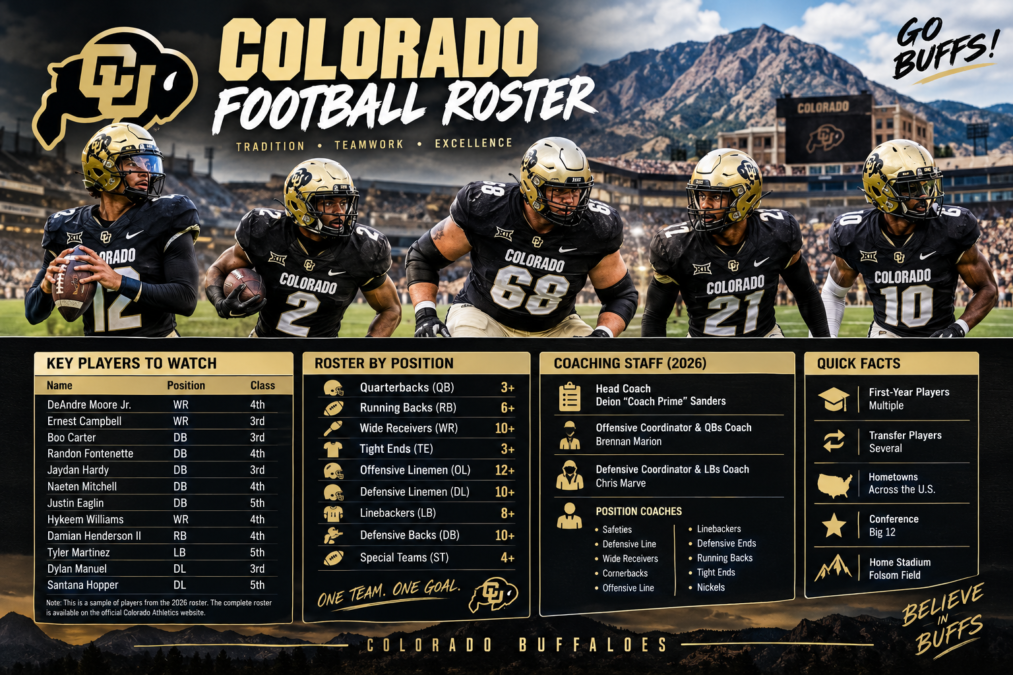
For the 2026 season, the Colorado Buffaloes have a roster featuring experienced players, younger athletes, transfers, and newcomers. The official University of Colorado Athletics roster lists players across offensive, defensive, and special-teams roles, while also identifying their academic year and previous schools.
The program is led by head coach Deion “Coach Prime” Sanders. The 2026 coaching staff includes Brennan Marion as offensive coordinator and quarterbacks coach and Chris Marve as defensive coordinator and linebackers coach.
For fans, students, analysts, and college football followers, understanding the colorado football roster is a great way to follow how the Buffaloes are building their team.
Understanding the Colorado Football Roster
A college football roster can look confusing at first. There are jersey numbers, positions, academic years, hometowns, high schools, and previous colleges to consider. However, each part tells readers something useful about a player.
The 2026 Colorado roster includes players listed as:
- Quarterbacks
- Running backs
- Wide receivers
- Tight ends
- Offensive linemen
- Defensive linemen
- Linebackers
- Defensive backs
- Specialists and other football roles
The official roster also shows whether players are first-year, second-year, third-year, fourth-year, fifth-year, or sixth-year athletes. Some players arrived at Colorado directly from high school, while others transferred from different college programs.
This mixture is important because college football teams often combine youth with experience. Younger players bring development potential, while experienced athletes can provide leadership and familiarity with college-level competition.
The 2026 Colorado Football Roster at a Glance
The following table highlights several players listed on the official 2026 roster. It isn’t intended to replace the complete official roster, which should remain the primary source for the latest information.
| Player | Position | Class | Hometown | Previous School |
|---|---|---|---|---|
| DeAndre Moore Jr. | WR | 4th | Bellflower, California | Texas |
| Ernest Campbell | WR | 3rd | Refugio, Texas | Texas A&M / Sacramento State |
| Boo Carter | DB | 3rd | Chattanooga, Tennessee | Tennessee |
| Randon Fontenette | DB | 4th | Freeport, Texas | TCU / Vanderbilt |
| Jaydan Hardy | DB | 3rd | Lewisville, Texas | Oklahoma |
| Naeten Mitchell | DB | 4th | Temple, Texas | New Mexico State |
| Justin Eaglin | DB | 5th | Fayetteville, North Carolina | James Madison |
| Hykeem Williams | WR | 4th | Fort Lauderdale, Florida | Florida State |
| Damian Henderson II | RB | 4th | Los Alamitos, California | Colorado State / Sacramento State |
| Tyler Martinez | LB | 5th | Albuquerque, New Mexico | New Mexico Military Institute / New Mexico State |
| Dylan Manuel | DL | 3rd | Stockbridge, Georgia | Appalachian State |
| Santana Hopper | DL | 5th | Shelby, North Carolina | Appalachian State / Tulane |
These players illustrate the variety of backgrounds represented on the roster. Some have transferred from well-known college programs, while others have developed through different football pathways.
Quarterbacks and the Offensive Direction
The quarterback position naturally receives plenty of attention because it influences how an offense operates. Quarterbacks are responsible for reading defenses, communicating plays, distributing the football, and making decisions under pressure.
The 2026 Colorado coaching structure lists Brennan Marion as both offensive coordinator and quarterbacks coach.
That dual responsibility connects the overall offensive system with quarterback development. A quarterback isn’t simply asked to throw the ball. The position requires leadership, timing, communication, awareness, and decision-making.
As the season develops, fans can use the official roster and game statistics together to understand which quarterbacks are receiving playing opportunities and how the offense is being organized.
Running Backs Bring Balance
Running backs remain an important part of a balanced college football offense. They can contribute through rushing, receiving, pass protection, and special situations.
The 2026 colorado football roster includes experienced running backs such as Damian Henderson II and Bryce Hicks. Henderson is listed as a fourth-year player and previously played at Colorado State and Sacramento State, while Hicks is listed as a third-year player with West Georgia shown as his previous school.
Having multiple players at a position can give coaches flexibility. A team may use different backs depending on the situation, opponent, game plan, or player availability.
A strong running-back group can also help take pressure away from the passing game. When a team can move the ball in several ways, defenses have more responsibilities to handle.
Wide Receivers Add Speed and Variety
Wide receivers are another major part of the Buffaloes’ offensive structure. They create opportunities by running routes, catching passes, stretching the field, and helping quarterbacks move the football.
DeAndre Moore Jr. is listed as a fourth-year wide receiver and previously attended Texas. Ernest Campbell is listed as a third-year wide receiver and has previous-school information connected with Texas A&M and Sacramento State. Hykeem Williams is another fourth-year receiver listed on the roster, with Florida State shown as his previous school.
The roster also includes younger receivers, including Quentin Gibson and other developing players.
That’s where roster depth can become especially valuable. Injuries and game situations can change a team’s rotation quickly, so having several capable receivers gives coaches more options.
The Offensive Line Provides the Foundation
The offensive line doesn’t always receive the same attention as quarterbacks and wide receivers, but its role is fundamental.
Offensive linemen are responsible for blocking during running plays and protecting the quarterback during passing plays. Their work can determine how much time a quarterback has and how much space a running back receives.
The 2026 Colorado program also added new offensive linemen through its recruiting and roster-building efforts. The 2026 newcomer information includes players such as Ben Gula, Josiah Manu, and Xavier Payne.
This demonstrates how roster construction isn’t only about adding skill-position players. Building depth in the trenches is also an important part of developing a complete football team.
Colorado’s Defensive Backs
The defensive backfield is another notable part of the 2026 colorado football roster.
The official roster lists players such as Boo Carter, Jaydan Hardy, Randon Fontenette, Naeten Mitchell, Justin Eaglin, RJ Johnson, and others.
Defensive backs generally include cornerbacks and safeties. Their responsibilities can include:
- Covering receivers
- Defending against deep passes
- Supporting the run defense
- Reading the quarterback
- Creating turnovers
- Communicating coverage assignments
Because modern college football features many passing plays, defensive backs often need speed, awareness, discipline, and strong communication.
The Colorado roster includes both experienced players and younger defensive backs. That combination can help a coaching staff develop competition at different positions.
Linebackers and Defensive Front
A football defense needs strength in the middle of the field, and linebackers play a major role in that area.
The 2026 roster includes Tyler Martinez as a fifth-year linebacker. The roster also lists several younger defensive players who can contribute to the team’s depth.
The defensive line is equally important. Defensive linemen work to stop running plays, pressure quarterbacks, and occupy blockers.
Among the players listed on the 2026 roster are Santana Hopper and Dylan Manuel. Hopper is listed as a fifth-year defensive lineman with previous experience at Appalachian State and Tulane, while Manuel is listed as a third-year defensive lineman who previously played at Appalachian State.
Strong defensive-line play can influence the entire defense. If linemen can create pressure without requiring excessive blitzing, other defenders may have more freedom in coverage.
Newcomers Add Another Layer
One interesting feature of the 2026 colorado football roster is its group of newcomers.
The official newcomer roster lists players such as Preston Ashley, Rodney Colton Jr., Carson Crawford, Braylon Edwards, Ben Gula, Colby Johnson, Josiah Manu, Cam Newton, Xavier Payne, Domata Peko Jr., Jacob Swain, Alex Ward, Christian Ward, and Mojo Williams Jr.
These newcomers cover several positions.
For example:
- Preston Ashley is listed as a cornerback.
- Rodney Colton Jr. is listed as a linebacker.
- Carson Crawford is listed as a linebacker.
- Ben Gula is listed as an offensive lineman.
- Cam Newton is listed as a running back.
- Jacob Swain is listed as a wide receiver.
- Christian Ward is listed as a wide receiver.
- Mojo Williams Jr. is listed as a cornerback.
Some newcomers arrive as first-year players, while others have different eligibility backgrounds. The roster therefore represents a blend of recruiting and player movement.
Transfer Players on the Colorado Football Roster
Transfer players have become an important part of modern college football. Athletes can move between programs and bring previous college experience to their new teams.
Colorado’s 2026 roster contains several players whose previous schools are listed. For example, DeAndre Moore Jr. is listed with Texas as his previous school, Boo Carter with Tennessee, Jaydan Hardy with Oklahoma, and Hykeem Williams with Florida State.
Other players have backgrounds at multiple institutions. Randon Fontenette is listed with TCU and Vanderbilt, while Damian Henderson II is listed with Colorado State and Sacramento State.
For fans, previous-school information can provide useful context. A transfer may arrive with experience in a different offensive or defensive system, which can add another dimension to roster development.
The Role of Experience and Class Years
The academic-year column on a college football roster helps readers understand how much college experience a player may have.
The Colorado roster includes:
- First-year players
- Second-year players
- Third-year players
- Fourth-year players
- Fifth-year players
- Sixth-year players
A roster with several older athletes may have players who have already experienced college practices, travel, game preparation, and high-pressure situations.
At the same time, younger players can bring energy and long-term development potential.
The balance between these groups is one reason college football rosters are constantly evolving.
Coaching Staff Supporting the Roster
Players don’t develop in isolation. Coaches and support staff are responsible for teaching techniques, preparing game plans, developing athletes, and managing many aspects of a college football program.
Deion “Coach Prime” Sanders is listed as Colorado’s head football coach for 2026. Brennan Marion serves as offensive coordinator and quarterbacks coach, while Chris Marve serves as defensive coordinator and linebackers coach.
The coaching staff also includes specialized coaches for different position groups.
The official roster page lists coaches working with:
- Safeties
- Defensive line
- Wide receivers
- Cornerbacks
- Offensive line
- Linebackers
- Defensive ends
- Running backs
- Tight ends
- Nickels
This structure shows how a major college football program divides development responsibilities across specialized areas.
How to Read a Colorado Football Roster
If you’re new to college football, the roster may seem like a long list of names. Don’t worry; it’s easier to understand once you know the basic abbreviations.
| Roster Term | Meaning |
|---|---|
| QB | Quarterback |
| RB | Running Back |
| WR | Wide Receiver |
| TE | Tight End |
| OL | Offensive Line |
| DL | Defensive Line |
| LB | Linebacker |
| DB | Defensive Back |
| CB | Cornerback |
| Yr. | Academic year or eligibility classification |
| Ht. | Height |
| Wt. | Weight |
The roster may also include previous-school information. This is particularly useful for identifying transfer players.
Why the Roster Can Change
One important thing to remember is that a college football roster isn’t necessarily a permanent document.
Players can experience:
- Injuries
- Eligibility changes
- Transfers
- Position changes
- Redshirt decisions
- Academic changes
- Other roster adjustments
Because of this, the official Colorado Athletics roster should be checked for the most current information.
The university provides a dedicated 2026 football roster page and also publishes a downloadable 2026 roster document.
That’s especially useful during the season when changes can happen quickly.
What Makes the 2026 Roster Interesting?
The 2026 Buffaloes roster combines several different types of players.
There are established college athletes, transfers, first-year players, and returning players. This creates a roster with different levels of experience.
Another interesting feature is geographic diversity. Players on the roster come from states including California, Texas, Georgia, Florida, Tennessee, Pennsylvania, North Carolina, Colorado, New Mexico, and others.
That variety reflects the national nature of college football recruiting.
At the end of the day, though, a roster is only the starting point. Practices, player development, coaching, teamwork, health, and game performance all influence what happens on the field.
Following Players During the Season
Fans who want to follow the Buffaloes shouldn’t rely on the roster alone.
A useful approach is to combine roster information with:
- Official game statistics
- Depth charts when published
- Game previews
- Post-game reports
- Player interviews
- Injury updates
- Official team announcements
Colorado’s official athletics website also provides football media resources and historical roster information.
This makes it easier to understand how the roster changes from the beginning of the season to later games.
Colorado Football Roster and Team Development
A roster is essentially a blueprint for a football program. It shows the available talent, but it doesn’t tell the whole story.
Two players with similar positions and physical measurements can have very different roles. One may become a starter, another may contribute on special teams, and another may spend time developing before seeing significant game action.
That’s normal in college football.
Coaches must evaluate players during practices, determine the best combinations, and create roles that fit their overall strategy.
The 2026 Colorado coaching staff has specialists working across nearly every position group, which supports this detailed development process.
The Importance of Depth
Depth is one of the most important concepts for understanding a football roster.
A team doesn’t simply need eleven starters. It needs additional players who can step onto the field when necessary.
For example, if a wide receiver is unavailable, another receiver may need to take additional snaps. If a defensive back is injured, another member of the secondary may be asked to play a larger role.
Depth can therefore affect how a team handles the long college football season.
The 2026 colorado football roster includes players across multiple classes and positions, giving the coaching staff a broad group from which to build game-day combinations.
Looking at the Roster With a Long-Term View
One of the most useful ways to understand a college football roster is to think beyond one game.
First-year players may become important contributors in future seasons. Third- and fourth-year players may be entering important stages of their college careers. Fifth- and sixth-year athletes can bring additional experience.
Recruiting also plays a role in the long-term picture.
Colorado’s 2026 newcomer list shows the program continuing to add players at different positions, including offensive line, defensive back, linebacker, running back, and wide receiver.
So, while fans naturally focus on the current season, the roster also gives clues about how a program is building for the future.
Frequently Asked Questions About the Colorado Football Roster
Who is the head coach of Colorado football?
Deion “Coach Prime” Sanders is listed as the head football coach for the 2026 Colorado Buffaloes.
Where can I find the official Colorado football roster?
The University of Colorado Athletics website provides the official 2026 football roster, including player names, positions, class years, heights, weights, hometowns, and previous schools.
Does the Colorado roster include transfer players?
Yes. The official roster identifies previous schools for many players, including transfers from programs such as Texas, Tennessee, Oklahoma, Florida State, New Mexico State, and others.
Does the roster include freshmen?
Yes. The 2026 newcomer roster includes multiple first-year players, including Preston Ashley, Rodney Colton Jr., Carson Crawford, Braylon Edwards, Ben Gula, and others.
Why are previous schools listed?
Previous-school information helps fans understand whether a player joined Colorado from high school, another college, or a different football program.
Can the roster change during the season?
Yes. College football rosters can change because of injuries, transfers, eligibility matters, and other circumstances. For current information, readers should consult Colorado Athletics’ official roster page.
Final Thoughts on the Colorado Football Roster
The colorado football roster offers a detailed look at the players and structure behind the Colorado Buffaloes. The 2026 group features a combination of returning experience, transfers, younger players, and newcomers across offense and defense. The official roster also shows the extensive coaching structure supporting player development.
For fans, the best way to understand the roster is to look beyond individual names. Position, class year, previous school, experience, depth, and coaching all help explain how a college football team is assembled.
As the season continues, roster information should be combined with official game statistics and team announcements for the clearest picture. And, of course, college football can change quickly—one week a young player may be developing quietly, and the next week that same player could be making an important contribution.
Ultimately, the colorado football roster is more than a list of athletes. It’s a snapshot of a developing football program, bringing together players from different backgrounds and experience levels while giving fans a useful way to follow the Buffaloes throughout the 2026 season.
How the Colorado Football Roster Shapes the Team
The colorado football roster gives fans an inside look at how the Buffaloes are built from the ground up. Every player has a role, even if that role changes throughout the season. Some athletes may receive regular starting opportunities, while others contribute as backups, special-teams players, or developing members of the program.
Building a successful college football team isn’t simply about collecting talented players. Coaches must consider position balance, experience, physical development, teamwork, and the needs of the overall system.
For example, having several talented wide receivers is useful, but a team also needs enough offensive linemen to protect the quarterback and create running lanes. Similarly, a strong secondary needs support from the defensive line and linebackers.
That’s why the roster should be viewed as a complete unit rather than just a collection of individual names.
Offensive Roster Depth
Offensive depth is especially important because different positions work closely together.
A quarterback depends on his offensive line for protection and on receivers and running backs to execute plays. Running backs need blocking, while receivers need accurate throws and enough time for routes to develop.
The main offensive groups include:
- Quarterbacks
- Running backs
- Wide receivers
- Tight ends
- Offensive linemen
Each group has a different responsibility, but they must work together.
When the offensive line performs well, quarterbacks can have more time to make decisions. When receivers run precise routes, passing opportunities can improve. Meanwhile, an effective running game can force a defense to respect multiple options.
In other words, football is a team sport in every sense of the word.
Defensive Roster Depth
The defensive side of the colorado football roster is structured around stopping the opposing offense.
Defensive players generally fall into several groups:
| Defensive Group | Main Responsibility |
|---|---|
| Defensive Line | Stop runs and pressure quarterbacks |
| Linebackers | Defend runs, cover receivers, and pressure |
| Cornerbacks | Cover opposing receivers |
| Safeties | Provide deep coverage and run support |
| Nickel/Hybrid Players | Handle specialized coverage roles |
A defense needs communication and discipline. One player making the wrong assignment can create an opening for the opposing offense.
For that reason, experience matters. However, young players can also develop quickly when they receive good coaching and practice against experienced teammates.
Special Teams Shouldn’t Be Overlooked
When people discuss a football roster, they often focus on offense and defense. Special teams, however, can also influence field position and game situations.
Special-teams responsibilities can include:
- Kickoffs
- Kickoff coverage
- Punts
- Punt coverage
- Field goals
- Extra points
- Kick returns
- Punt returns
These plays may appear only a few times in a game, but they can have a significant impact on field position.
A good roster therefore needs players who can contribute beyond their primary offensive or defensive positions.
The Transfer Portal and Roster Construction
Modern college football roster building has changed considerably because of player movement and the transfer portal.
Colorado, like other major college football programs, can add experienced players from other universities. These athletes may already understand the demands of college football and can bring knowledge from previous programs.
At the same time, transfers must learn a new playbook, meet new teammates, adjust to a new coaching staff, and become comfortable in a different system.
This creates an interesting balance.
A transfer may arrive with significant experience, but that doesn’t automatically determine his role. Coaches still evaluate players through practices, meetings, workouts, and game preparation.
Therefore, the colorado football roster reflects both recruitment and ongoing roster management.
Recruiting and the Future of Colorado Football
Recruiting remains an important part of maintaining a college football program.
High school players can enter a program with limited college experience but significant potential. Coaches then work to develop their technical skills, physical strength, football knowledge, and confidence.
A younger player might initially contribute on special teams or as a backup before earning a larger role.
This gradual development is common throughout college football.
For Colorado, recruiting also helps maintain roster depth. When older players graduate or leave the program, younger athletes can eventually move into larger roles.
It’s a cycle that continues year after year.
Why Player Position Matters
A player’s listed position provides an important starting point for understanding his role.
For example, a quarterback generally operates behind the center and directs the offense. A wide receiver works primarily in the passing game, while a running back can contribute as a runner and receiver.
On defense, cornerbacks frequently match up with receivers, linebackers operate closer to the middle of the defense, and defensive linemen work near the line of scrimmage.
Some modern players, however, can perform multiple jobs.
Hybrid players may line up in different locations depending on the play. This flexibility can make a player valuable because coaches have more ways to use his skills.
Height and Weight on the Colorado Football Roster
The official roster also provides physical information such as height and weight.
These measurements give fans basic information about a player’s physical profile, but they shouldn’t be treated as the only measure of ability.
Football performance also depends on:
- Speed
- Strength
- Technique
- Awareness
- Decision-making
- Football intelligence
- Conditioning
- Consistency
- Teamwork
A smaller athlete can sometimes succeed through speed and technique, while a larger athlete may use strength and leverage.
So, while roster measurements are interesting, they only tell part of the story.
Hometown Information Adds More Context
Another interesting part of the colorado football roster is the hometown information.
Players come to Colorado from different parts of the United States. This geographic variety demonstrates how college football recruiting has become a national process.
A player from California may join teammates from Texas, Florida, Georgia, Tennessee, North Carolina, Colorado, or another state.
Despite their different backgrounds, these athletes become members of the same football program.
That experience can help create strong team relationships. Players spend significant time together during practices, meetings, workouts, travel, and competition.
The Importance of Team Chemistry
Statistics and roster information are useful, but football also depends on relationships.
Players need to trust teammates to perform their assignments. Offensive linemen must communicate with one another. Defensive backs need to understand coverage responsibilities. Quarterbacks and receivers need timing and communication.
Team chemistry doesn’t appear on a roster page, yet it can influence how effectively players work together.
A roster with talented individuals still needs cooperation.
As the season progresses, players become more familiar with each other’s habits, strengths, communication styles, and tendencies. That familiarity can be valuable on game day.
Young Players to Watch
Fans often enjoy identifying younger athletes who could develop into important contributors.
However, predicting exactly which players will become major stars can be difficult. Playing time depends on many factors, including injuries, competition, practice performance, coaching decisions, and game situations.
The best approach is to monitor official team information and actual game participation rather than relying only on preseason expectations.
For younger players on the colorado football roster, every practice can be an opportunity to learn and improve.
Experienced Players as Leaders
Veteran players can provide leadership to younger teammates.
They’ve already experienced college practices, road games, difficult losses, major victories, academic responsibilities, and the physical demands of a college football season.
Leadership isn’t limited to team captains. Experienced players can help younger teammates understand:
- How to prepare for games
- How to study opponents
- How to handle pressure
- How to maintain discipline
- How to approach practice
- How to respond to mistakes
That knowledge can be just as valuable as physical talent.
How Injuries Can Affect the Roster
Injuries are an unavoidable part of football.
When a player becomes unavailable, another athlete may have to take on additional responsibilities. This is one reason roster depth matters so much.
For example, losing a starting offensive lineman may require a backup to step into a larger role. A defensive-back injury could lead to another player receiving more defensive snaps.
These changes can also give younger players valuable experience.
Because injury information can change, fans should use official Colorado Athletics updates when looking for current availability rather than relying on old roster information.
Tracking the Colorado Buffaloes During the Season
Following the colorado football roster becomes more interesting when fans compare the roster with actual game results and statistics.
Useful information includes:
- Player participation
- Passing statistics
- Rushing statistics
- Receiving statistics
- Tackles
- Sacks
- Interceptions
- Fumbles
- Special-teams statistics
- Team wins and losses
These numbers help explain how players are contributing.
For example, a wide receiver’s importance can be viewed through catches and receiving yards, while a defensive player can be evaluated through tackles, sacks, interceptions, and other defensive statistics.
Still, statistics don’t capture everything. Blocking, coverage, leadership, and assignments may not always appear in a box score.
Frequently Asked Questions
Where can fans find the latest Colorado football roster?
The University of Colorado Athletics website is the primary source for the team’s official roster. Because rosters can change, checking the official page is better than relying on old articles or social-media posts.
Does every player on the roster play in every game?
No. A roster contains more players than can participate in every play. Playing time depends on coaching decisions, game plans, player development, injuries, and other factors.
Why does Colorado have players from so many states?
College football programs recruit nationally. Players may choose Colorado because of its coaching staff, academic opportunities, football program, location, facilities, or other factors.
Can a player’s position change?
Yes. Coaches sometimes move players to different positions when their skills or team needs make a different role appropriate.
Why are transfer players important?
Transfers can bring previous college experience to a new program. They can also add competition and depth at positions that need additional players.
Is the roster the same as the depth chart?
No. A roster lists players in the program, while a depth chart generally indicates how coaches currently organize players by role or expected playing position.
How Fans Can Use Roster Information
The colorado football roster can be useful for both casual fans and serious followers.
A casual fan might use it to identify a favorite player’s position and hometown. A more serious fan might compare the roster with statistics, schedules, previous seasons, and player development.
For example, when watching a game, fans can keep the roster available to identify unfamiliar players.
This is especially helpful when younger athletes enter the game.
Over time, following the roster can make watching football more enjoyable because fans begin to recognize not only star players but also developing athletes and important role players.
Final Perspective
The colorado football roster provides a window into the structure of the Buffaloes football program. It shows the combination of veterans, younger athletes, transfers, newcomers, and players competing for roles across offense, defense, and special teams.
More importantly, the roster represents an ongoing process. Players develop, positions evolve, and coaches continually evaluate how individual strengths can fit into the larger team structure.
For fans, the most useful approach is to treat the roster as a starting point. Combine it with official statistics, team announcements, game reports, and current information to build a clearer understanding of the Buffaloes.
College football is full of surprises, and that’s part of the fun. A player listed as a newcomer today could become an important contributor tomorrow. A veteran can take on a leadership role. A backup can suddenly receive an opportunity.
Through all these changes, the colorado football roster remains one of the best resources for understanding who makes up the Buffaloes and how the program continues to develop.
Discover more insightful articles, helpful updates, and engaging stories on Leo ART New, and stay connected with the latest information. For more details, Contact Us.