
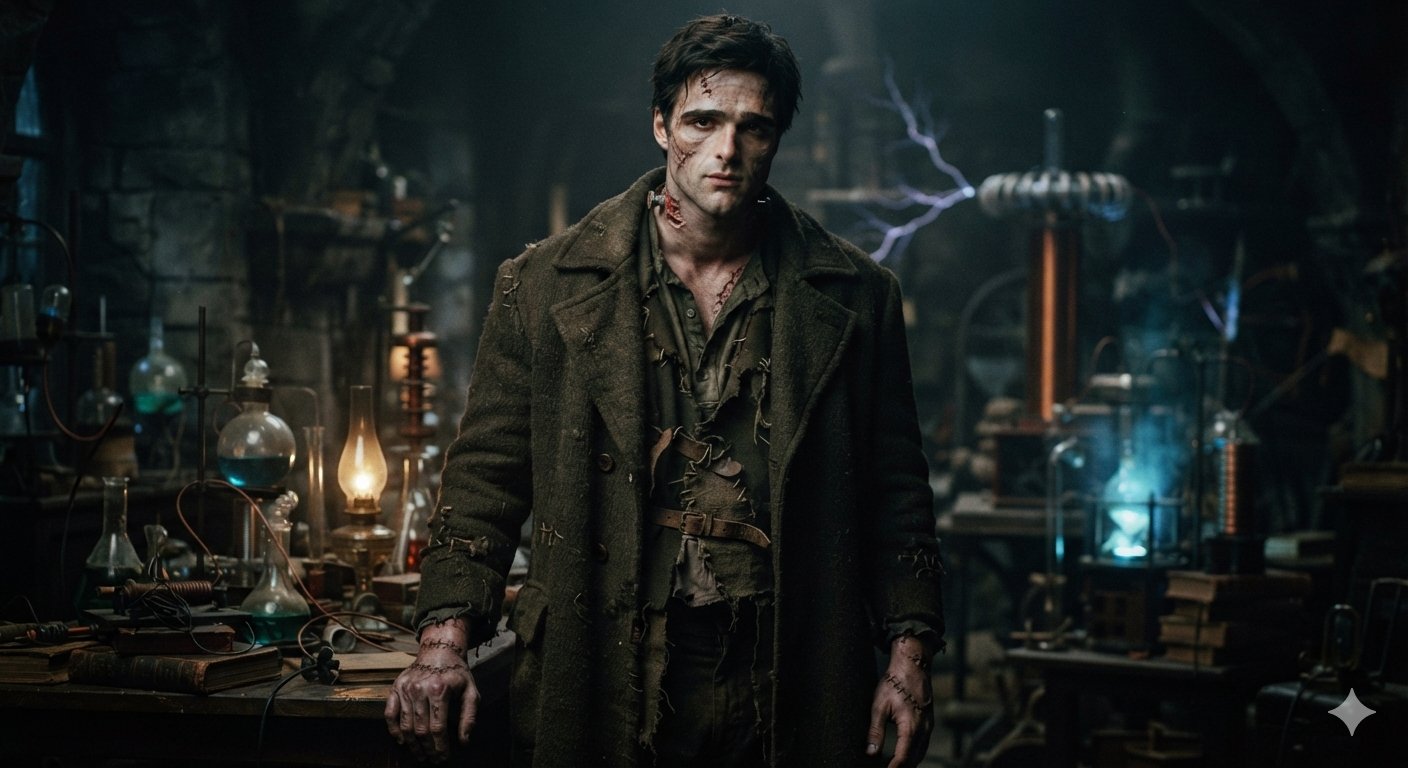

jacob elordi frankenstein has become a widely searched phrase because Australian actor Jacob Elordi takes on one of the most challenging roles of his career in Guillermo del Toro’s Frankenstein. Rather than playing Victor Frankenstein, Elordi portrays the Creature, the mysterious being created by Victor in Mary Shelley’s famous Gothic story.
The 2025 film is written and directed by Oscar-winning filmmaker Guillermo del Toro and stars Oscar Isaac as Victor Frankenstein, Jacob Elordi as the Creature, and Mia Goth in a major role. Netflix describes the movie as a new interpretation of Mary Shelley’s classic tale about a brilliant scientist whose experiment brings a creature to life.
Elordi’s performance is especially interesting because del Toro approaches the Creature as more than a frightening monster. The character has innocence, loneliness, anger, curiosity, and a powerful desire for acceptance. In other words, the film asks viewers to look beyond the Creature’s appearance and consider the person—or being—inside.
Released in 2025 and now available on Netflix, Frankenstein represents a major chapter in Elordi’s growing film career.
Who Is Jacob Elordi?
Jacob Elordi is an Australian actor who became internationally known through his work in film and television. He gained major attention through The Kissing Booth films and later appeared in projects such as Euphoria, Priscilla, and Saltburn.
Over time, Elordi has taken on increasingly different types of characters. His work has moved beyond conventional romantic or youthful roles toward complicated dramatic performances.
That development makes his casting in Frankenstein particularly notable.
Playing the Creature requires an actor to communicate a great deal without depending only on traditional dialogue or facial expressions. The character goes through an unusual emotional journey, and Elordi had to make audiences understand that journey while wearing extensive prosthetic makeup and costume work.
Netflix’s behind-the-scenes coverage explains that Elordi joined the production after hearing directly about del Toro’s vision. The actor had only a short period between another project in Australia and arriving on the Frankenstein set in Toronto, yet he accepted the opportunity to work with the acclaimed filmmaker.
What Is jacob elordi frankenstein About?
When people search for jacob elordi frankenstein, they’re usually asking one simple question: What role does Jacob Elordi play in Frankenstein?
The answer is important.
Jacob Elordi plays the Creature, commonly known as Frankenstein’s monster.
The movie follows the basic foundation of Mary Shelley’s story. Victor Frankenstein is a brilliant scientist who becomes obsessed with creating life. His experiment succeeds, but the result is a living being who must suddenly understand a world that doesn’t understand him.
Guillermo del Toro adds his own visual and emotional approach to the story. Netflix describes his film as a reimagining of Shelley’s classic novel, with Oscar Isaac portraying Victor and Elordi portraying his creation.
The Creature isn’t simply presented as a scary figure who appears from the shadows. His experiences, memories, relationships, and search for meaning become central to the story.
That difference matters because Mary Shelley’s original novel itself is much more complicated than the familiar image of a silent monster walking through a laboratory.
Jacob Elordi as the Creature
Elordi’s role is one of the central elements of Guillermo del Toro’s adaptation.
The Creature begins his existence without the ordinary experiences most people take for granted. He doesn’t grow up with parents, attend school, make childhood friends, or learn about the world gradually. Instead, he is brought into existence by Victor Frankenstein and must discover life almost immediately.
That creates an unusual performance challenge.
Elordi needs to portray someone who can appear physically powerful while emotionally feeling inexperienced. Netflix’s coverage of the film notes that del Toro wanted the Creature to move between the qualities of a newborn, a philosopher, and a mature person.
This combination gives the character several layers:
- Physical strength
- Childlike innocence
- Curiosity about the world
- Loneliness
- Emotional pain
- Anger
- A desire for love
- A search for identity
- A complicated relationship with Victor
So, although the Creature looks intimidating, his emotional journey is much more important than his appearance.
How Guillermo del Toro Reimagines Frankenstein
Guillermo del Toro has had a long relationship with monsters in his filmmaking. His movies often ask viewers to consider whether the creature everyone fears is actually the most dangerous character in the story.
His Frankenstein follows that tradition.
For del Toro, Mary Shelley’s novel has been a lifelong source of inspiration. Netflix reports that he has described Frankenstein as deeply important to him and wanted to reinterpret the story in his own artistic language rather than simply reproduce earlier movie versions.
That approach can be seen in the Creature’s design, movement, emotional development, and relationship with Victor.
The movie also gives the Creature a stronger narrative presence. Instead of allowing Victor’s perspective to completely control the story, the adaptation explores what it might mean for the Creature to have his own voice.
That’s where Elordi becomes essential.
His performance helps transform the Creature from a familiar horror image into a character with an emotional point of view.
The Difference Between Frankenstein and the Creature
One common misunderstanding is that Frankenstein is the name of the monster.
Technically, Victor Frankenstein is the scientist, while the Creature is the being he creates.
This distinction becomes especially important when discussing jacob elordi frankenstein because Elordi does not play Victor Frankenstein. Oscar Isaac plays Victor.
| Character | Actor | Role |
|---|---|---|
| Victor Frankenstein | Oscar Isaac | Scientist and creator |
| The Creature | Jacob Elordi | Being created by Victor |
| Main female character | Mia Goth | Major character in the story |
| Captain Anderson | Lars Mikkelsen | Ship captain |
| The Blind Man | David Bradley | Character encountered by the Creature |
| Other major role | Christoph Waltz | Important figure in Victor’s world |
Netflix’s official cast information confirms Elordi’s role as the Creature and Isaac’s role as Victor.
Understanding this difference makes the film easier to discuss and also explains why Elordi’s performance has attracted so much attention.
The Creature’s Appearance in the Movie
One of the most noticeable aspects of Elordi’s transformation is his appearance.
Instead of simply copying the famous square-headed monster design associated with older Hollywood movies, del Toro developed a different interpretation.
Netflix’s trailer coverage describes the Creature as a more statuesque and almost delicate figure, while still giving him a frightening physical presence.
The design is connected to the story’s unusual origin for the Creature. In del Toro’s version, his body is assembled from the remains of soldiers from the Crimean War.
That detail gives the character a disturbing but meaningful physical history.
His body isn’t simply a collection of random parts for visual shock. It becomes part of the story’s questions about death, identity, memory, and humanity.
The result is a Creature who can appear beautiful, strange, frightening, and vulnerable at the same time.
Jacob Elordi’s Physical Transformation
Playing the Creature required more than simply acting in front of a camera.
Elordi underwent a substantial physical transformation involving prosthetic makeup and costume design. Netflix’s behind-the-scenes feature discusses the collaboration between Elordi and prosthetic designer Mike Hill in creating the character.
This kind of performance requires patience because prosthetic work can change how an actor moves, speaks, sees, and reacts.
For a role like this, even small movements can become important.
A turn of the head may communicate confusion. A slow step may suggest uncertainty. A change in posture can show confidence or fear.
That’s why the physical performance of the Creature is just as important as the spoken performance.
Interestingly, Elordi also looked toward unexpected sources when developing the character’s movement. Netflix reports that he drew inspiration from the Japanese dance form butoh and even observed his golden retriever’s movements and innocence.
It’s an unusual preparation method, but it makes sense for a character who isn’t supposed to move like an ordinary human being.
The Emotional Story Behind the Creature
At the heart of the movie is a simple but powerful question:
What happens when someone is created but not loved?
The Creature doesn’t choose to be born. Victor creates him, yet Victor struggles to accept the result.
This creates a painful relationship between creator and creation.
The Creature wants connection, but rejection changes him. His anger doesn’t appear without a reason. It develops through his experiences.
Netflix’s coverage of the film emphasizes the Creature’s journey from a newborn being toward a more mature individual who must confront his creator.
This emotional development is one of the reasons Elordi’s role is so demanding.
He isn’t simply playing an angry monster.
He’s playing someone trying to understand why he exists.
The Relationship Between Jacob Elordi’s Creature and Victor Frankenstein
The relationship between the Creature and Victor is the emotional center of the story.
Victor creates life because of his ambition and obsession. But creation comes with responsibility.
The Creature, meanwhile, wants answers.
Why was he created?
Why does Victor reject him?
Why does he look different?
Why does he suffer?
Why can’t he experience the same kind of acceptance as other people?
These questions create tension between the two characters.
Oscar Isaac’s Victor represents scientific ambition and personal obsession, while Elordi’s Creature represents the consequences of that ambition.
The relationship can therefore be understood as more than a battle between a scientist and a monster. It’s also a story about responsibility between creator and creation.
Love, Rejection, and Loneliness
One of the strongest themes associated with del Toro’s Frankenstein is the Creature’s need for love.
The trailers make this emotional conflict clear. The Creature seeks affection and acceptance but becomes increasingly angry when those needs aren’t met.
This is where the movie moves beyond traditional horror.
A traditional monster story might ask:
How can the hero defeat the monster?
Frankenstein asks a different question:
Why did the monster become violent in the first place?
That doesn’t mean every action of the Creature is excused. Instead, the film encourages viewers to understand the circumstances that shape him.
This approach fits del Toro’s long-standing interest in misunderstood creatures and outsiders.
Jacob Elordi’s Acting Challenge
The role demands several different acting styles at once.
Physical acting
Elordi has to communicate through movement, posture, and body language.
Emotional acting
The Creature experiences fear, wonder, loneliness, anger, and hope.
Character development
He changes throughout the story rather than remaining the same from beginning to end.
Working with prosthetics
His performance has to remain convincing even when his face and body are transformed.
Working with a large visual production
The film includes elaborate sets, costumes, makeup, effects, and period details, so Elordi had to remain connected to the character while working within a highly constructed world.
All of these factors make the role different from a standard dramatic performance.
What Inspired Jacob Elordi’s Performance?
Elordi’s preparation for the Creature included studying unusual forms of movement.
According to Netflix’s behind-the-scenes reporting, he looked at butoh, a Japanese dance form, to help understand how the Creature might move. He also found inspiration in his dog, particularly the animal’s innocence and natural way of moving through the world.
That preparation reflects an important idea about the character.
The Creature isn’t born knowing how to behave.
He has to discover movement, language, emotion, and relationships.
Therefore, making him move like an ordinary adult wouldn’t necessarily fit the character.
Instead, Elordi had to create a physical language that could show the Creature learning how to exist.
The Importance of Mike Hill’s Prosthetic Design
Acting isn’t the only reason the Creature looks different.
Prosthetic designer Mike Hill played a major role in creating the character’s appearance. Netflix’s detailed behind-the-scenes feature specifically explores how Hill and Elordi worked together to bring the Creature to life.
Makeup and prosthetics can completely change an actor’s silhouette and facial structure.
For Frankenstein, the goal wasn’t simply to make Elordi look frightening. The design needed to support the emotional story.
The Creature needed to look like someone who had been assembled from human remains, yet he also needed to retain an unusual beauty and vulnerability.
That balance is crucial.
Too frightening, and audiences might see only a monster.
Too ordinary, and the character may lose the supernatural quality that makes him distinctive.
Del Toro’s version attempts to exist somewhere between those extremes.
Frankenstein’s Visual Style
Guillermo del Toro is widely recognized for creating visually rich worlds, and Frankenstein continues that tradition.
The movie combines:
- Gothic architecture
- Victorian-era settings
- Dark laboratories
- Elaborate costumes
- Dramatic lighting
- Practical creature effects
- Period details
- Large-scale production design
- Atmospheric landscapes
Netflix describes the film as visually striking and places it within genres including science fiction, horror, drama, period film, and movies based on books.
The visual design isn’t just decoration.
It helps create the emotional atmosphere of the story.
Dark rooms can suggest secrecy. Huge laboratories can reflect Victor’s ambition. Empty landscapes can emphasize the Creature’s isolation.
In that way, the setting becomes part of the storytelling.
How the Movie Connects to Mary Shelley’s Novel
Mary Shelley’s Frankenstein; or, The Modern Prometheus was first published in 1818.
The original novel explored major ideas about science, ambition, responsibility, isolation, and what it means to be human.
Guillermo del Toro’s adaptation is inspired by the same foundational story, but it isn’t simply a scene-by-scene reproduction of the novel.
Del Toro has said that he wanted to make the story his own while remaining deeply connected to Shelley’s creation.
This gives viewers two useful ways to approach the movie.
First, it can be watched as a new film by Guillermo del Toro.
Second, it can be viewed as another interpretation of a classic literary story that has been adapted many times.
That’s part of the fun of Frankenstein. Each generation can discover different meanings in the story.
Jacob Elordi Frankenstein and the Film’s Themes
The phrase jacob elordi frankenstein represents more than an actor and a movie title. It also points toward several themes explored through Elordi’s character.
Creation and responsibility
Victor creates life, but creation brings responsibility.
Isolation
The Creature is physically powerful but emotionally isolated.
Identity
He must discover who he is after being created by someone else.
Rejection
The way others react to his appearance influences his emotional journey.
Humanity
The movie asks what truly makes someone human.
Ambition
Victor’s desire to overcome natural limits has serious consequences.
Love
The Creature’s desire for connection becomes one of the most important emotional elements.
Fear
People often react to what they don’t understand with fear.
These themes help make Frankenstein relevant even centuries after Mary Shelley’s original novel.
The Film’s Release and Netflix Availability
Guillermo del Toro’s Frankenstein was released in 2025 and is now available to stream on Netflix. The official Netflix listing identifies Oscar Isaac, Jacob Elordi, and Mia Goth among the principal cast members.
The film has a reported runtime of approximately 2 hours and 32 minutes.
Its combination of drama, horror, science fiction, period filmmaking, and Gothic storytelling makes it a distinctive interpretation of the classic tale.
For viewers interested specifically in Elordi, the film also offers an opportunity to see him working in a role that requires an extensive transformation.
Recognition for Jacob Elordi’s Performance
Elordi’s portrayal of the Creature received major awards attention.
Netflix reported that Frankenstein received multiple Golden Globe nominations, including recognition for Elordi’s supporting performance. The film later received several Critics Choice nominations and won four Critics Choice Awards, including Best Supporting Actor for Jacob Elordi.
The film also received nine Academy Award nominations when the 2026 nominations were announced, including a nomination for Elordi in the Supporting Actor category.
These recognitions are useful indicators of the level of industry attention surrounding the performance, although awards alone don’t determine how every viewer will respond to a character.
For Elordi, however, the role represents a significant expansion of his acting range.
Why the Role Matters in Jacob Elordi’s Career
Elordi has already played a variety of characters, but the Creature presents a different kind of challenge.
In some of his earlier work, audiences could rely heavily on his face and natural appearance to understand the character.
With Frankenstein, much of that changes.
Prosthetics, costume, movement, and physical transformation become part of the performance.
That means viewers aren’t simply watching Jacob Elordi.
They’re watching Elordi disappear into a character.
Netflix’s cover story describes the transformation as a major artistic experience for the actor and reports that Elordi said the production renewed his enthusiasm for filmmaking.
That’s an important point because challenging roles can push actors into new creative territory.
What Makes the Creature Different From Traditional Movie Monsters?
Older screen versions of Frankenstein often presented the monster as a frightening figure with limited speech.
Del Toro’s Creature is more emotionally expressive and central to the story.
Here’s a simple comparison:
| Feature | Traditional Monster Image | Del Toro’s Creature |
|---|---|---|
| Appearance | Often heavily frightening | Gothic, unusual, and statuesque |
| Personality | Frequently silent or intimidating | Emotional and thoughtful |
| Story role | Mainly a threat | Central character |
| Emotional focus | Fear | Loneliness, love, anger, identity |
| Relationship with Victor | Creator vs. monster | Complicated creator and creation |
| Movement | Often stiff | Designed with character-specific movement |
| Main question | How can he be stopped? | Why does he suffer? |
This doesn’t mean every earlier adaptation follows exactly the same pattern. Frankenstein has been interpreted in many different ways.
However, del Toro’s film clearly places substantial attention on the Creature’s emotional experience.
Is Jacob Elordi Actually Playing Frankenstein?
No.
This is worth repeating because online searches can sometimes create confusion.
Jacob Elordi plays the Creature, not Victor Frankenstein.
Oscar Isaac plays Victor Frankenstein, the scientist who creates the Creature.
The title Frankenstein refers to the overall story and, traditionally, the scientist’s surname.
The Creature himself is often called “Frankenstein’s monster” in popular culture, but in the film’s official Netflix material he is generally referred to as the Creature.
Knowing this distinction makes discussions about the film much clearer.
What Viewers Can Learn From the Story
Although Frankenstein is a fantasy story, its themes can connect with real human experiences.
People can feel rejected because they look different.
People can struggle when they don’t feel understood.
People can make mistakes because they don’t think about the consequences of their actions.
And sometimes, the people who appear frightening at first may have a deeper story.
The film doesn’t necessarily provide simple answers to these questions. Instead, it creates a dramatic space where audiences can think about them.
That’s one reason Mary Shelley’s story has remained important for so long.
Frequently Asked Questions About jacob elordi frankenstein
Does Jacob Elordi play Frankenstein?
Jacob Elordi plays the Creature, while Oscar Isaac plays Victor Frankenstein.
What movie is Jacob Elordi in as Frankenstein’s monster?
Elordi plays the Creature in Guillermo del Toro’s 2025 film Frankenstein. The movie is based on Mary Shelley’s classic novel and is available on Netflix.
Who directed Frankenstein?
Guillermo del Toro wrote and directed the film.
Who plays Victor Frankenstein?
Oscar Isaac plays Victor Frankenstein.
Is Jacob Elordi’s Creature the main character?
The Creature is one of the central characters and has a major emotional and narrative role in the film.
How did Jacob Elordi prepare for the role?
Netflix reports that Elordi studied movement, including the Japanese dance form butoh, and drew inspiration from his golden retriever while developing the Creature’s physical behavior.
Did Jacob Elordi receive awards recognition for Frankenstein?
Yes. Netflix reports that he won the Critics Choice Award for Best Supporting Actor for his performance and received an Academy Award nomination for Supporting Actor.
Is Frankenstein available on Netflix?
Yes. Netflix’s official listing confirms that the 2025 film is available to stream on the service.
Final Thoughts on jacob elordi frankenstein
jacob elordi frankenstein is a search phrase connected to one of Jacob Elordi’s most ambitious performances. In Guillermo del Toro’s 2025 adaptation, Elordi doesn’t play the scientist Victor Frankenstein. Instead, he becomes the Creature, a character whose story explores loneliness, identity, rejection, love, responsibility, and the consequences of creation.
What makes the performance especially interesting is the combination of acting, movement, prosthetic makeup, costume, and emotional storytelling. Elordi had to create a character who could appear powerful while still carrying the innocence of someone discovering the world for the first time. Netflix’s behind-the-scenes material shows how much thought went into both the Creature’s physical appearance and his emotional development.
Guillermo del Toro’s version also gives audiences a chance to revisit Mary Shelley’s classic story from a fresh perspective. Rather than treating the Creature as a simple monster, the film explores the complicated connection between a creator and his creation.
For viewers searching for jacob elordi frankenstein, the key fact is simple: Jacob Elordi is the Creature, Oscar Isaac is Victor Frankenstein, and Guillermo del Toro brings the story to life through a visually rich and emotionally focused adaptation. With its strong cast, detailed production, ambitious Creature design, and significant awards recognition, the film gives this centuries-old story a new cinematic identity while keeping its central questions about humanity and responsibility alive.
jacob elordi frankenstein: A Deeper Look at the Creature
The story of jacob elordi frankenstein becomes even more interesting when we look beyond the basic cast information. Jacob Elordi’s role as the Creature brings together acting, physical transformation, Gothic storytelling, and emotional drama. Guillermo del Toro’s interpretation doesn’t simply ask audiences to be afraid of the Creature. Instead, it encourages them to understand his experiences and consider the complicated relationship between a creator and the life he creates.
This approach gives Elordi an opportunity to explore a character who changes dramatically throughout the story. At first, the Creature is inexperienced and curious. As he learns about people and the world around him, however, his feelings become more complicated. His journey includes moments of wonder, sadness, frustration, anger, and hope.
jacob elordi frankenstein and the Meaning of the Creature
The Creature is one of the most recognizable figures in Gothic literature. Yet Mary Shelley’s original character is much more complex than the popular image of a frightening monster.
In Guillermo del Toro’s adaptation, this complexity becomes especially important.
The Creature doesn’t ask to be created. He suddenly enters a world that already has rules, relationships, and expectations. Everyone around him seems to understand life, while he has to discover everything from the beginning.
That situation creates several questions:
- Who am I?
- Why was I created?
- Why does my creator reject me?
- Can I find someone who accepts me?
- What makes a person human?
- Can loneliness change someone’s behavior?
- Does a creator have responsibility for what they create?
These questions make the Creature much more than a horror character.
He becomes a symbol of someone trying to find a place in a world that doesn’t immediately accept him.
The Creature’s Search for Identity
Identity is one of the strongest themes in jacob elordi frankenstein.
Most people develop their identity through family, education, friendships, culture, and personal experiences. The Creature doesn’t have that ordinary beginning.
His first major connection is with Victor Frankenstein, the person responsible for bringing him to life.
But Victor’s reaction creates an emotional problem.
Instead of welcoming his creation, Victor is horrified by what he has made.
This rejection becomes a major part of the Creature’s development.
As the story progresses, he has to create an identity for himself. He learns by observing other people, experiencing the natural world, and understanding human emotions.
His appearance tells one story, but his thoughts and feelings tell another.
That’s what makes the character fascinating.
Why Jacob Elordi Was an Interesting Choice
Casting an actor for the Creature isn’t a simple task.
The performer needs to handle physical transformation while still communicating emotion. The character also needs to feel unusual without becoming completely disconnected from the audience.
Jacob Elordi brings a particular combination of physical presence and dramatic experience to the role.
Before Frankenstein, he had already worked in different genres and played characters with complicated emotional lives. His filmography includes romantic comedy, teen drama, psychological drama, and biographical storytelling.
Moving into Gothic horror therefore represents another stage in his career.
The role also requires him to work beneath extensive prosthetic makeup. In such a situation, natural facial expressions can become less visible, so body language becomes especially important.
A small movement can speak volumes.
Guillermo del Toro’s Interest in Outsiders
To understand jacob elordi frankenstein, it helps to understand Guillermo del Toro’s filmmaking style.
Del Toro has frequently created stories about characters who exist outside ordinary society. His films often feature beings who look unusual but possess emotional depth.
This can be seen in his approach to fantasy and horror.
Instead of automatically treating a strange-looking creature as evil, del Toro often asks audiences to consider the creature’s experiences.
That idea fits Frankenstein remarkably well.
The Creature is physically different from everyone else. People react to his appearance before they understand his personality.
As a result, the film can explore the difference between appearance and character.
Someone may look frightening and still have feelings, hopes, and a desire to be loved.
The Role of Victor Frankenstein
While Jacob Elordi receives major attention as the Creature, Oscar Isaac’s Victor Frankenstein is equally important to the story.
Victor is an ambitious scientist who wants to achieve something that seems impossible: creating life.
His determination is impressive, but his ambition comes with consequences.
The story therefore creates a contrast between the two central characters.
| Victor Frankenstein | The Creature |
|---|---|
| Creates life | Receives life |
| Has knowledge | Must learn about the world |
| Chooses his actions | Doesn’t choose his creation |
| Pursues scientific ambition | Searches for identity |
| Fears his creation | Wants acceptance |
| Has an established identity | Must build an identity |
This contrast creates much of the film’s emotional tension.
Victor believes he controls the experiment.
The Creature eventually demonstrates that life cannot simply be controlled like a scientific project.
The Creator and Creation Relationship
One of the most important ideas in jacob elordi frankenstein is responsibility.
Victor doesn’t simply discover the Creature. He actively creates him.
That creates an important moral question:
What responsibility does a creator have toward what they create?
This idea can be understood beyond the story itself.
Parents have responsibilities toward children. Scientists have responsibilities regarding discoveries. Engineers have responsibilities when developing technology. Writers and artists can also think about the effects of what they create.
In the film, Victor’s scientific achievement doesn’t end when the Creature comes to life.
That’s only the beginning.
The real challenge is what happens afterward.
The Creature as an Outsider
The Creature’s physical appearance immediately separates him from other people.
This makes him an outsider.
But being an outsider isn’t only about appearance.
The Creature also lacks a normal history. He doesn’t have childhood memories in the ordinary sense. He doesn’t have a family structure that teaches him social behavior.
He has to learn by watching others.
This gives his character a childlike quality despite his large physical form.
That’s one of the fascinating contradictions of the character:
He looks powerful but can be emotionally vulnerable.
Jacob Elordi has to balance these opposing qualities throughout the performance.
The Importance of Movement
Movement plays an unusually important role in the Creature’s characterization.
A normal human character can walk, sit, turn, and gesture naturally without the audience questioning it.
The Creature is different.
His movements need to remind viewers that he has only recently entered the world.
Elordi’s preparation reportedly included studying butoh, a Japanese dance form known for unusual and highly controlled physical expression.
This helped him explore a different way of moving.
Rather than simply pretending to be a monster, he could develop a physical language for the character.
That physical language becomes part of the storytelling.
The Creature’s First Experiences
Imagine experiencing the world without knowing its basic rules.
You see light.
You hear voices.
You feel cold.
You discover pain.
You encounter people.
You see your own reflection.
You begin to understand language.
You discover that some people are kind while others are afraid of you.
For the Creature, these experiences are not ordinary memories.
They’re the foundation of his identity.
This is why the character’s early experiences matter so much.
The audience gets to see a being slowly discovering what it means to exist.
Fear and the Human Response
Fear is another major theme in the story.
People often fear things they don’t understand.
When someone sees the Creature, they may react to his appearance before learning anything about him.
This creates an interesting cycle.
The Creature wants acceptance.
People fear him.
He becomes frustrated.
His behavior changes.
People become even more afraid.
The cycle becomes difficult to break.
The story therefore raises a powerful question about prejudice without needing to present a simple answer.
Can people overcome their fear long enough to understand someone who looks different?
The Creature and the Natural World
Nature also plays an important role in the Frankenstein story.
The natural world represents freedom, discovery, and beauty.
For the Creature, nature may offer a place where he isn’t immediately judged.
Mountains, forests, open spaces, and changing weather can create a contrast with Victor’s enclosed laboratory.
The laboratory represents scientific ambition and control.
Nature represents something larger than human control.
This visual contrast fits del Toro’s cinematic style and adds another layer to the story.
Gothic Elements in Frankenstein
The word “Gothic” often describes stories filled with mystery, darkness, old buildings, supernatural elements, and emotional tension.
Frankenstein is one of the most famous examples of Gothic literature.
The film continues many of these traditions.
Important Gothic elements include:
- Dark laboratories
- Mysterious experiments
- Stormy environments
- Ancient-looking architecture
- Strange discoveries
- Death and resurrection
- Isolation
- Secrets
- Emotional tragedy
- Supernatural or scientific mystery
These elements create an atmosphere that feels both beautiful and unsettling.
Science and Ambition
Victor Frankenstein’s scientific ambition drives the story.
He wants to achieve something that challenges the natural limits of life and death.
Scientific curiosity itself isn’t presented as a simple villain.
Instead, the story explores what can happen when ambition becomes disconnected from responsibility.
This distinction is important.
Science can produce remarkable discoveries.
But discoveries also create responsibilities.
The story’s central tragedy comes partly from Victor’s failure to understand what his experiment means after it succeeds.
Why Frankenstein Still Matters Today
Mary Shelley’s story has survived for more than two centuries because its questions remain relevant.
Technology has changed dramatically since the novel was published.
Yet people still debate questions about scientific responsibility, artificial intelligence, biotechnology, genetic engineering, and the consequences of creating powerful new technologies.
That doesn’t mean the story directly predicts modern technology.
Instead, its central question remains useful:
Just because humans can create something, does that automatically mean they understand the consequences?
This is one reason new adaptations continue to attract attention.
Jacob Elordi Frankenstein and Modern Audiences
Modern audiences are used to complex characters.
Viewers often want to understand why a character behaves a certain way rather than simply being told that the character is good or bad.
The Creature fits this type of storytelling perfectly.
He can make disturbing choices while still being emotionally understandable.
That doesn’t mean audiences must approve of every action.
Understanding a character and agreeing with that character are two different things.
The film can therefore allow viewers to feel sympathy for the Creature while still recognizing the consequences of his behavior.
The Importance of Prosthetics
For Jacob Elordi, prosthetic makeup is a major part of the transformation.
Prosthetics can change:
- Facial proportions
- Skin texture
- Body shape
- Head size
- Movement
- Facial expression
- Overall silhouette
This creates a unique acting challenge.
Elordi has to perform while wearing a physical design that changes how he normally works.
The audience, however, shouldn’t feel that they’re watching an actor struggling with makeup.
The goal is for the transformation to disappear into the character.
That’s where preparation becomes essential.
The Team Behind the Creature
The Creature is not the work of one person.
A successful cinematic creature usually requires cooperation between:
- Actor
- Director
- Makeup artists
- Prosthetic designers
- Costume designers
- Cinematographers
- Production designers
- Visual effects artists
- Sound designers
- Editors
Each department contributes something different.
The actor creates the emotional performance.
Makeup creates the physical appearance.
Costume establishes the character’s place in the world.
Lighting determines how the audience sees the Creature.
Sound can make his presence feel powerful or mysterious.
Editing determines when audiences see different parts of his journey.
Together, these elements create the finished character.
The Emotional Power of the Creature
The Creature’s emotional journey is arguably one of the strongest parts of the story.
He begins with very little understanding of the world.
He gradually learns.
He experiences rejection.
He searches for connection.
He develops his own understanding of right and wrong.
Eventually, he must confront the person responsible for his existence.
That journey gives the character a beginning, middle, and emotional transformation.
Jacob Elordi’s performance has to make each stage feel believable.
A character can’t suddenly become emotionally complex without showing how those experiences changed him.
What Makes Jacob Elordi’s Performance Different?
Elordi’s performance stands out because the actor’s recognizable appearance is largely hidden beneath the Creature’s design.
That changes the normal relationship between actor and audience.
Viewers aren’t watching Elordi simply play himself or a recognizable modern character.
Instead, they’re watching him disappear into a fictional being.
The performance depends heavily on:
- Voice
- Timing
- Movement
- Posture
- Physical presence
- Emotional reactions
- Interaction with other characters
This makes the role a demanding example of character acting.
The Connection Between Beauty and Horror
One unusual feature of del Toro’s approach is the mixture of beauty and horror.
The Creature can be unsettling without being visually simple.
The environments can be dark while still being beautiful.
The story can be tragic while containing moments of wonder.
This mixture prevents the film from becoming ordinary horror.
Instead, it becomes a Gothic fantasy drama where visual beauty and emotional darkness exist together.
That’s a major part of del Toro’s filmmaking identity.
Jacob Elordi Frankenstein and the Idea of Humanity
Perhaps the biggest question surrounding the Creature is:
What makes someone human?
Is it appearance?
Is it intelligence?
Is it emotion?
Is it the ability to love?
Is it the ability to make moral choices?
Is it having memories?
The Creature challenges simple answers.
He may not look like an ordinary human being, but he can think, learn, feel, and develop relationships.
The story therefore encourages audiences to consider whether humanity should be defined by appearance or by something deeper.
The Lasting Legacy of Frankenstein
Mary Shelley’s Frankenstein has inspired countless movies, television shows, books, plays, artworks, and cultural references.
The famous image of Frankenstein’s monster has become part of global popular culture.
However, Guillermo del Toro’s adaptation demonstrates that the story still has room for new interpretations.
Each filmmaker can emphasize different themes.
One version might focus on horror.
Another might emphasize science.
Another might explore loneliness.
Del Toro’s version places considerable attention on the emotional relationship between Victor and the Creature.
That gives Jacob Elordi’s performance an especially important position within the story.
Frequently Asked Questions
Is Jacob Elordi Frankenstein in the movie?
Jacob Elordi doesn’t play Victor Frankenstein. He plays the Creature created by Victor.
Who plays Frankenstein?
Oscar Isaac plays Victor Frankenstein in Guillermo del Toro’s adaptation.
What character does Jacob Elordi play?
Elordi portrays the Creature, often known in popular culture as Frankenstein’s monster.
Is the Creature evil?
The character is more complicated than a simple good-or-evil figure. His behavior is influenced by his experiences, rejection, loneliness, and relationship with Victor.
Did Jacob Elordi wear prosthetic makeup?
Yes. His portrayal involved extensive physical transformation created through prosthetic makeup and character design.
Who directed the film?
Guillermo del Toro wrote and directed the adaptation.
Is the movie based on a book?
Yes. It is based on Mary Shelley’s classic novel Frankenstein; or, The Modern Prometheus.
Why is Jacob Elordi’s role important?
The Creature is one of the story’s central characters, and Elordi’s performance helps communicate the character’s emotional and physical transformation.
Final Thoughts on jacob elordi frankenstein
jacob elordi frankenstein represents an important moment in Jacob Elordi’s acting career and a fresh interpretation of one of literature’s most recognizable characters. By playing the Creature rather than Victor Frankenstein, Elordi takes on a role that requires physical transformation, emotional depth, unusual movement, and strong character development.
Guillermo del Toro’s approach allows the Creature to be more than a frightening figure. He’s also a lonely being searching for identity, acceptance, and meaning. The story reminds viewers that appearances don’t always reveal what exists underneath.
Ultimately, jacob elordi frankenstein is about much more than a famous actor playing a famous monster. It’s about creation, responsibility, rejection, love, ambition, and the difficult search for belonging. By bringing these themes together, the film gives audiences another opportunity to experience Mary Shelley’s timeless story from a fresh and emotionally powerful perspective.
Discover more insightful articles, helpful updates, and engaging stories on Leo ART New, and stay connected with the latest information. For more details, Contact Us.