
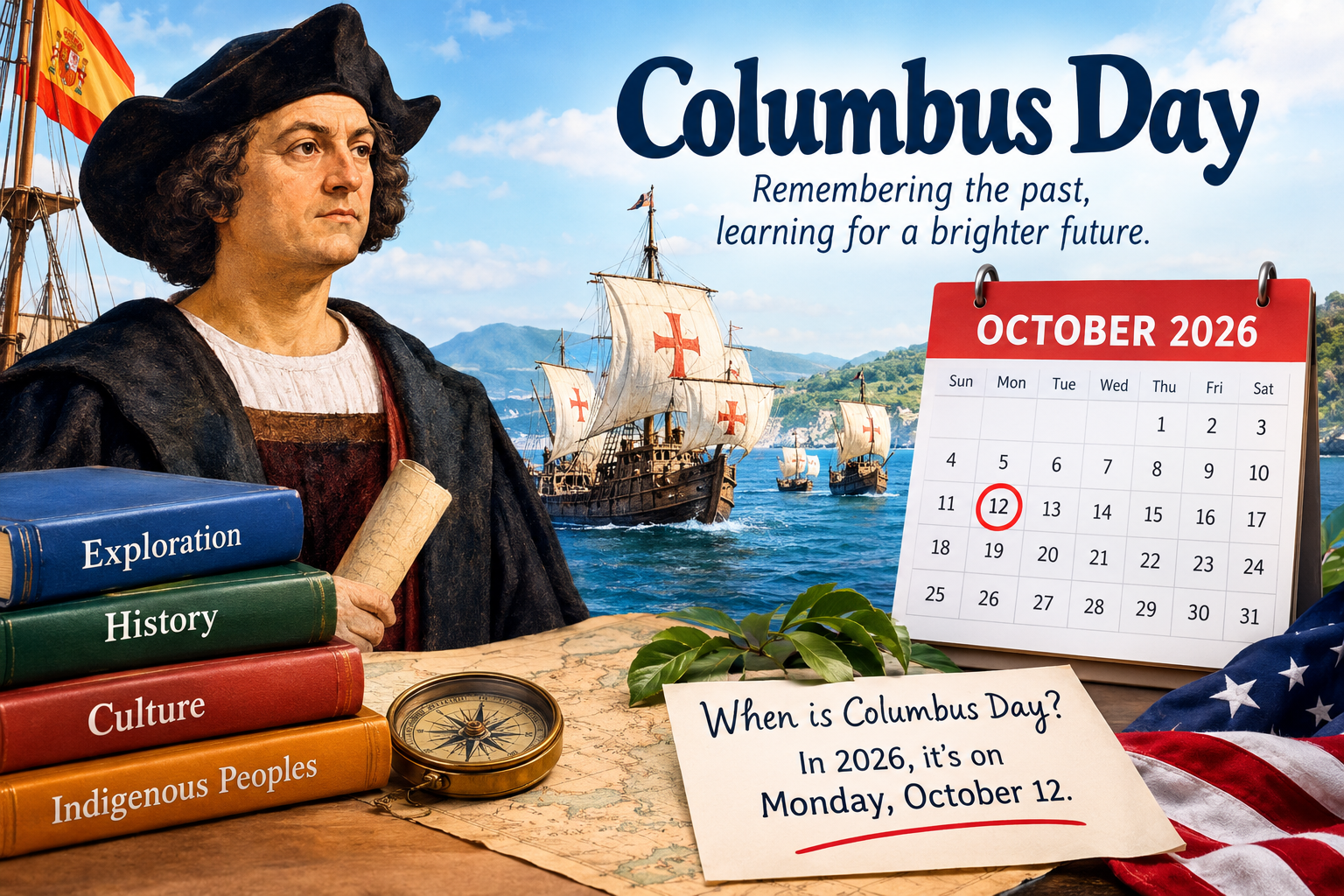

Introduction: When Is Columbus Day?
When is Columbus Day? In the United States, Columbus Day is observed on the second Monday of October every year. In 2026, Columbus Day falls on Monday, October 12, 2026. It is a federal holiday that remembers Christopher Columbus and his historic voyage across the Atlantic Ocean in 1492.
Many people look up when is Columbus Day to find out whether banks, government offices, schools, and businesses will close. Others want to learn about the history of the holiday, its meaning, and the reasons why some communities observe Indigenous Peoples’ Day instead.
Columbus Day has a long history in the United States. For many Italian Americans, it represents cultural pride and recognition of their heritage. At the same time, the holiday has become part of a wider discussion about Native American history, European exploration, and the effects of colonization.
Understanding this holiday helps readers see why it remains important and why people observe it in different ways. Whether you’re planning your October schedule or researching American history, this guide explains the essential facts in simple language.
When Is Columbus Day in 2026?
Columbus Day will be celebrated on Monday, October 12, 2026. The date follows the federal rule that places the holiday on the second Monday in October.
According to the U.S. Office of Personnel Management, Columbus Day is included in the official federal holiday calendar. The same date is also listed in the federal government’s holiday information.
Here are the key details:
| Holiday information | Details |
|---|---|
| Holiday name | Columbus Day |
| Date in 2026 | Monday, October 12 |
| Month | October |
| Day of the week | Monday |
| Frequency | Every year |
| Federal holiday in the United States | Yes |
| Annual date rule | Second Monday in October |
| Related observance | Indigenous Peoples’ Day in many communities |
If you’re planning a trip, arranging a bank visit, or scheduling work, it’s a good idea to check local opening hours before the holiday. Although many federal offices close, private businesses and local institutions may follow different schedules.
When Is Columbus Day in Future Years?
The date of Columbus Day changes each year because it is based on the weekday rather than a fixed date on the calendar.
The holiday always falls on the second Monday in October. This makes it easy to identify once you know the rule.
| Year | Columbus Day date | Day |
|---|---|---|
| 2026 | October 12 | Monday |
| 2027 | October 11 | Monday |
| 2028 | October 9 | Monday |
| 2029 | October 8 | Monday |
| 2030 | October 14 | Monday |
| 2031 | October 13 | Monday |
| 2032 | October 11 | Monday |
| 2033 | October 10 | Monday |
| 2034 | October 9 | Monday |
| 2035 | October 8 | Monday |
These dates follow the second-Monday rule. As a result, Columbus Day can occur anywhere from October 8 through October 14.
Why Does the Date Change Every Year?
Some holidays, such as Christmas, always fall on the same calendar date. Columbus Day works differently.
Instead of being fixed on October 12, the holiday is observed on the second Monday of October. This creates a predictable weekday holiday while allowing the calendar date to change.
For example, October 12 is Columbus Day in 2026, but the holiday falls on October 11 in 2027. In 2028, it moves to October 9.
What Is Columbus Day?
Columbus Day is a federal holiday in the United States associated with Christopher Columbus’s 1492 voyage across the Atlantic.
Columbus was a navigator sailing under the Spanish Crown. His expedition crossed the Atlantic and reached islands in the Caribbean. His voyages helped establish lasting contact between Europe and the Americas, followed by major changes in trade, migration, politics, and society.
The holiday developed over time as a way to recognize Columbus and, particularly, the contributions and heritage of Italian Americans.
However, the meaning of Columbus Day is not the same for everyone. Some people focus on exploration, cultural identity, and historical traditions. Others emphasize the suffering that European colonization brought to Indigenous peoples.
These different perspectives are important when learning about the holiday. History involves understanding both major events and the experiences of the people affected by them.
Who Was Christopher Columbus?
Christopher Columbus was an explorer born in the Republic of Genoa, in what is now Italy. He lived during the late fifteenth and early sixteenth centuries, when European kingdoms were searching for new sea routes to trade with Asia.
Columbus believed he could reach Asia by sailing west across the Atlantic. In 1492, he received support from King Ferdinand II and Queen Isabella I of Spain.
He departed with three ships commonly known as the Niña, the Pinta, and the Santa María. After crossing the Atlantic, his expedition reached an island in the Caribbean on October 12, 1492.
Columbus believed he had reached parts of Asia, but the lands he encountered were part of a region already inhabited by Indigenous peoples for thousands of years.
Why Is Columbus Important in History?
Columbus’s voyages contributed to lasting connections between Europe and the Americas. These connections changed the world in many ways.
Important consequences included:
- Increased travel between Europe and the Americas.
- New trade routes and commercial networks.
- The movement of crops, animals, and people between continents.
- European settlement and the expansion of colonial empires.
- Severe harm to Indigenous communities through disease, forced labor, violence, and the loss of land.
The historical impact was complex. Although Columbus is remembered for his voyages, his expeditions also formed part of a colonial process that caused profound suffering among Indigenous populations.
Understanding these facts provides a fuller picture than viewing his journey only as an adventure.
The History of Columbus Day in America
Columbus Day did not become a national holiday immediately after Columbus’s voyage. Its development took place over several centuries.
Early Celebrations
One of the earliest recorded Columbus Day celebrations in the United States took place in New York City in 1792. The event marked the 300th anniversary of Columbus’s arrival in the Caribbean.
During the nineteenth century, Italian American communities increasingly used Columbus celebrations to recognize their heritage and contributions to American society.
For many Italian immigrants, these events provided a way to celebrate their cultural identity at a time when immigrants sometimes faced prejudice and discrimination.
The 1892 Anniversary
The 400th anniversary of Columbus’s voyage brought renewed attention to his place in American history.
President Benjamin Harrison issued a proclamation encouraging Americans to observe the anniversary. Schools, communities, and civic organizations held educational programs and other activities.
The anniversary helped make Columbus a more familiar figure in public celebrations across the country.
Columbus Day Becomes a Federal Holiday
In 1934, Congress established a federal basis for the annual observance, with a presidential proclamation designating Columbus Day. Later, legislation changed the observance to the second Monday in October.
The Monday-based schedule became effective through federal legislation in 1971.
Today, Columbus Day remains on the list of federal holidays, although the way it is observed varies across states, cities, schools, and workplaces.
Why Is Columbus Day Celebrated?
Columbus Day is observed for historical, cultural, and social reasons. Its importance depends partly on the community and its traditions.
Celebrating Italian American Heritage
For many Italian Americans, Columbus Day has served as a symbol of cultural pride.
Italian American organizations have organized parades, public gatherings, and educational activities to recognize Italian heritage and the achievements of Italian Americans.
These celebrations may include traditional food, music, community events, and speeches about the contributions of Italian Americans to the United States.
Remembering an Important Historical Event
The holiday also draws attention to Columbus’s 1492 voyage and the period of exploration that followed.
Teachers, historians, and museums may use the occasion to discuss the Age of Exploration, Atlantic travel, European empires, and the connections that developed between continents.
Understanding American History
Columbus Day can also encourage people to examine how national holidays develop and change over time.
Public celebrations often reflect the values and concerns of the period in which they were created. As communities learn more about the past, they may reconsider how historical figures should be remembered.
That process is part of studying history thoughtfully.
Is Columbus Day a Federal Holiday?
Yes. Columbus Day is a federal holiday in the United States.
Federal holidays are recognized under federal law and affect the operating schedules of many government offices. However, a federal holiday does not automatically mean that every school, store, employer, or private company must close.
The U.S. government lists Columbus Day as the second Monday in October on its official holiday calendar.
What Does a Federal Holiday Mean?
A federal holiday generally means that federal government offices and many federal employees observe a day off, subject to applicable work schedules and exceptions.
Other organizations make their own decisions about holiday operations.
For example:
- Federal offices commonly close.
- Some banks close or provide limited services.
- Many private businesses remain open.
- Schools may follow district-specific calendars.
- State and local government offices may have different arrangements.
If you need an appointment or a particular service, check the organization’s official website or contact its office directly.
Are Banks Open on Columbus Day?
Many traditional bank branches close on Columbus Day because it is a federal banking holiday. However, the exact arrangements can vary by bank and location.
Even when a branch is closed, customers may still be able to use online banking, mobile banking, and ATMs.
Banking Services to Check
Before visiting a bank on October 12, 2026, consider checking:
- Whether your local branch will be open.
- Whether customer service is available by telephone.
- Whether mobile and online transfers will work normally.
- Whether deposits or payments will be processed on the holiday or the next business day.
Some transactions may take longer to settle when banks are closed. If a payment is urgent, arranging it before the holiday can help prevent delays.
Is the Stock Market Open on Columbus Day?
The major U.S. stock exchanges, including the New York Stock Exchange and Nasdaq, generally remain open on Columbus Day.
This is an important distinction because financial markets do not all follow the same holiday schedule.
In 2026, the stock market is scheduled to operate during its regular trading hours on Monday, October 12. Bond markets, however, generally observe the holiday and close.
Investors should check the official exchange calendar and relevant financial institution schedules before making plans.
Stock Market Versus Bond Market
| Financial service | Typical Columbus Day schedule |
|---|---|
| New York Stock Exchange | Open |
| Nasdaq | Open |
| Bond markets | Generally closed |
| Traditional bank branches | Many close |
| Online investment accounts | Usually accessible, subject to provider services |
Market schedules can affect the timing of settlements and certain financial transactions. If you trade or manage investments, always verify the applicable calendar.
Are Schools Closed on Columbus Day?
School schedules vary across the United States.
Some public schools close for Columbus Day or Indigenous Peoples’ Day. Others remain open and use the day for normal lessons or special educational activities.
Private schools and colleges may follow their own calendars.
How to Check Your School Schedule
If you are a student, parent, or teacher, the easiest way to confirm the schedule is to:
- Visit the school’s official website.
- Review the academic calendar.
- Check messages from the school district.
- Contact the school office if the schedule is unclear.
Don’t assume that every school observes the holiday in the same way. Local policies can differ even between neighboring districts.
Are Post Offices Open on Columbus Day?
The United States Postal Service generally observes Columbus Day as a federal holiday.
Regular retail counter services and ordinary mail delivery may be suspended on the holiday, although some self-service facilities and online services can remain available.
Private delivery companies may follow different schedules.
If you’re expecting an important letter or package, check the tracking information and the delivery company’s holiday calendar. This can help you plan around possible delays.
Columbus Day and Indigenous Peoples’ Day
One of the most important aspects of the modern discussion about Columbus Day is its relationship with Indigenous Peoples’ Day.
Indigenous Peoples’ Day recognizes the history, cultures, communities, and contributions of Indigenous peoples. It also encourages greater awareness of the harm caused by colonization.
Many cities, states, schools, and organizations observe Indigenous Peoples’ Day on the same Monday as Columbus Day. Some recognize one name, while others acknowledge both.
Why Do Some Communities Observe Indigenous Peoples’ Day?
Indigenous communities lived throughout the Americas long before Columbus arrived in the Caribbean in 1492.
Following European arrival, colonization brought major changes to Indigenous societies. Many communities experienced the loss of land, violence, forced labor, displacement, and devastating diseases.
Supporters of Indigenous Peoples’ Day believe the observance provides an opportunity to recognize Indigenous history and culture and to remember experiences that were often left out of traditional accounts of Columbus.
The observance also highlights the continued presence and contributions of Indigenous peoples today.
Are Columbus Day and Indigenous Peoples’ Day the Same Holiday?
They are related in timing, but their main purposes differ.
| Columbus Day | Indigenous Peoples’ Day |
|---|---|
| Focuses on Columbus’s voyages and historical legacy. | Focuses on Indigenous peoples, cultures, and histories. |
| Has longstanding connections with Italian American heritage. | Highlights Indigenous communities and their experiences. |
| Is a federal holiday under U.S. law. | Is recognized by many states, cities, and institutions, with recognition varying by location. |
| May be marked by parades and cultural events. | May include cultural gatherings, educational programs, and community events. |
Some communities observe both holidays, while others have replaced Columbus Day celebrations with Indigenous Peoples’ Day.
These differences reflect ongoing conversations about history, cultural identity, and public recognition.
How Is Columbus Day Celebrated?
Columbus Day celebrations vary widely throughout the United States. In some places, it is a quiet public holiday. In others, it is marked by large community events.
Parades and Public Events
Some cities organize parades featuring marching bands, community groups, cultural organizations, and Italian American associations.
These events can bring residents together and provide opportunities to celebrate family traditions and cultural heritage.
Cultural Activities
Communities may organize Italian food festivals, music performances, art exhibitions, and educational programs.
These activities often celebrate Italian American contributions to business, education, the arts, public service, and community life.
Educational Programs
Schools and museums may use the holiday to discuss Columbus, the Age of Exploration, Indigenous history, and the development of the United States.
A balanced educational program can explain why Columbus’s voyages were historically important while also examining the consequences of colonization.
Community Service
Some people choose to mark the holiday through volunteering, visiting museums, supporting cultural organizations, or attending local events.
There is no single required way for individuals to spend the day. People can use it as an opportunity to learn, reflect, or participate in community activities.
Interesting Facts About Columbus Day
Here are several useful facts that help explain the holiday.
- It falls on a Monday: Columbus Day is observed on the second Monday in October.
- The date changes each year: The holiday can fall between October 8 and October 14.
- The first U.S. celebration dates to 1792: New York City held an observance marking the 300th anniversary of Columbus’s voyage.
- It became a federal holiday in 1934: Federal legislation established the annual observance.
- The Monday schedule began in 1971: The federal observance moved to the second Monday in October.
- Not everyone celebrates it in the same way: Some communities observe Indigenous Peoples’ Day instead, while others recognize both.
- It does not close every business: Private companies and schools decide their own schedules.
- The stock market usually stays open: Major U.S. stock exchanges generally trade on Columbus Day.
These facts show that the holiday is more than a date on the calendar. It reflects a long history of public celebrations and changing views about the past.
How to Plan for Columbus Day 2026
If you’re planning activities for Monday, October 12, 2026, a little preparation can make the holiday easier to manage.
Check Opening Hours
Confirm the opening hours of banks, government offices, schools, libraries, and other services you plan to visit.
Plan Payments Early
If you need a bank transfer, bill payment, or other time-sensitive financial service, check whether the holiday will affect processing.
Confirm Travel Arrangements
Public transportation and private travel services may follow different schedules. Check the relevant timetable if you’re traveling that day.
Look for Local Events
Search for official city announcements, museums, community organizations, and cultural centers to find events in your area.
Learn About Different Historical Perspectives
You can also use the holiday to explore historical sources, visit a museum, or read about Indigenous communities and Italian American history.
Taking time to learn about different perspectives can help you understand why the holiday remains a subject of public discussion.
Frequently Asked Questions About When Is Columbus Day
When is Columbus Day in 2026?
Columbus Day in 2026 is Monday, October 12. It falls on the second Monday in October.
Is Columbus Day always on October 12?
No. Columbus Day is observed on the second Monday in October, so the calendar date changes each year. October 12 is the date in 2026, but other years have different dates.
Is Columbus Day a national holiday?
It is a federal holiday in the United States. Federal offices generally observe it, but not every state, school, private business, or employer follows the same closing schedule.
Why is Columbus Day celebrated in October?
October is connected to the anniversary of Columbus’s arrival in the Caribbean on October 12, 1492. The modern U.S. holiday is observed on the second Monday in October rather than always on the anniversary date.
Do all states celebrate Columbus Day?
No. State and local recognition varies. Some states and cities observe Columbus Day, some recognize Indigenous Peoples’ Day, and others acknowledge both.
Is Indigenous Peoples’ Day on the same date?
In many communities, yes. Indigenous Peoples’ Day is often observed on the second Monday in October, the same date as Columbus Day. However, recognition and local practices vary.
Are banks closed on Columbus Day 2026?
Many traditional bank branches are expected to close on Monday, October 12, 2026. Check your bank’s official holiday schedule for confirmation.
Is the U.S. stock market closed on Columbus Day?
No. Major U.S. stock exchanges generally remain open on Columbus Day. Bond markets typically close, so investors should check the relevant financial calendar.
Is mail delivered on Columbus Day?
The U.S. Postal Service generally observes Columbus Day as a holiday, and regular mail delivery may be suspended. Private delivery companies may follow different schedules.
Why is Columbus Day controversial?
Some people value the holiday as a celebration of exploration and Italian American heritage. Others believe it overlooks the suffering Indigenous peoples experienced during European colonization. Indigenous Peoples’ Day provides an alternative focus on Indigenous histories, cultures, and contributions.
Conclusion: When Is Columbus Day?
When is Columbus Day? In 2026, it falls on Monday, October 12, following the rule that the holiday is observed on the second Monday of October each year.
Columbus Day is a federal holiday with a long history in the United States. It is connected to Christopher Columbus’s 1492 voyage, Italian American cultural heritage, and the development of public holiday traditions. At the same time, its meaning continues to change as communities recognize Indigenous history and consider the effects of colonization.
If you’re planning your October schedule, remember to check the opening hours of banks, schools, government offices, and local businesses. If you’re researching the holiday, consider exploring both the history of Columbus’s voyages and the experiences of Indigenous peoples.
Ultimately, understanding when is Columbus Day is only the beginning. Learning why the holiday exists, how it is observed, and why its meaning differs across communities offers a more complete view of American history and the many people whose experiences have shaped it.
Why Do People Search for When Is Columbus Day?
Many people search for when is Columbus Day because they want to prepare for a federal holiday, plan a trip, or find out whether their workplace or school will be closed. The date also matters to people who want to attend community celebrations or learn more about American history.
Columbus Day falls on the second Monday in October. In 2026, it is observed on October 12. However, the way people recognize the holiday depends on where they live and which traditions their communities follow.
Some people celebrate Italian American heritage, while others use the day to learn about Indigenous history. Both perspectives are part of the wider conversation about how the United States remembers its past.
What Happened on October 12, 1492?
October 12, 1492, is commonly associated with Christopher Columbus’s arrival in the Caribbean. Columbus was leading an expedition supported by Spain and hoped to reach Asia by sailing west across the Atlantic Ocean.
After weeks at sea, his expedition reached an island in the Caribbean. The island is commonly identified with Guanahani, known today by the name San Salvador in the Bahamas, although historical debates remain about its exact identification.
The region was already home to Indigenous peoples with their own languages, cultures, communities, and traditions. Columbus did not discover an uninhabited continent. Instead, his voyage began a new period of sustained contact between Europe and the Americas.
This contact changed global history. Trade expanded, crops and animals moved between continents, and European powers established colonies. However, colonization also brought violence, disease, forced labor, and the loss of land for many Indigenous communities.
Learning about these events helps explain why Columbus’s legacy is viewed differently by different people today.
How Columbus Day Became a Public Holiday
Columbus Day developed gradually rather than becoming a nationwide holiday immediately after the 1492 voyage.
An early American celebration took place in New York City in 1792, marking the 300th anniversary of Columbus’s voyage. Over time, Italian American communities helped make the celebration more widely recognized.
In 1892, the 400th anniversary received national attention. President Benjamin Harrison encouraged Americans to mark the occasion with educational and patriotic activities.
In 1934, federal legislation established Columbus Day as an annual federal observance. Later, the Uniform Monday Holiday Act moved the observance to the second Monday in October, beginning in 1971.
Today, the holiday remains part of the federal calendar, but its local recognition varies.
Is Columbus Day a Paid Holiday?
Columbus Day is a federal holiday, but that does not mean every worker automatically receives a paid day off.
Federal employees generally follow the applicable federal holiday schedule. Private employers, however, usually determine their own holiday policies, subject to relevant employment laws and agreements.
Before making plans, workers should check their employee handbook or ask their human resources department.
Here are a few things to remember:
- Federal government offices generally close.
- Private businesses may remain open.
- Some employers provide paid leave, while others do not.
- Essential services may continue operating.
- Local government employees may follow state or municipal rules.
Knowing your workplace policy can help you plan your schedule without confusion.
What Can Families Do on Columbus Day?
Columbus Day can provide an opportunity for families to spend time together and explore history. Even if local businesses follow normal hours, families can plan educational and enjoyable activities.
Visit a Museum
History museums may offer exhibits about exploration, migration, Indigenous communities, and the development of the United States. Check the museum’s official website before visiting because holiday opening hours vary.
Explore Italian American Culture
Families interested in Italian American heritage can learn about traditional food, music, art, and community history. Local cultural organizations may arrange public programs or celebrations.
Learn About Indigenous History
Reading books by Indigenous authors or exploring resources from Indigenous cultural organizations can provide a deeper understanding of the peoples who lived in the Americas before European arrival.
Enjoy Outdoor Activities
A walk in a park, a picnic, or a visit to a local attraction can also make the holiday enjoyable. October weather varies across the country, so checking the local forecast is a sensible step.
Create a Family History Project
Children can make a timeline, draw historical maps, or compare different accounts of Columbus’s voyages. These activities encourage curiosity and help young learners understand that historical events can affect different groups in different ways.
Columbus Day Around the United States
The holiday is not observed identically in every state or city. Local governments, schools, and cultural organizations may choose different names and activities.
In some places, Columbus Day remains the main official observance. Other communities recognize Indigenous Peoples’ Day, and some recognize both.
The difference often reflects local history, community priorities, and decisions made by state or local authorities.
If you are traveling within the United States, do not assume that every city will host a Columbus Day parade or that every public office will follow the same schedule. Check local announcements for accurate information.
Is Columbus Day the Same as Indigenous Peoples’ Day?
No. Although both observances often fall on the second Monday in October, they emphasize different aspects of history.
Columbus Day is associated with Christopher Columbus’s voyages and has a longstanding connection to Italian American heritage.
Indigenous Peoples’ Day recognizes Indigenous peoples, their cultures, their histories, and their continuing contributions. It also encourages people to learn about the consequences of European colonization.
Some communities observe both holidays. Others have replaced Columbus Day with Indigenous Peoples’ Day as their official local observance.
Understanding the difference helps explain why the October holiday can have different meanings across the country.
How to Find Accurate Columbus Day Information Online
If you want to confirm when is Columbus Day or check whether a service will be open, use reliable sources rather than depending only on social media posts.
Useful sources include:
- USA.gov: Federal holiday information.
- U.S. Office of Personnel Management: Official federal employee holiday schedules.
- Your local school district: School calendars and closures.
- Your bank’s official website: Branch opening hours and transaction information.
- Your city or state government website: Local holiday observances and public events.
- The official website of a museum or event organizer: Event dates, tickets, and opening hours.
Always check the year because the calendar date changes. For 2026, Columbus Day is Monday, October 12.
Final Thoughts on When Is Columbus Day
When is Columbus Day? In 2026, the holiday falls on Monday, October 12. It is observed on the second Monday in October and remains a federal holiday in the United States.
The holiday has connections to Columbus’s 1492 voyage, Italian American heritage, and the history of public celebrations. It is also part of an ongoing discussion about Indigenous peoples and the effects of colonization.
Whether you are checking work schedules, planning family activities, or researching American history, use trustworthy sources to confirm the information you need. By learning about the holiday’s background and the different ways it is observed, readers can gain a clearer understanding of its place in modern American society.
Discover more insightful articles, helpful updates, and engaging stories on Leo ART News, and stay connected with the latest information. For more details, Contact Us.