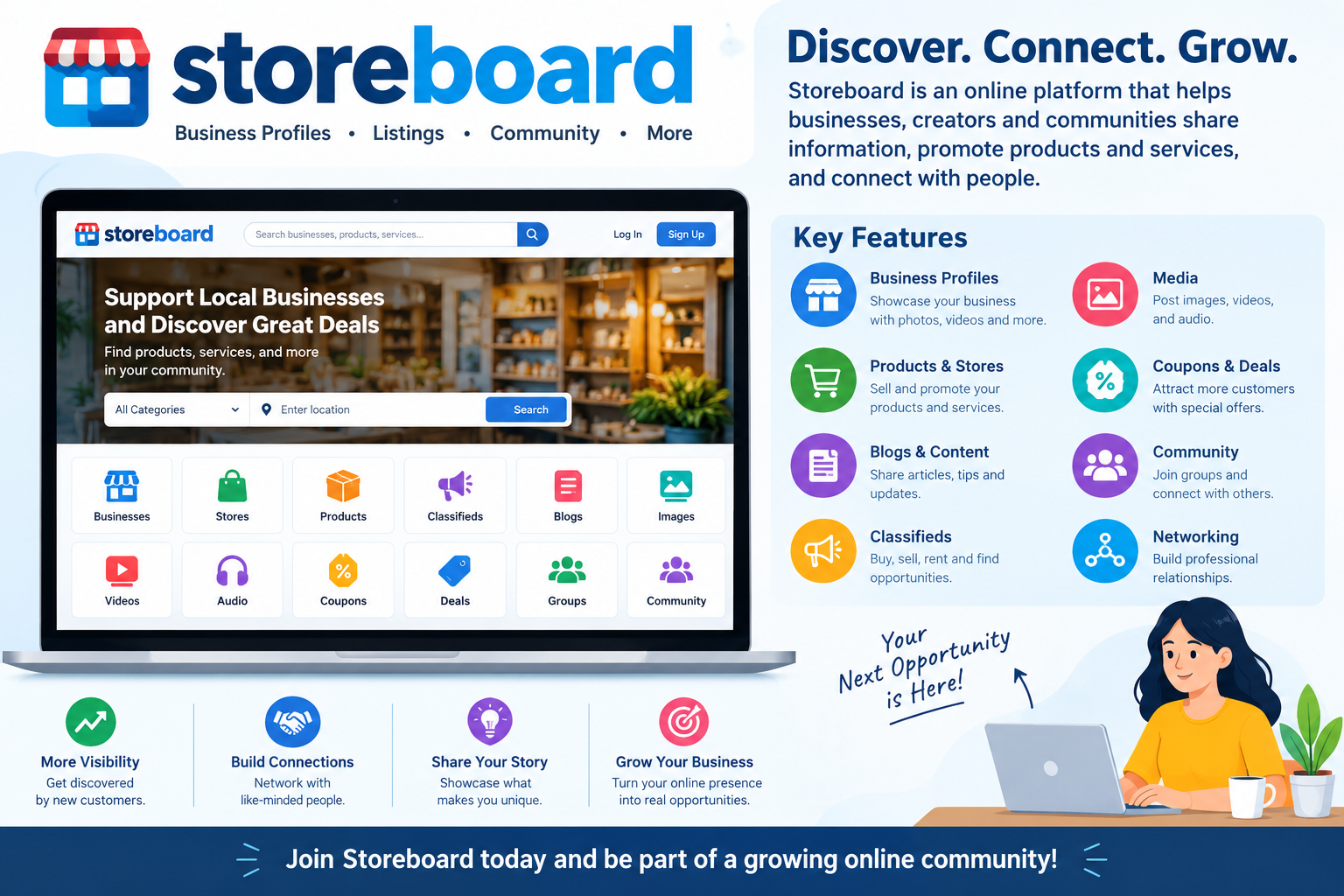

storeboard is an online platform designed to help businesses, organizations, creators, and community members build an online presence, share information, promote products and services, and connect with other people. Unlike a simple business directory, Storeboard brings several functions together, including business profiles, products, stores, blogs, images, videos, coupons, deals, classifieds, community features, and networking tools.
For a small business owner, getting noticed online can sometimes feel like trying to stand out in a very crowded street. A company may have excellent products and friendly service, yet potential customers might never discover it. Platforms such as Storeboard can provide another place where a business can present its information and connect with potential customers.
Storeboard describes itself as a networking site where businesses can create profile pages containing information such as contact details, photos, videos, blogs, audio, coupons, products, and website links. It also offers classified listings and other community-focused features.
This guide explains what Storeboard is, how it works, what businesses can do with it, how its different sections fit together, and what users should consider before using the platform.
What Is Storeboard?
Storeboard is an online business and social networking platform that combines several types of online services in one place. The platform is particularly focused on helping businesses establish an online presence and share promotional or informational content.
According to Storeboard’s official information, a business can create a profile and use it to display different kinds of media and business information. These can include products, services, photos, videos, blogs, coupons, audio, and links.
The platform also contains areas for:
- Businesses
- Stores
- Products
- Classifieds
- Blogs
- Images
- Videos
- Audios
- Coupons
- Deals
- Community content
- Groups
- Networks
- Local information
This combination gives Storeboard a broader purpose than a traditional directory.
A simple business directory might mainly show a business name, phone number, address, and website. Storeboard’s approach allows businesses to add more types of content to their online presence.
That’s useful because customers often want more than a phone number. They may want to see products, read information, watch videos, view images, or understand what a company actually offers.
How Storeboard Works
The basic idea behind storeboard is fairly straightforward.
A business or member creates a presence on the platform and adds useful information. That information can then be organized into different sections and discovered by other users.
For example, imagine a local bakery.
The bakery could potentially use its online presence to share:
- Business information
- Opening details
- Product information
- Photos of cakes
- Videos
- Special offers
- Coupons
- Blog posts
- Website links
- Classified advertisements
- Community information
Instead of keeping every piece of information on a separate page or service, the business can bring different types of content together.
Storeboard also organizes content by categories and locations, making it possible for users to search for businesses and other types of media based on different factors.
Storeboard for Small Businesses
Small businesses are an important part of Storeboard’s purpose.
A large company may have a marketing team, professional designers, advertising specialists, and a large budget. A small business owner might be handling everything alone.
That’s where affordable online tools can become useful.
A small business could use storeboard as another digital channel for presenting its brand.
For example, a local:
- Restaurant
- Photographer
- Plumber
- Clothing shop
- Real estate business
- Repair service
- Consultant
- Beauty salon
- Contractor
- Online seller
could create an online presence and publish relevant information.
Storeboard’s official materials say the platform is designed to help businesses gain online exposure and provide tools for advertising, networking, and commerce.
Of course, creating a profile doesn’t automatically guarantee customers. The quality of the information, the usefulness of the content, the business itself, and the way the profile is maintained all matter.
Storeboard Business Profiles
A business profile is one of the central features of the platform.
A useful profile should give visitors a clear idea of what the business does.
Important information can include:
| Profile Element | Purpose |
|---|---|
| Business name | Identifies the company |
| Description | Explains what the business offers |
| Contact details | Helps customers get in touch |
| Photos | Shows products, services, or locations |
| Videos | Provides visual information |
| Products | Displays items for customers |
| Services | Explains available services |
| Website link | Sends visitors to the main website |
| Blog content | Provides useful information |
| Coupons | Can highlight special offers |
| Location | Helps people discover local businesses |
Storeboard’s profile features are designed to support different forms of business content rather than relying only on a short text description.
A complete profile can also make it easier for visitors to understand a company before contacting it.
For example, if someone searches for a local photographer, they may want to see examples of previous work before making a decision. Images and other media can provide that context.
Storeboard and Online Business Promotion
Online promotion is about making people aware of a business, product, service, or idea.
Storeboard provides several features that can support this goal.
Businesses can publish different forms of content and connect that content with their profiles. Storeboard’s platform materials describe features involving blogs, images, videos, products, audio, deals, coupons, classified advertisements, PDFs, links, and groups.
This gives businesses multiple ways to communicate.
For instance, a clothing business could publish a product listing, add photographs, write a blog post about seasonal fashion, and provide a special deal.
A service provider could explain its services, publish useful articles, share photographs of completed work, and link visitors to its website.
In other words, content doesn’t have to be limited to advertisements.
Helpful information can also attract attention.
Storeboard Classifieds
The classified section is another major part of the platform.
Storeboard’s current classifieds include categories covering areas such as products for sale, property, vehicles, services, events, jobs, tickets, pets and animals, and community listings.
The wide range of categories means users can find different kinds of advertisements in one place.
For example, classified sections include areas for:
- Cars
- Boats
- Apartments
- Homes
- Jobs
- Services
- Electronics
- Clothing
- Furniture
- Pets
- Events
- Tickets
- Business opportunities
- Community activities
This makes the platform relevant not only to businesses but also to people looking for products, services, opportunities, or community information.
When creating a classified listing, clarity is important.
A good listing should normally explain:
- What is being offered
- Important features
- Condition, when relevant
- Location
- Contact method
- Useful photographs
- Any important terms
Avoid making claims that cannot be supported. Honest descriptions help create trust.
Storeboard Stores and Products
Storeboard also includes sections for stores and products.
This can be useful for businesses that want to showcase what they sell online.
A product listing can provide customers with important information before they visit a website or contact the seller.
Depending on the type of business, product content might include:
- Product name
- Description
- Photographs
- Category
- Price information
- Website or checkout link
- Related content
Storeboard’s official platform information describes ways for members to add products and connect product pages with external websites, landing pages, or checkout pages.
For a small business, this can create another path between discovery and purchase.
However, users should always check the current platform rules and available features before relying on any specific selling or payment function.
Storeboard for Content Creators
Storeboard isn’t limited to traditional businesses.
Its platform includes blogs, images, videos, audio, and community features, making it useful for people who want to share different forms of content.
A content creator might use the platform to publish:
- Educational articles
- Business advice
- Photography
- Videos
- Industry information
- Product information
- Community posts
- Creative work
This can help creators build a collection of content around a particular subject.
For example, a photographer could publish images and articles about photography. A marketing consultant could share business tips. A local organization could publish community announcements.
The key is consistency.
Posting one article and disappearing for six months probably won’t create the same effect as regularly publishing useful information.
Storeboard and Local Discovery
Location can be important for businesses.
A restaurant doesn’t only need people who are interested in food. It needs people who can actually visit or order from it.
The same is true for many local service providers.
Storeboard supports searching and organizing content by location and category, according to its platform information.
This can help users discover businesses and other content connected with particular places.
For example, a person searching for a service in a specific city may be interested in:
- Local restaurants
- Repair companies
- Hotels
- Shops
- Contractors
- Professional services
- Events
- Community groups
Location-based information can make an online directory more practical because it connects digital information with real-world needs.
Storeboard and SEO
Search engine optimization, commonly called SEO, is the process of improving online content so that search engines can understand and potentially display it for relevant searches.
Storeboard can be part of a broader online marketing strategy, but it shouldn’t be treated as a magic SEO solution.
A business profile may provide another online location where business information, content, links, products, and media can be presented.
Good SEO practices include:
- Writing clear descriptions
- Using relevant words naturally
- Keeping business information accurate
- Publishing useful content
- Avoiding keyword stuffing
- Using descriptive titles
- Providing helpful links
- Keeping information updated
The goal should be to help real people first.
If a profile is stuffed with repeated keywords but provides little useful information, visitors may quickly lose interest.
Good content should sound natural.
After all, people are reading it—not search engines alone.
Storeboard for Community Engagement
Storeboard also includes community-oriented sections.
Its current platform includes community categories such as activities, artists, childcare, classes, connections, groups, local news, musicians, volunteers, and other community topics.
This means the platform can serve purposes beyond direct commercial advertising.
Community members might use online spaces to:
- Share local information
- Promote activities
- Discover events
- Find groups
- Connect around interests
- Share announcements
- Promote volunteer opportunities
For local businesses, community participation can also help create a more human online presence.
A business isn’t just a logo or product catalog. It’s often part of a neighborhood or community.
Storeboard and Social Networking
Storeboard describes itself as a social networking site and combines social functions with directory, marketplace, product, and classified features.
This combination is one of the platform’s distinguishing ideas.
Traditional directories generally focus on finding businesses.
Social networks focus more on people, content, conversations, and connections.
Marketplaces focus on products.
Classified websites focus on advertisements.
Storeboard attempts to bring several of these ideas together.
Its platform materials also describe features for groups, member engagement, sharing content, and business networking.
For users, this means they can potentially discover business information while also exploring content and community activity.
Storeboard Platform for Organizations
Storeboard also offers a platform product aimed at organizations that want to create customized online communities.
Its official platform page says the Storeboard Platform can be customized for directories, shopping centers, malls, publications, and other organizations. It combines social, directory, product, and classified functions.
This is different from simply creating an individual business profile.
An organization could potentially use such a platform to build a larger online environment containing:
- Multiple businesses
- Locations
- Categories
- Products
- Community features
- Media
- Classified listings
- Advertising options
The platform page also describes customization of branding, search parameters, membership options, and administrative tools.
This shows that Storeboard isn’t only intended as a consumer-facing website; it also offers technology for organizations that want a broader directory or community system.
How Businesses Can Make a Useful Storeboard Profile
Creating a profile is only the first step.
The next challenge is making it useful.
Start with accurate information.
A profile should clearly communicate:
Who are you?
Explain the business.
What do you offer?
Describe products and services.
Where are you located?
Provide useful location information when appropriate.
How can people contact you?
Give a reliable contact method.
Why should visitors learn more?
Use useful content, images, products, or service information.
A good profile should be easy to understand.
Avoid long paragraphs filled with complicated words. Customers generally want answers quickly.
Use short sections, descriptive headings, and clear information.
Benefits and Limitations of Storeboard
Like any online platform, storeboard has potential benefits as well as practical limitations.
| Area | Potential Benefit | Important Consideration |
|---|---|---|
| Business profile | Gives a business another online presence | Information should stay updated |
| Classifieds | Supports different listing categories | Listings need clear descriptions |
| Products | Helps showcase items | Current selling features should be checked |
| Blogs | Allows educational content | Quality matters more than quantity |
| Images and videos | Adds visual information | Media should be relevant |
| Local discovery | Helps organize information by location | Location data must be accurate |
| Networking | Can support business connections | Engagement takes time |
| SEO | Adds another online content location | No platform guarantees search rankings |
| Community | Supports local and interest-based activity | Participation is needed |
| Custom platform | Can support larger directories | Suitable for organizations with broader needs |
The important lesson is that an online platform is a tool, not a guaranteed result.
A strong business still needs good products, good service, honest communication, and effective marketing.
Best Practices for Using Storeboard
If you’re planning to use storeboard, a few simple habits can make your profile more useful.
Keep Information Accurate
Make sure names, descriptions, websites, contact information, and locations are correct.
Use High-Quality Images
Clear images can help visitors understand products and services.
Write Helpful Descriptions
Don’t simply say, “We are the best.”
Explain what you actually provide.
Update Your Content
Old information can reduce trust.
If your business changes its services, location, hours, or products, update the relevant information.
Avoid Spam
Posting the same promotional message repeatedly can make your profile less useful.
Share Useful Information
Educational and helpful content can provide value beyond direct advertising.
Respect Platform Rules
Before publishing content, review Storeboard’s current terms and posting guidelines.
Measure Results
If analytics or tracking tools are available for your account, use them to understand which content receives attention.
Storeboard’s platform information says analytics can be available to members to help measure effectiveness.
Final Thoughts on Storeboard
storeboard is a multi-purpose online platform that brings business profiles, social networking, products, stores, classifieds, blogs, media, community features, and promotional tools together. Its official materials show a strong focus on helping businesses and organizations establish an online presence and connect with customers or communities.
For a small business, the biggest lesson is simple: being online is useful, but being useful online is even better. A complete profile, accurate information, helpful content, relevant images, and clear product or service details can give visitors a better understanding of what a business offers.
At the same time, users should keep realistic expectations. A Storeboard profile is one part of a broader digital strategy. Businesses may also need their own website, social media presence, customer reviews, strong service, and other marketing methods.
Used thoughtfully, storeboard can serve as another online space for businesses, creators, advertisers, and community members to present information, discover opportunities, and connect with people.
Storeboard: Practical Strategies, Content Ideas, and Business Uses
Understanding the Wider Purpose of Storeboard
storeboard can be understood as more than a simple place to publish a business listing. Its broader purpose is to bring business information, content, products, community activity, and online networking into one environment.
For a new business owner, this can be helpful because building an online presence often requires using several different tools. One service may be used for a website, another for classified advertisements, another for business networking, and another for publishing content.
Storeboard brings several of these ideas together.
The platform can be useful for people who want to:
- Promote a business
- Share products
- Publish articles
- Post images
- Share videos
- Create classified listings
- Connect with other users
- Participate in communities
- Promote special offers
- Present professional services
Of course, simply having an account doesn’t guarantee traffic or sales. The real value comes from how thoughtfully the platform is used.
Storeboard for New Businesses
Starting a new business can be exciting—and a little overwhelming.
A new company usually needs to establish its identity before customers become familiar with it. An online profile can provide a place to introduce the business and explain what it offers.
A new business profile might include:
- Company name
- Business description
- Main services
- Products
- Location
- Contact information
- Website
- Images
- Promotional information
- Helpful articles
For example, imagine someone starts a home-cleaning service.
Instead of writing only:
“We provide cleaning services.”
A stronger description could explain the types of cleaning offered, the service area, the customer groups served, and the kinds of spaces the company handles.
Specific information is generally more useful than vague marketing language.
Storeboard for Service-Based Businesses
Not every business sells physical products.
Many businesses sell services, knowledge, skills, or experiences.
Examples include:
- Web designers
- Accountants
- Electricians
- Plumbers
- Photographers
- Tutors
- Consultants
- Fitness trainers
- Repair technicians
- Marketing agencies
For these businesses, photographs, descriptions, articles, and customer-focused information can help explain what the company does.
A photographer, for example, could use images to demonstrate different types of work.
A tutor could publish educational articles.
A repair company could explain common problems and solutions.
This approach turns a basic business profile into a useful information resource.
Storeboard for Product Promotion
Businesses selling products can use product-focused content to give potential customers more information.
A strong product description should answer basic questions.
What Is the Product?
Clearly identify it.
What Does It Do?
Explain its main purpose.
Who Is It For?
Describe the intended customer when relevant.
What Makes It Useful?
Explain practical benefits without making unsupported claims.
Where Can Customers Learn More?
Provide an appropriate website or additional information when available.
Images can also make product information easier to understand.
A clear photograph may tell a customer more than a long paragraph.
Storeboard and Content Marketing
Content marketing involves creating useful information that attracts and helps an audience.
Instead of constantly saying, “Buy our product,” a business can publish information related to the customer’s interests.
For example, a gardening store could publish:
- How to care for indoor plants
- Beginner gardening tips
- Seasonal planting advice
- Common gardening mistakes
- Tools beginners may need
A customer searching for gardening information may discover the article and then learn about the business.
This is a more natural approach to online promotion.
Content should provide genuine value rather than being written only to repeat keywords.
Storeboard Blog Content Ideas
If you’re using the blogging features of storeboard, choosing useful topics is important.
Here are some ideas:
- Beginner guides
- Frequently asked questions
- Product explanations
- Industry tips
- Customer education
- Local information
- Behind-the-scenes stories
- Case studies
- Seasonal advice
- Common mistakes
- How-to guides
For example, a computer repair company could publish:
“How to Tell When Your Laptop Needs Professional Repair”
A local restaurant could publish:
“How We Prepare Fresh Ingredients Each Morning”
A real estate professional could write:
“Things First-Time Home Buyers Should Check Before Making an Offer”
The best topic is often one that answers a real question.
Storeboard and Visual Content
People understand visual information quickly.
That makes images and videos useful parts of online marketing.
A business could use photographs to show:
- Products
- Storefronts
- Workspaces
- Completed projects
- Events
- Team members
- Before-and-after examples
Videos could demonstrate:
- How a product works
- How a service is performed
- A short business introduction
- Customer education
- Product demonstrations
However, visual content should be clear and relevant.
A blurry photograph or unrelated image can make an otherwise professional profile look careless.
Storeboard Classified Advertising
Classified advertising can be useful when you have something specific to offer.
For example:
- A product for sale
- A service
- A job opportunity
- Property
- A vehicle
- An event
- A community activity
A classified advertisement should be direct.
Include the most important details near the beginning rather than hiding them at the bottom.
A useful structure might be:
Title → Description → Main Features → Location → Price Information → Contact Method
Avoid exaggerated claims.
If you’re selling a used product, explain its condition honestly. Transparency can save both the seller and buyer time.
Storeboard for Local Businesses
Local businesses can benefit from making their information easy to understand.
Imagine someone searches for a nearby service.
They may want to know:
- What does the business offer?
- Where is it located?
- What areas does it serve?
- How can I contact it?
- What does the business look like?
- What products or services are available?
A clear profile can answer these questions quickly.
Location-based information is especially important for businesses such as restaurants, repair companies, salons, contractors, stores, and professional services.
Storeboard and Customer Trust
Trust isn’t created by saying, “Trust us.”
It’s created through useful and consistent information.
A professional online profile can support trust when it provides:
- Accurate business details
- Clear descriptions
- Real images
- Helpful content
- Consistent information
- Professional communication
- Easy contact methods
If a business claims to offer ten services but its profile explains only two, visitors may be confused.
Keep information consistent across your online presence.
For example, the business name and website should match the information shown elsewhere whenever possible.
Storeboard and Online Reputation
An online reputation develops over time.
Customers may encounter a business through different channels before deciding whether to contact it.
A business should therefore think about its entire online presence.
This may include:
- Website
- Business directories
- Social media
- Classified platforms
- Review platforms
- Content websites
- Professional networks
Storeboard can be one part of that larger picture.
Don’t depend on a single platform.
If your main website is the center of your online presence, other platforms can support it by providing additional information and discovery opportunities.
Storeboard for Networking
Networking is another possible use.
Business owners can connect with people who have similar interests or complementary services.
For example, a wedding photographer might connect with:
- Event planners
- Florists
- Caterers
- Wedding venues
- Clothing businesses
These relationships could potentially lead to useful professional connections.
Networking works best when it isn’t treated as a one-way sales pitch.
Instead of immediately asking someone to buy something, start by learning about their work and finding common interests.
A helpful relationship can be more valuable than a single advertisement.
Storeboard and Community Groups
Community-based features can help people connect around shared interests.
Possible topics can include:
- Local events
- Education
- Arts
- Music
- Volunteer work
- Hobbies
- Business activities
- Local news
A community group can give users a place to exchange information.
For businesses, participation can also help them become more familiar within their local community.
However, promotional posts should be balanced with useful contributions.
Nobody likes a person who enters a conversation just to advertise.
How to Write a Better Storeboard Description
Writing a business description doesn’t have to be difficult.
Start with the basics.
Sentence one: Say what the business does.
Sentence two: Explain the main products or services.
Sentence three: Mention the customers or area served.
Sentence four: Add something useful or distinctive.
For example:
“We provide residential and commercial cleaning services for homes and offices. Our team handles regular cleaning, deep cleaning, and move-in or move-out services. We serve customers throughout the local area and focus on reliable scheduling and clear communication.”
Notice how the description provides useful information without making dramatic claims.
That’s the goal.
Storeboard and Keyword Use
Keywords can help describe what a business is about, but they should be used naturally.
Suppose a business provides photography services.
Useful phrases might include:
- Wedding photography
- Event photography
- Portrait photography
- Professional photographer
- Local photography services
Don’t repeat the same phrase in every sentence.
For example, this would sound unnatural:
“Our photography service provides photography. We are a photography company offering photography services for photography customers.”
Yikes!
Instead, write naturally.
Search engines and readers both benefit from clear language.
Storeboard and Website Traffic
A business may use online profiles as additional paths toward its main website.
For example, someone might discover a business profile, read the description, view photographs, and then click through to the company’s website.
This is why website information should be clear and current.
Before publishing a website link, check that:
- It works
- It leads to the correct page
- The page loads properly
- The information matches the business profile
Broken links can create a poor user experience.
Storeboard for Professional Branding
Branding is about creating a consistent identity.
Important branding elements include:
- Business name
- Logo
- Colors
- Writing style
- Images
- Description
- Main message
Try to keep these elements consistent across platforms.
If your website uses one business name while your online profile uses a different name, customers may wonder whether they’re looking at the same company.
Consistency makes information easier to recognize.
Storeboard Content Planning
Posting content randomly can make online marketing difficult.
Instead, create a simple content plan.
For example:
| Day | Content Idea |
|---|---|
| Monday | Educational tip |
| Tuesday | Product information |
| Wednesday | Business story |
| Thursday | Helpful article |
| Friday | Special offer |
| Saturday | Image or video |
| Sunday | Community content |
You don’t need to publish every day.
The important thing is to create a schedule you can realistically maintain.
Quality and consistency generally matter more than flooding your profile with posts.
Mistakes to Avoid on Storeboard
A few mistakes can reduce the usefulness of your online presence.
Incomplete Profiles
Leaving important fields blank can make visitors search elsewhere for answers.
Outdated Information
Old phone numbers, addresses, prices, or services can create confusion.
Excessive Promotion
Every post shouldn’t be a sales pitch.
Poor Grammar
Typos can make a business appear less professional.
Low-Quality Images
Use clear and relevant photographs.
Unsupported Claims
Don’t promise results you can’t prove.
Duplicate Content
Repeating identical content everywhere can make your online presence feel unoriginal.
Ignoring Questions
If users can interact with your content, respond professionally and respectfully.
Measuring Your Storeboard Efforts
Marketing becomes easier when you understand what is working.
If available, review relevant analytics or engagement information.
Look for signs such as:
- Profile visits
- Content views
- Clicks
- Messages
- Listing responses
- Product interest
- Website visits
Don’t focus on one number alone.
For example, a page could receive many views but very few inquiries. Another page might receive fewer views but generate more useful leads.
The goal isn’t always maximum traffic.
The goal is meaningful results.
Storeboard for Different Types of Users
Different users can approach the platform in different ways.
| User Type | Possible Use |
|---|---|
| Small business | Business profile and promotion |
| Freelancer | Service presentation |
| Seller | Product and classified listings |
| Blogger | Articles and information |
| Creator | Images, videos, and content |
| Community member | Local activities and groups |
| Organization | Directory and community tools |
| Advertiser | Promotional listings |
This flexibility is one reason the platform can be relevant to different audiences.
Is Storeboard Worth Exploring?
Whether storeboard is useful depends on what you’re trying to accomplish.
If you need another place to present your business, publish content, list products, or participate in online communities, the platform may be worth exploring.
But remember the bigger picture.
A digital marketing strategy shouldn’t depend entirely on one website.
Consider your:
- Main website
- Search presence
- Social media
- Customer service
- Reviews
- Content
- Email marketing
- Local marketing
- Business directories
Each channel can serve a different purpose.
Final Thoughts on Storeboard
storeboard provides a broad collection of tools for businesses, sellers, creators, organizations, and community members. From business profiles and products to blogs, classified listings, images, videos, networking, and community content, the platform offers several ways to establish and expand an online presence.
The smartest approach is to focus on usefulness rather than simply publishing as much content as possible.
Create a complete profile. Use accurate information. Add helpful descriptions. Share relevant media. Keep listings updated. Communicate professionally. Most importantly, give visitors a reason to care about what you’re offering.
When used as part of a wider online strategy, storeboard can become another useful digital channel for presenting information, reaching potential audiences, and building meaningful connections.
Discover more insightful articles, helpful updates, and engaging stories on Leo ART New, and stay connected with the latest information. For more details, Contact Us.