
Introduction
Where is the Cape of Good Hope? The Cape of Good Hope is located on the southwestern coast of South Africa, near the famous city of Cape Town. It lies on the Cape Peninsula in the Western Cape province and forms part of Table Mountain National Park. This remarkable coastal landmark is known for its rocky cliffs, beautiful ocean views, rich maritime history, and diverse wildlife.
For hundreds of years, the Cape of Good Hope has attracted explorers, sailors, scientists, and travelers. Its position near the southern end of Africa made it an important landmark for ships traveling between Europe and Asia. Today, it is one of South Africa’s most recognized natural attractions and a popular destination for people who enjoy sightseeing, hiking, photography, and learning about geography.
However, there is an interesting fact that many people don’t know: the Cape of Good Hope isn’t the southernmost point of Africa. That title belongs to Cape Agulhas, which lies farther southeast. Even so, the Cape of Good Hope remains famous because of its historical importance, dramatic landscape, and connection to the development of international sea travel.
Whether you’re a student researching world geography or a traveler planning a visit to South Africa, this guide explains the cape’s location, history, natural environment, and visitor attractions in simple and helpful language.
Where Is the Cape of Good Hope Located on the Map?
The Cape of Good Hope is situated on the southwestern side of South Africa, at the southern end of the Cape Peninsula. It lies south of Cape Town, a major coastal city known for Table Mountain, its beaches, and its rich cultural life.
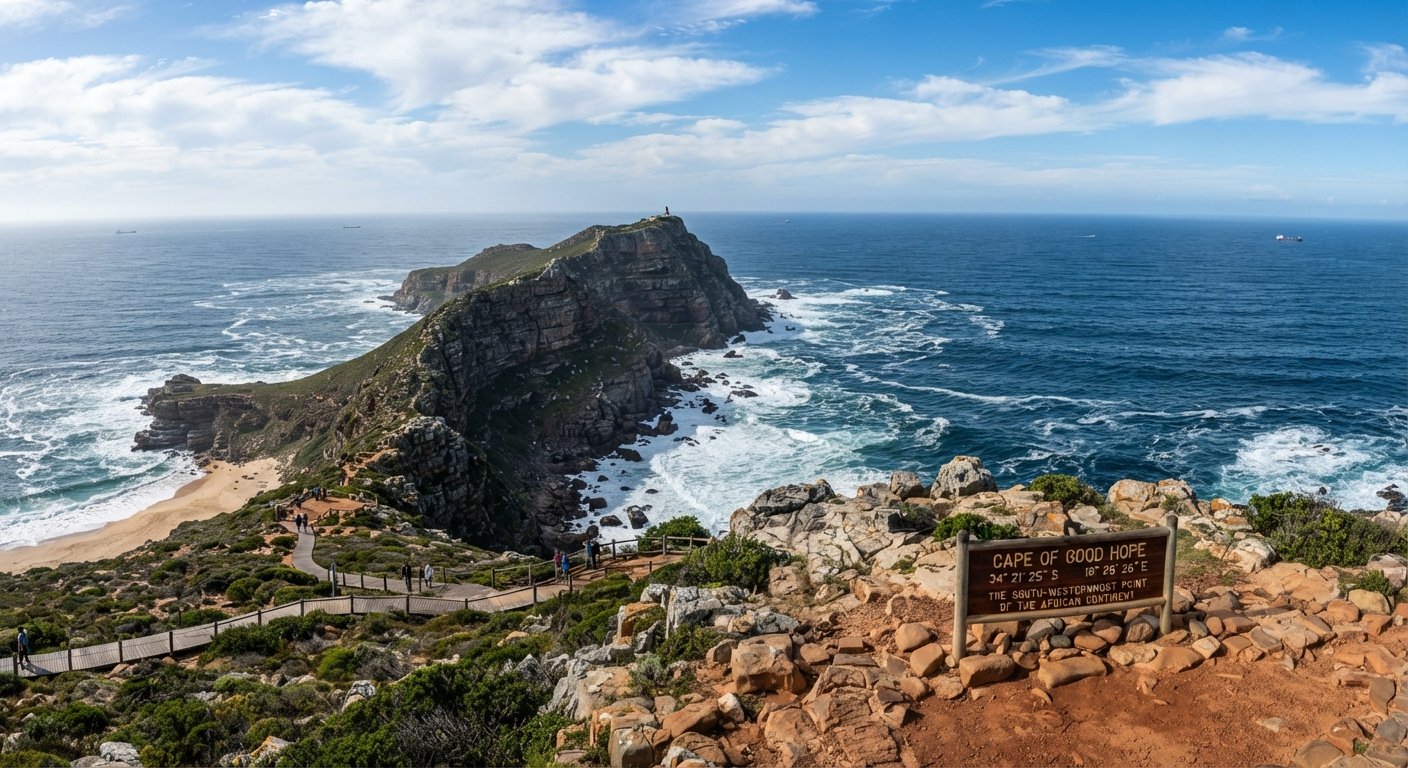
The landmark is surrounded by a rugged coastal environment where land meets the Atlantic Ocean. The nearby landscape includes steep cliffs, rocky shores, open grasslands, native plants, and winding roads that offer impressive views of the sea.
The cape is part of the Cape of Good Hope section of Table Mountain National Park. This protected area helps conserve the region’s plants, wildlife, and natural scenery.
Important Geographical Details
| Feature | Information |
|---|---|
| Country | South Africa |
| Province | Western Cape |
| Geographic region | Cape Peninsula |
| Nearest major city | Cape Town |
| Protected area | Table Mountain National Park |
| Nearby attraction | Cape Point |
| Ocean along the western coastline | Atlantic Ocean |
| Famous for | History, cliffs, wildlife, and ocean views |
| Actual southernmost point of Africa | Cape Agulhas |
The Cape of Good Hope isn’t a separate city, town, or country. It is a geographical landmark within a protected natural area.
Its location has made it important in both physical geography and human history. From the shape of the coastline to the routes followed by historic sailing ships, the region demonstrates how land and water can influence travel and trade.
How Far Is the Cape of Good Hope From Cape Town?
The Cape of Good Hope is approximately 60 to 70 kilometers (37 to 43 miles) from central Cape Town by road, depending on the route. The journey often takes around 1.5 to 2 hours without long stops, although traffic and road conditions can affect travel time.
Many tourists visit the cape on a day trip from Cape Town. The journey is an enjoyable part of the experience because it passes through scenic coastal areas, mountain landscapes, and charming seaside communities.
Ways to Travel to the Cape
There are several ways to reach the Cape of Good Hope.
- By rental car: Renting a car gives visitors freedom to stop at scenic viewpoints and explore the peninsula at their own pace.
- By guided tour: Organized tours often combine the Cape of Good Hope with Cape Point and other nearby attractions.
- By private transport: A private driver can provide a flexible travel schedule.
- By public transport and local connections: Public transport can reach parts of the peninsula, but additional transport may be needed to access the protected area.
One popular route passes through Chapman’s Peak Drive, which is known for its mountain and ocean scenery. Another option passes through Simon’s Town, where visitors can explore the historic town and nearby Boulders Beach.
Before leaving Cape Town, check road conditions, park access, weather forecasts, and current entrance information. Planning ahead can help you enjoy the journey without unnecessary delays.
Is the Cape of Good Hope the Southernmost Point of Africa?
No, the Cape of Good Hope isn’t the southernmost point of Africa. This is one of the most common geographical misunderstandings about the landmark.
The actual southernmost point of the African continent is Cape Agulhas, located farther southeast along South Africa’s coastline.
Cape Agulhas is the geographical point generally recognized as the place where the Atlantic and Indian oceans meet. The Cape of Good Hope, by comparison, lies farther west on the Cape Peninsula.
Cape of Good Hope vs. Cape Agulhas
| Feature | Cape of Good Hope | Cape Agulhas |
|---|---|---|
| Location | Southwestern Cape Peninsula | Southern coast of South Africa |
| Relationship to Cape Town | Relatively close | Much farther away |
| Geographic importance | Famous coastal landmark | Southernmost point of Africa |
| Main attractions | Rugged cliffs, scenery, and wildlife | Lighthouse and southernmost-point marker |
| Historical connection | European maritime exploration | Navigation and geographical significance |
Why do people confuse the two places? The Cape of Good Hope became internationally famous during the age of European maritime exploration. Its name appeared in historical accounts, maps, and sailing records, making it familiar to people around the world.
Cape Agulhas is geographically farther south, but the Cape of Good Hope remains an important destination because of its remarkable scenery and long history.
Understanding this difference helps readers develop a more accurate picture of Africa’s geography.
The History of the Cape of Good Hope
The Cape of Good Hope has played an important role in the history of maritime travel. Before modern transportation systems and major shipping canals, ships traveling between Europe and Asia often relied on routes around southern Africa.
The coastline was a significant landmark because sailors needed to navigate around the continent to reach the Indian Ocean from the Atlantic Ocean.
The Voyage of Bartolomeu Dias
In 1488, Portuguese explorer Bartolomeu Dias reached and rounded the southern tip of Africa during an important voyage. His expedition demonstrated that ships could travel around the continent and continue toward the Indian Ocean.
The cape was associated with the name Cape of Storms, reflecting the difficult weather encountered by sailors in the region. Portugal’s King John II later gave it the name Cape of Good Hope, expressing optimism about the possibility of finding a sea route to Asian trading centers.
This change of name reflected the hope that the voyage would open new opportunities for trade and exploration.
Why the Cape Became Historically Important
The Cape of Good Hope became significant for several reasons:
- It served as a recognizable landmark for sailors navigating southern Africa.
- It formed part of a major sea route connecting Europe and Asia.
- It became associated with the expansion of maritime trade.
- It encouraged improvements in navigation and long-distance sailing.
- It became a symbol of exploration and the search for new trading opportunities.
However, the region’s history began long before European explorers arrived. Indigenous communities, including Khoekhoe and San peoples, had lived in the wider Cape region for thousands of years.
Their cultures, traditions, and knowledge of the natural environment are also essential to understanding the history of the area.
Why Is It Called the Cape of Good Hope?
The name Cape of Good Hope reflects the optimism surrounding the search for a sea route from Europe to Asia around southern Africa.
During the fifteenth century, European traders wanted more direct access to valuable Asian goods, including spices, textiles, and other products. Sailing around Africa offered a possible route toward the Indian Ocean and its trading networks.
The name suggested that the difficult journey around the southern African coastline could lead to new opportunities.
Over time, the Cape of Good Hope became a symbol of determination, discovery, and the connection between distant parts of the world.
Today, the name still captures the imagination of visitors. It reminds people that geographical landmarks can represent more than physical locations; they can also reflect the ambitions, challenges, and achievements of human history.
What Is the Difference Between the Cape of Good Hope and Cape Point?
The Cape of Good Hope and Cape Point are two separate geographical features located close to each other within the protected area of Table Mountain National Park.
Because they are often mentioned together, visitors sometimes assume that they are the same place. In reality, each has its own characteristics and attractions.
The Cape of Good Hope
The Cape of Good Hope is known for its rocky coastline, ocean views, and famous landmark sign. Visitors often stop here to take photographs and enjoy the surrounding scenery.
It is also associated with the region’s maritime history and geographical importance.
Cape Point
Cape Point is a prominent headland with steep cliffs and elevated viewpoints. It is famous for its lighthouse area, hiking routes, and wide views of the surrounding ocean.
Visitors can explore walking trails and viewpoints, although some routes are steep and require suitable footwear.
Which Place Should You Visit?
If time allows, visit both locations. They are close enough to explore during the same trip, and each offers a different view of the Cape Peninsula.
The Cape of Good Hope is especially popular for landmark photographs, while Cape Point is known for its elevated scenery and lighthouse area.
Together, they provide a fuller understanding of the region’s landscape and natural beauty.
Natural Beauty and Landscape of the Cape of Good Hope
The Cape of Good Hope is famous for its rugged and beautiful landscape. Its scenery includes rocky cliffs, open grasslands, coastal plants, and waves moving against the shore.
The coastline has been shaped over long periods by wind, water, and geological processes. These natural forces have helped create the cliffs and rock formations that make the area so distinctive.
Unlike a busy urban setting, much of the surrounding area is protected. This allows visitors to experience a natural environment with relatively open views and opportunities to observe wildlife.
The Cape Floristic Region
The wider Western Cape belongs to the Cape Floristic Region, one of the world’s important centers of plant diversity.
A well-known type of vegetation in this region is called fynbos. It includes many kinds of shrubs, flowering plants, and other species adapted to local soil and weather conditions.
Some fynbos plants are adapted to periodic fires, which play a natural role in parts of the region’s ecology. Others have developed special ways to survive dry summers and nutrient-poor soils.
During suitable seasons, visitors may see colorful wildflowers across parts of the wider Cape region. The timing and variety of flowers depend on rainfall, temperature, and location.
Protecting this vegetation is important because many plant species are found naturally only in this part of the world.
Wildlife at the Cape of Good Hope
The protected environment around the Cape of Good Hope supports a variety of wildlife. Animals live in the grasslands, rocky areas, and coastal habitats throughout the region.
Visitors may encounter wildlife while driving or walking through the reserve, although sightings depend on the season, weather, and animal behavior.
Animals You May See
- Chacma baboons: These intelligent primates live in the wider Cape Peninsula and may be seen near roads or open areas.
- Ostriches: These large flightless birds can sometimes be spotted in coastal habitats.
- Bontebok: This antelope species may be seen in protected grassland areas.
- Lizards: Various reptiles live among the rocks and vegetation.
- Seabirds: Different bird species can be observed along the cliffs and coastline.
The wider peninsula also supports marine life. Seals and other marine animals may be seen at suitable locations along the coast.
How to Watch Wildlife Responsibly
Wild animals should always be treated with respect. Baboons, in particular, may approach visitors who carry food.
Follow these simple guidelines:
- Never feed wild animals.
- Keep food stored securely.
- Maintain a safe distance from wildlife.
- Follow instructions from park staff.
- Avoid blocking animals’ paths.
- Never approach animals just to take a photograph.
Responsible wildlife viewing protects both visitors and animals while helping maintain a healthy natural environment.
Weather and the Best Time to Visit the Cape of Good Hope
The Cape of Good Hope has a Mediterranean-type climate, with generally wetter winters and warmer, drier summers. However, its exposed coastal position means that weather can change quickly.
Strong winds are common, and temperatures may feel cooler near the sea than they do in the city.
Summer
Summer in South Africa generally lasts from December through February. The weather is often warmer and relatively dry, making this a popular period for sightseeing and outdoor activities.
Visitors can enjoy scenic drives, hiking, and photography. However, tourist attractions may be busier during holidays and peak travel periods.
Winter
Winter generally lasts from June through August. Temperatures are cooler, and rainfall is more common.
The coast can look especially dramatic during cloudy or stormy weather, but strong winds and rough seas may affect outdoor activities. Always follow safety instructions and check current conditions.
Seasonal Comparison
| Season | Typical conditions | Suitable activities |
|---|---|---|
| Summer | Warm and often dry | Scenic drives, sightseeing, and hiking |
| Autumn | Gradually cooler | Coastal walks and photography |
| Winter | Cooler, wetter, and sometimes stormy | Scenic views when conditions are safe |
| Spring | Mild to warming, with seasonal flowers | Nature walks and landscape photography |
Spring can be a wonderful time to explore the wider Western Cape because some areas display beautiful seasonal flowers.
There is no single perfect time for everyone. Your ideal visit depends on your preferred weather, planned activities, and tolerance for crowds.
Things to Do at the Cape of Good Hope
The Cape of Good Hope offers many activities beyond taking a photograph beside its famous sign. Visitors can enjoy nature, explore the coastline, and learn about the region’s history.
Enjoy the Ocean Views
The rocky coastline offers excellent opportunities for photography and sightseeing. On a clear day, the contrast between the ocean, cliffs, and vegetation creates a memorable scene.
Stay behind barriers and away from unstable cliff edges. Waves and wind can be dangerous near exposed coastal areas.
Explore Hiking Trails
The wider Cape Point area contains walking trails that allow visitors to explore the natural environment.
Some walks are relatively short, while others require more time and physical effort. Check trail conditions and difficulty levels before starting.
Wear comfortable shoes and carry enough water, particularly during warm weather.
Visit the Lighthouse Area
The Cape Point lighthouse area is one of the region’s best-known attractions. From its viewpoints, visitors can enjoy wide views of the ocean and surrounding peninsula.
Some paths are steep, so choose a route that matches your fitness level. Allow time to stop and enjoy the scenery rather than rushing through the visit.
Enjoy Birdwatching
The reserve provides opportunities to observe birds in coastal and grassland habitats. Binoculars can help you see birds without approaching them too closely.
Move quietly and avoid disturbing nesting areas or other sensitive habitats.
Take a Scenic Drive
Driving through the Cape Peninsula offers opportunities to see mountains, beaches, coastal communities, and viewpoints.
A relaxed itinerary is often more enjoyable than trying to visit every attraction in a single day. Allow extra time for road conditions, photographs, and walking breaks.
How to Reach the Cape of Good Hope
Most international travelers reach the region through Cape Town International Airport. From Cape Town, the Cape of Good Hope can be reached by car, guided tour, or a combination of public transport and local travel arrangements.
Traveling by Car
A rental car offers flexibility and makes it easier to explore multiple locations along the peninsula.
Before departing, check your route, fuel level, parking arrangements, and current road conditions. Follow posted speed limits and park rules.
Joining a Guided Tour
Guided tours are convenient for travelers who prefer not to drive. Many tours include the Cape of Good Hope, Cape Point, and selected attractions along the peninsula.
Before booking, confirm which attractions are included and whether park entrance fees are part of the price.
Using Public Transport
Public transport can take visitors to some communities on the peninsula, but direct access to every attraction may not be available.
Travelers may need to arrange a taxi, shuttle, or guided excursion for the remaining distance.
Regardless of your transport choice, check current schedules and park opening hours before setting out.
Entrance Fees and Visitor Information
The Cape of Good Hope is within a protected section of Table Mountain National Park. Entrance fees may apply, and charges can vary according to visitor category and current park policies.
Because fees, operating hours, and access arrangements can change, check the official South African National Parks website before traveling.
Useful details to confirm include:
- Current entrance fees.
- Gate opening and closing times.
- Road and trail closures.
- Weather-related warnings.
- Parking and transport arrangements.
- Wildlife and visitor safety rules.
Arriving earlier in the day can provide more time to explore. It also helps reduce the chance of rushing toward the exit near closing time.
Remember that the reserve is a protected natural area. Visitors should stay in permitted locations and follow all park instructions.
Important Travel Tips for First-Time Visitors
A little preparation can make a visit to the Cape of Good Hope safer and more enjoyable.
What to Bring
Consider packing the following items:
- Comfortable walking shoes.
- A light jacket or windbreaker.
- Sunscreen and a hat.
- Drinking water.
- Suitable snacks.
- A camera or smartphone.
- Binoculars for birdwatching.
- A fully charged phone with directions available offline if needed.
Even on a sunny day, strong coastal winds can make the temperature feel lower than expected.
Safety Guidelines
The coastline is beautiful, but it also has natural hazards.
- Stay away from cliff edges.
- Follow marked paths and safety signs.
- Avoid swimming in unfamiliar or rough waters.
- Keep a safe distance from wildlife.
- Don’t leave valuables visible inside parked vehicles.
- Check the weather forecast before hiking.
Ocean currents, large waves, and slippery rocks can be dangerous. Never assume that water is safe for swimming simply because it looks calm.
Protect the Environment
Visitors can help preserve the Cape of Good Hope by taking their rubbish with them, staying on designated paths, and avoiding damage to native plants.
Don’t pick flowers or remove natural objects from the reserve. Small actions can have a lasting effect when many visitors repeat them.
Responsible travel allows people to enjoy the landscape while helping protect it for future generations.
Interesting Facts About the Cape of Good Hope
The Cape of Good Hope is an interesting destination for geography students, history enthusiasts, and travelers.
Here are some useful facts:
- It is located in South Africa’s Western Cape province.
- It lies on the Cape Peninsula, south of Cape Town.
- It forms part of Table Mountain National Park.
- Bartolomeu Dias reached and rounded the southern tip of Africa in 1488.
- Its name became associated with the hope of finding a sea route to Asia.
- It isn’t the southernmost point of Africa.
- Cape Agulhas is the southernmost point of the continent.
- The wider region is famous for its rich plant diversity.
- Strong winds can affect coastal conditions.
- Cape Point is a nearby attraction known for its lighthouse area and viewpoints.
These facts show why the cape matters beyond its beautiful appearance. It connects physical geography, exploration, conservation, and international trade.
Why Is the Cape of Good Hope Important Today?
The Cape of Good Hope remains important because of its historical, geographical, environmental, and economic value.
Its history helps explain how sailors explored the world’s oceans and developed new trading routes. Its location also provides a useful example of how geography can influence transportation and international commerce.
Conservation is another important part of the region’s value. The Cape Peninsula contains distinctive vegetation and wildlife habitats that require careful protection.
Tourism also contributes to the local economy. Visitors spend money on transport, accommodation, guided tours, meals, and other services in the Cape Town region.
When managed responsibly, tourism can support local businesses while encouraging respect for natural and cultural heritage.
For students, the cape offers an example of the relationship between geography and history. For travelers, it provides an opportunity to explore an extraordinary landscape. For conservationists, it demonstrates why protected natural areas matter.
Frequently Asked Questions
Where is the Cape of Good Hope located?
The Cape of Good Hope is on the Cape Peninsula in southwestern South Africa, within the Western Cape province. It lies south of Cape Town and forms part of Table Mountain National Park.
Is the Cape of Good Hope close to Cape Town?
Yes. It is approximately 60 to 70 kilometers from central Cape Town by road, depending on the route. The journey often takes around 1.5 to 2 hours.
Is the Cape of Good Hope the southernmost point of Africa?
No. Cape Agulhas is the southernmost point of Africa. The Cape of Good Hope is a famous landmark farther west.
Which ocean is near the Cape of Good Hope?
The Cape of Good Hope lies on the Atlantic side of the Cape Peninsula. The wider southern African coastline is influenced by both Atlantic and Indian Ocean water systems.
Can tourists visit the Cape of Good Hope?
Yes. Visitors can explore designated viewpoints, take photographs, enjoy selected hiking trails, and observe wildlife. Park rules and entrance fees apply.
What is the best month to visit?
The best month depends on your preferences. Summer is generally warmer and drier, while spring can offer seasonal flowers in parts of the wider Western Cape.
How much time should I spend there?
Many visitors allow half a day to explore the Cape of Good Hope and Cape Point. A full day is useful if you want to include other attractions along the peninsula.
Why is the Cape of Good Hope famous?
It is famous for its maritime history, dramatic coastline, geographical location, wildlife, and role in European exploration.
Conclusion: Where Is the Cape of Good Hope?
Where is the Cape of Good Hope? It is located on the southwestern coast of South Africa, on the Cape Peninsula south of Cape Town. This well-known landmark lies within Table Mountain National Park and is famous for its rugged cliffs, scenic ocean views, diverse wildlife, and rich maritime history.
Although it isn’t the southernmost point of Africa, the Cape of Good Hope remains one of the continent’s most recognizable destinations. Its connection to historic sea routes, the nearby Cape Point lighthouse area, and the unique natural environment make it a valuable place to explore and study.
Whether you’re researching geography, learning about world history, or planning a South African holiday, the Cape of Good Hope offers a memorable combination of natural beauty and human heritage. By visiting responsibly and respecting its protected environment, travelers can help preserve this remarkable landmark for generations to come.
The Geography of the Cape Peninsula
To understand where the Cape of Good Hope is located, it helps to learn more about the Cape Peninsula. This narrow stretch of land extends southward from Cape Town and separates different coastal environments along the southwestern edge of South Africa.
The peninsula contains mountains, beaches, rocky shores, valleys, and protected natural areas. Its landscape changes from busy urban neighborhoods in the north to quieter coastal environments farther south.
The Cape of Good Hope is located near the southern end of this peninsula. It forms part of a larger protected area that includes Cape Point and other important natural attractions.
The peninsula’s geography has influenced human settlement, wildlife movement, tourism, and maritime activity for centuries. Its position also makes it a useful place for studying coastal erosion, ocean currents, and the effects of changing weather.
How Ocean Currents Affect the Cape of Good Hope
The waters around the Cape Peninsula are influenced by major ocean currents. These currents transport water of different temperatures and help shape the marine environment.
The cold Benguela Current flows northward along the southwestern coast of southern Africa. Farther southeast, the warm Agulhas Current flows southwestward along the eastern coast of South Africa before turning back toward the Indian Ocean.
The interaction between these different water systems influences marine ecosystems, weather patterns, and the movement of nutrients.
Why Ocean Currents Matter
Ocean currents are important because they:
- Transport nutrients that support marine food chains.
- Influence water temperatures along the coast.
- Affect the distribution of fish and other marine species.
- Help shape local and regional weather patterns.
- Create challenging conditions for some vessels navigating the region.
It’s important to understand that the Cape of Good Hope isn’t the exact geographical point where the Atlantic and Indian oceans officially meet. That distinction is generally associated with Cape Agulhas.
Even so, the waters around the Cape Peninsula are part of a complex ocean system that makes the region especially interesting to scientists and nature lovers.
The Cape of Good Hope and International Shipping
The Cape of Good Hope has played an important role in international shipping for hundreds of years. Before modern canals and advanced transportation systems, sailing around the southern coast of Africa was a major way to travel between Europe and Asia by sea.
Ships carrying spices, textiles, precious goods, and other cargo used routes around southern Africa. The journey could be long and dangerous because of strong winds, rough waves, and limited navigation technology.
Why Ships Still Use the Cape Route
Even today, some commercial ships travel around the Cape of Good Hope. The route can become especially important when shipping through other waterways is disrupted or when particular vessels cannot use certain canals.
For example, very large ships may face restrictions related to a canal’s depth, width, or operating requirements. In other cases, security concerns or delays may make a longer route more practical.
However, sailing around the cape usually adds distance to many journeys between Europe and Asia compared with a suitable route through the Suez Canal.
This makes the Cape of Good Hope an important example of how geography continues to influence international trade.
Photography at the Cape of Good Hope
The Cape of Good Hope is a wonderful destination for photography. Its rugged coastline, changing skies, and natural vegetation create many opportunities for memorable pictures.
Whether you’re using a professional camera or a smartphone, you can capture the beauty of the landscape by paying attention to light, weather, and composition.
Best Photography Ideas
Coastal landscapes: Photograph the waves moving toward the rocky shore. A wide view can show the relationship between the cliffs and the ocean.
Dramatic skies: Clouds and changing weather can create striking backgrounds. Always choose a safe place away from exposed cliff edges.
Wildlife photography: Photograph birds and other animals from a respectful distance. Avoid using food to attract wildlife.
Flower photography: During suitable seasons, native plants may provide colorful subjects for close-up pictures.
Landmark photographs: The well-known Cape of Good Hope sign is a popular place for visitors to record their trip.
For the best results, visit during daylight and allow enough time to explore different viewpoints. Remember that strong winds can make photography difficult, especially when using lightweight equipment.
Cultural and Historical Connections
The Cape of Good Hope is part of a region with a long human history. Indigenous communities lived in the wider Cape region long before European explorers arrived by sea.
Khoekhoe communities practiced pastoralism, while San communities had diverse hunting and gathering traditions. These communities had their own knowledge of the environment, cultural practices, and relationships with the land.
European arrival during the late fifteenth and following centuries changed the region’s history. Trade, colonial settlement, and later political developments affected Indigenous communities and helped shape the society that exists in South Africa today.
Learning about these different experiences provides a more balanced understanding of the Cape of Good Hope. Its history is not only about explorers and ships; it is also about the people who lived in the region and experienced the changes that followed.
Today, South Africa’s cultural diversity is an important part of the wider Cape Town visitor experience. Travelers can learn about local history through museums, cultural tours, historic buildings, and educational programs.
Conservation Challenges Around the Cape of Good Hope
Although the Cape of Good Hope is protected, its natural environment still faces several challenges. Conservation organizations and park managers work to protect the region’s plants, wildlife, and coastal habitats.
Major Environmental Concerns
- Invasive plant species: Non-native plants can compete with local vegetation and change natural ecosystems.
- Wildfires: Fire is a natural part of some fynbos environments, but severe or poorly timed fires can damage habitats and threaten nearby communities.
- Human disturbance: Leaving marked paths, littering, and approaching wildlife can harm the environment.
- Climate change: Changing temperatures and rainfall patterns may affect plant communities, water availability, and wildlife habitats.
- Marine pollution: Plastic waste and other pollution can harm coastal ecosystems and marine animals.
How Visitors Can Help
Visitors can support conservation by staying on marked trails, disposing of waste properly, and following park instructions.
It’s also helpful to avoid picking flowers or removing rocks, shells, and other natural objects. Even small actions can damage sensitive habitats when repeated by many visitors.
Choosing responsible tour operators and learning about local conservation projects can make a trip more meaningful.
Protecting the Cape of Good Hope ensures that its distinctive landscapes and wildlife remain available for future generations.
Planning a Full-Day Trip to the Cape of Good Hope
If you’re staying in Cape Town, a full-day trip can provide enough time to explore several attractions around the Cape Peninsula.
Here is a sample itinerary. Travel times and access conditions can vary, so check current information before setting out.
| Time | Suggested activity |
|---|---|
| 8:00 AM | Leave Cape Town |
| 9:00 AM | Enjoy a scenic coastal drive |
| 10:00 AM | Explore the Cape Point area |
| 11:30 AM | Visit the Cape of Good Hope viewpoint |
| 12:30 PM | Take a break for lunch |
| 1:30 PM | Enjoy a short walk or wildlife viewing |
| 2:30 PM | Visit Simon’s Town or Boulders Beach |
| 4:00 PM | Begin the return journey |
| 5:30 PM | Arrive in Cape Town, depending on traffic |
This is only an example, not a fixed schedule. Some visitors may prefer longer hikes, while others may spend more time photographing the coastline.
If you’re traveling with children or older adults, choose accessible walking routes and allow extra time for rest stops.
Is the Cape of Good Hope Suitable for Families?
Yes, the Cape of Good Hope can be a rewarding destination for families, provided everyone follows park rules and chooses suitable activities.
Children can learn about geography, wildlife, plants, and maritime history while enjoying the outdoors.
Family-Friendly Activities
- Looking for birds and other wildlife from safe viewpoints.
- Learning how explorers navigated the oceans.
- Taking photographs of the coastline.
- Enjoying short walks on appropriate trails.
- Visiting nearby attractions along the Cape Peninsula.
Parents and guardians should supervise children closely, especially near cliffs, roads, and wildlife.
The weather can change quickly, so bring suitable clothing, water, and sun protection. It’s also wise to check the difficulty of any planned walk before starting.
With proper preparation, the visit can become both an educational experience and a memorable family outing.
Final Thoughts: Where Is the Cape of Good Hope?
Where is the Cape of Good Hope? It is on the Cape Peninsula in South Africa’s Western Cape province, south of Cape Town. Located within Table Mountain National Park, it is famous for its coastal scenery, historical importance, wildlife, and connection to international maritime travel.
The cape also offers lessons about ocean currents, conservation, Indigenous history, and the ways geography influences human activity. Although it isn’t the southernmost point of Africa, it remains one of the continent’s most recognizable landmarks.
Whether you’re studying geography, planning a visit, or exploring the history of global shipping, the Cape of Good Hope is a destination worth understanding. Its combination of natural beauty and historical significance makes it an enduring symbol of exploration and discovery.
For more news, helpful articles, and the latest updates, visit Leo Art News.