
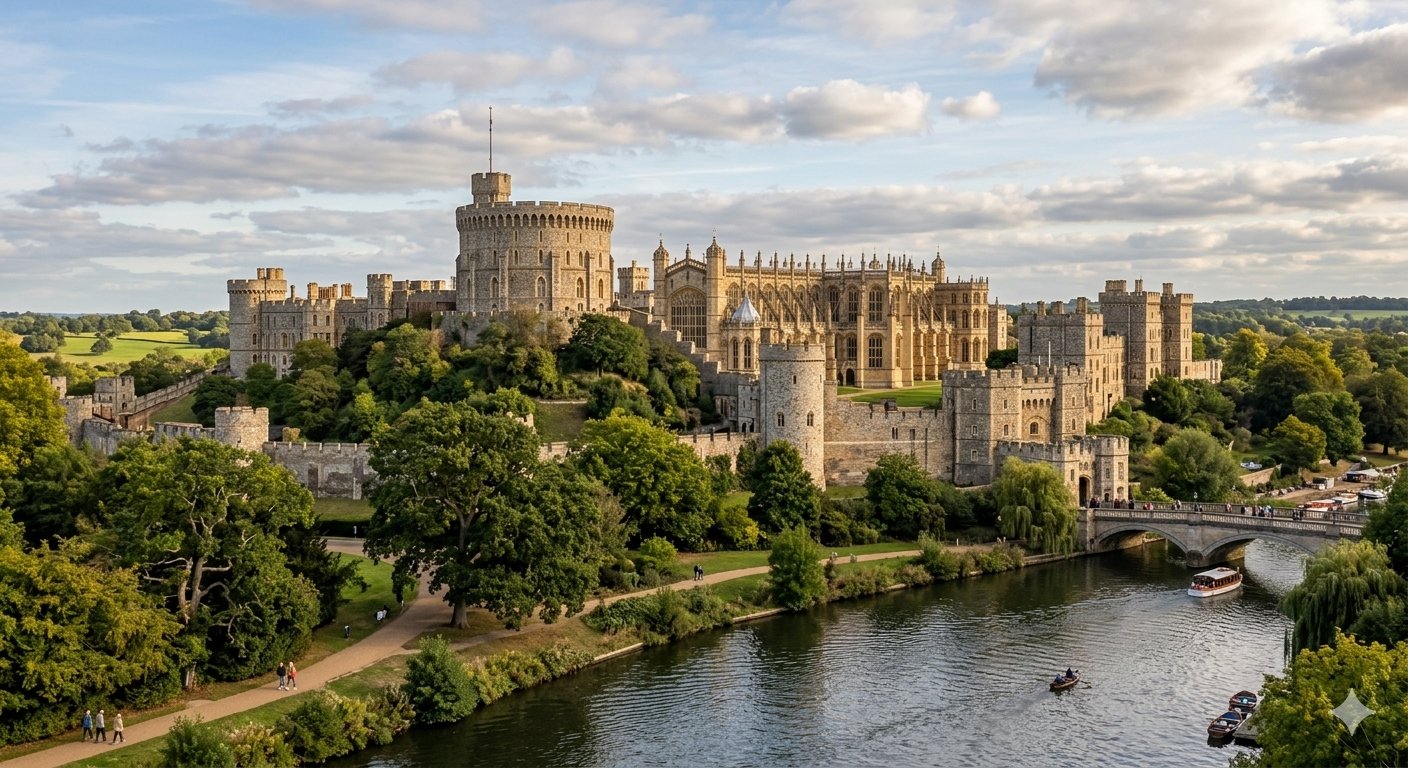

windsor castle is one of the world’s most famous historic royal residences and an important symbol of Britain’s long and fascinating history. Standing above the town of Windsor in England, the castle has witnessed centuries of royal life, political change, celebrations, conflicts, and important national events.
Unlike many historic buildings that survive mainly as monuments, windsor castle remains closely connected with the British monarchy. Its long history stretches back to the Norman period, while its buildings, chapels, artworks, and ceremonial spaces reflect many different periods of British architecture and royal life.
For visitors, the castle offers much more than impressive stone walls. It provides an opportunity to explore royal apartments, historic artwork, religious heritage, courtyards, gardens, and views across the surrounding landscape. Walking through its grounds, visitors can get a sense of how the site developed from a defensive stronghold into a grand royal residence.
Whether you’re interested in British history, architecture, royal traditions, or travel, windsor castle offers plenty to discover.
What Is windsor castle?
windsor castle is a historic royal castle located in Windsor, Berkshire, England. It stands on elevated ground overlooking the River Thames and the surrounding town.
The castle is associated with the British royal family and has served as a royal residence for centuries. It is also known for St George’s Chapel, the State Apartments, the Round Tower, and its extensive historic grounds.
One of the most interesting things about the castle is its combination of military and residential features. Thick walls, towers, and defensive structures remind visitors of its medieval origins, while grand rooms and ceremonial spaces show how the site later became a prestigious royal residence.
The castle’s location was also strategically important. Its elevated position provided defensive advantages while placing the royal residence near London.
Today, the castle is both a working royal residence and a major historic attraction.
The Early History of windsor castle
The story of windsor castle begins in the aftermath of the Norman Conquest of England.
William the Conqueror ordered a series of castles to be built in strategic locations after his victory in 1066. Windsor became one of these important sites because of its position near the River Thames and its relationship to London.
The earliest castle was primarily a defensive structure. It was designed to help control the surrounding area and protect important routes.
Over time, however, Windsor developed far beyond its original military purpose.
Wooden defensive structures were gradually replaced or strengthened with stone buildings. Kings added towers, walls, halls, chapels, and residential areas.
As centuries passed, each generation left its own mark on the castle.
That layered history is one of the reasons the site remains so fascinating today.
Medieval Development of windsor castle
During the medieval period, windsor castle became increasingly important to English kings.
Henry II played a significant role in transforming the castle into a more substantial stone fortress. Stone walls and towers provided greater strength and durability than the original timber structures.
Later monarchs continued to improve the site.
King John used Windsor during important periods of his reign, while Henry III carried out major building projects. Edward III also transformed parts of the castle, making it more suitable as a royal residence.
This period demonstrates how the castle’s role was changing.
It wasn’t simply a military fortress anymore. It was becoming a place where royal government, ceremonies, hospitality, and private life could take place.
Major Medieval Features
Important developments included:
- Strong stone defensive walls
- Towers and gateways
- Royal residential buildings
- Great halls
- Chapels
- Ceremonial spaces
- Improved internal courtyards
The combination of defense and royal living became a defining characteristic of the castle.
windsor castle and the British Monarchy
Few buildings have been connected with British monarchs for such a long period.
Kings and queens used Windsor for different reasons. Some appreciated its defensive position, while others enjoyed its location and royal surroundings.
For monarchs, the castle could serve as:
- A residence
- A place for ceremonies
- A military stronghold
- A venue for diplomatic meetings
- A location for religious observances
- A retreat from London
- A place for royal celebrations
The castle’s importance continued even as military technology changed and its defensive role became less significant.
Instead, its royal and ceremonial importance became increasingly prominent.
The Architecture of windsor castle
The architecture of windsor castle is fascinating because it doesn’t represent just one historical period.
Instead, the castle is the result of centuries of construction, rebuilding, restoration, and adaptation.
Visitors can see evidence of medieval defensive architecture alongside later royal interiors.
One of the most recognizable elements is the Round Tower, which stands prominently at the center of the castle complex.
The castle also features extensive curtain walls, gateways, towers, courtyards, apartments, and religious buildings.
The Round Tower
The Round Tower is among Windsor’s most recognizable landmarks.
Although its appearance has changed over time, the tower’s origins are connected to the medieval castle. Its elevated position also contributes to the dramatic appearance of the entire site.
The tower helps define the skyline of Windsor and provides a visual reminder of the castle’s defensive past.
Castle Walls
The massive walls surrounding the castle demonstrate how seriously medieval rulers viewed defense.
Walking along or near these historic structures can help visitors imagine the challenges faced by people protecting castles centuries ago.
St George’s Chapel
St George’s Chapel is one of the most important religious buildings within windsor castle.
It is associated with the Order of the Garter, one of Britain’s oldest and most prestigious orders of chivalry.
The chapel is also notable for its Gothic architecture, detailed stonework, stained glass, and royal connections.
Over the centuries, St George’s Chapel has been the setting for important religious ceremonies and royal occasions.
It is also a burial place for numerous British monarchs and members of the royal family.
Why St George’s Chapel Matters
The chapel represents several aspects of British heritage:
- Religious history
- Royal tradition
- Gothic architecture
- Ceremonial culture
- Royal funerary history
- The Order of the Garter
Its detailed design makes it an important destination for visitors interested in architecture as well as history.
The State Apartments
The State Apartments are among the most impressive parts of windsor castle.
These rooms were designed and decorated for royal use and ceremonial occasions. Their interiors contain fine decoration, historic furniture, artworks, and other objects connected with royal life.
The apartments demonstrate how royal residences evolved from medieval fortified spaces into grand centers of ceremony.
Large rooms were used for receiving guests, hosting formal events, and displaying royal wealth and artistic taste.
Visitors can observe:
- Elaborate interiors
- Historic furniture
- Decorative artwork
- Ceremonial spaces
- Architectural details
- Objects associated with royal history
The rooms provide an insight into how royal households used architecture to communicate tradition and status.
The Grand Reception Room
The Grand Reception Room is particularly notable for its rich decoration.
It was heavily damaged during the major fire that affected the castle in the early 1990s but was later restored.
The restoration became an important conservation project.
Careful work was undertaken to preserve the character of the room while repairing extensive damage. The result demonstrates how historic buildings can be protected through modern conservation methods.
For visitors, the restored room is also a reminder that heritage isn’t simply about preserving old objects. Sometimes, it requires significant effort to repair and protect them for future generations.
The Fire at windsor castle
One of the most dramatic events in the modern history of windsor castle occurred in November 1992, when a major fire broke out.
The fire caused extensive damage to parts of the castle, particularly several important rooms.
The event was devastating from a heritage perspective, but it also led to one of the most significant restoration projects in the castle’s modern history.
Restoration After the Fire
Restoration involved:
- Repairing damaged structures
- Conserving historic decoration
- Restoring important rooms
- Replacing damaged materials
- Using traditional craftsmanship
- Applying modern conservation techniques
The project demonstrated how historical preservation requires patience, technical skill, and careful decision-making.
Rather than simply rebuilding everything in a modern style, specialists worked to respect the castle’s historic character.
The successful restoration became an important chapter in the story of Windsor.
Windsor and the Order of the Garter
The castle has a special relationship with the Order of the Garter.
The Order of the Garter is one of the highest orders of chivalry in Britain. Its history is closely associated with Edward III and medieval royal traditions.
Each year, the Order’s traditional ceremony is connected with St George’s Chapel.
This relationship adds another layer to the castle’s significance.
For visitors interested in British traditions, the connection between Windsor, the monarchy, St George’s Chapel, and the Order of the Garter provides a fascinating look at ceremonies that have developed over many centuries.
windsor castle During the Reign of Queen Elizabeth II
Queen Elizabeth II had a particularly strong connection with Windsor.
She regularly used the castle as a royal residence and spent important periods there, including during the later years of her reign.
The castle was also associated with major national moments during her lifetime.
Her connection with Windsor helped reinforce the castle’s position as an active royal residence rather than simply an old historical building.
After her death in 2022, she was laid to rest at St George’s Chapel alongside her husband, Prince Philip, and other members of the royal family.
This added another significant chapter to the castle’s long royal history.
windsor castle and Royal Weddings
The castle and St George’s Chapel have hosted important royal weddings.
Perhaps the most widely recognized modern example is the wedding of Prince Harry and Meghan Markle in 2018, which took place at St George’s Chapel.
The ceremony attracted worldwide attention and brought millions of viewers’ focus to Windsor.
The chapel’s historic architecture provided a dramatic setting for the occasion.
Royal weddings at Windsor demonstrate how historic spaces can remain relevant to modern audiences.
A building with medieval origins can still become part of major contemporary events. That’s quite remarkable, really.
Royal Burials at windsor castle
St George’s Chapel has long served as a royal burial site.
Several monarchs and members of the British royal family are buried within the chapel and related areas.
The royal burial tradition adds a solemn dimension to the castle.
Visitors may encounter memorials and tombs that connect the present with centuries of British history.
Among the monarchs associated with the chapel are:
- Edward IV
- Henry VI
- Henry VIII
- Charles I
- George III
- George IV
- William IV
- George V
- George VI
- Elizabeth II
The presence of these royal burials makes the chapel an especially important historical site.
The Castle Grounds and Surrounding Landscape
The experience of windsor castle isn’t limited to the buildings.
The surrounding landscape contributes significantly to its character.
Windsor sits beside the River Thames, and the area around the castle includes historic streets, parks, gardens, and open spaces.
One particularly famous nearby landscape is Windsor Great Park, which extends across a large area south of the town.
The Long Walk is another well-known feature. It creates a dramatic avenue leading toward the castle and is one of the best-known views associated with Windsor.
Walking through the surrounding area, visitors can appreciate how the castle interacts with the landscape rather than existing as an isolated building.
Art and Collections at windsor castle
The castle contains important works of art and historic objects.
Royal collections have included paintings by famous artists, decorative objects, furniture, weapons, armor, and other pieces connected to royal history.
These collections are valuable because they provide more than visual beauty.
They can also reveal information about:
- Royal taste
- European artistic influences
- Political relationships
- Ceremonial traditions
- Craftsmanship
- Historical events
A visit can therefore feel like walking through several museums at once.
One room may focus attention on architecture, another on artwork, and another on royal ceremonies.
A Simple Guide to Visiting windsor castle
For travelers planning a visit, preparation can make the experience smoother.
Because the castle is a working royal residence as well as a historic attraction, access to certain areas can vary.
Visitors should check current official information before traveling because opening arrangements, security procedures, available rooms, and special events may change.
What to Consider Before Visiting
| Visitor Consideration | Why It Matters |
|---|---|
| Opening information | Access can vary |
| Tickets | Popular periods may be busy |
| Security | Entry procedures can take time |
| Footwear | The site involves walking |
| Weather | Outdoor areas may be exposed |
| Photography rules | Restrictions may apply in some areas |
| Chapel access | Religious services can affect visiting |
| Time | The castle contains many areas to explore |
Comfortable shoes are particularly useful. The castle complex is large, and there’s plenty to see.
Best Time to Explore windsor castle
The ideal time to visit depends on personal preferences.
Some travelers prefer quieter periods, while others enjoy visiting during special events when Windsor feels particularly lively.
Weather can also influence the experience.
Spring and summer often provide pleasant conditions for exploring the town and surrounding landscape. Autumn can bring beautiful seasonal scenery, while winter may offer a quieter atmosphere.
Whenever you visit, allow enough time rather than rushing through the castle.
History becomes much more enjoyable when you have time to stop, look, and read.
Interesting Facts About windsor castle
The castle has an unusually long and rich history, making it a source of many fascinating facts.
Here are some highlights:
- Its origins date back to the Norman period.
- It has been associated with British monarchs for centuries.
- St George’s Chapel is located within the castle complex.
- The castle has undergone major rebuilding and restoration.
- A major fire damaged parts of the castle in 1992.
- The State Apartments contain important royal collections.
- The castle remains connected with the British monarchy.
- It has hosted major royal events.
- Several monarchs are buried at St George’s Chapel.
- The castle continues to attract visitors from around the world.
These facts show why Windsor is more than a single historic building. It is a complex of architecture, art, religion, ceremony, and royal history.
Why windsor castle Remains Important Today
Historic buildings can sometimes feel disconnected from modern life. Windsor is different.
Its continuing royal role keeps it connected with contemporary Britain.
At the same time, its history makes it valuable to historians, architects, conservation experts, travelers, and students.
The castle also demonstrates how heritage can survive through change.
It has experienced:
- Wars
- Political changes
- Architectural transformations
- Changing royal traditions
- Fire
- Restoration
- Modern tourism
Yet it continues to stand as an important landmark.
That long survival is perhaps its greatest story.
windsor castle as an Educational Experience
For students and history enthusiasts, the castle provides a practical way to understand British history.
Instead of reading only about medieval castles in a textbook, visitors can see actual defensive walls, towers, chapels, royal apartments, and historic objects.
The site can help explain concepts such as:
- Medieval defense
- Monarchy
- Gothic architecture
- Conservation
- Religious history
- Royal ceremonies
- Art history
- British political history
A visit can therefore become more than sightseeing. It can become a lesson in how societies change over time.
How windsor castle Connects Past and Present
Perhaps the most remarkable feature of windsor castle is its ability to connect different periods of history.
Its medieval walls tell one story.
Its royal apartments tell another.
St George’s Chapel provides a religious and ceremonial connection.
Modern royal events add yet another layer.
Instead of replacing the past, each generation has added something new to the site.
That’s why walking through Windsor can feel like moving through a living timeline.
Final Thoughts on windsor castle
windsor castle is much more than a famous British landmark. It is a living record of centuries of royal history, architecture, religion, art, ceremony, conflict, restoration, and cultural change.
From its Norman beginnings to its continuing royal role, the castle has adapted to changing times while preserving important parts of its historic identity. Its towers and walls reveal its defensive origins, while its State Apartments and St George’s Chapel demonstrate its later importance as a royal residence and ceremonial center.
For anyone interested in British heritage, windsor castle offers an extraordinary opportunity to explore the past while seeing how history continues to influence the present. Whether you’re studying architecture, planning a trip, or simply curious about Britain’s royal heritage, windsor castle remains a remarkable place to discover.
windsor castle: Part 2
The Strategic Location of windsor castle
The location of windsor castle was never an accident. From its earliest days, the site offered important advantages because of its position above the River Thames and its relative closeness to London.
In medieval England, location mattered enormously. A castle needed to provide protection, visibility, and access to important routes. Windsor offered all three.
The elevated ground gave defenders a useful view across the surrounding countryside. At the same time, the River Thames provided an important route for travel and trade.
Over the centuries, the defensive importance of the location changed. However, its connection with London and the surrounding landscape continued to make Windsor an attractive royal residence.
Today, that same location makes the castle appealing to visitors. From the town below, the castle creates an impressive sight, while the surrounding countryside adds to the experience.
Medieval Life Inside windsor castle
It can be difficult to imagine daily life inside a medieval castle. Unlike modern homes, castles were busy communities with many different people performing specialized jobs.
A major royal castle could include:
- Members of the royal household
- Soldiers
- Servants
- Cooks
- Craftspeople
- Religious officials
- Administrators
- Visitors and messengers
The royal family was only one part of this larger community.
Food preparation alone required many workers. Large kitchens had to provide meals for important guests and members of the household. Supplies had to be stored, transported, prepared, and served.
Security was also a constant concern.
Guards watched entrances and controlled access to important areas. Gates could be closed during periods of danger, while towers and walls provided defensive positions.
Although today’s visitors experience a peaceful historic attraction, medieval Windsor was a much busier and more demanding environment.
The Role of Royal Ceremonies
Ceremony has always been an important part of royal life, and windsor castle provides an impressive setting for formal traditions.
Royal ceremonies can communicate history and continuity. Clothing, music, architecture, symbols, and formal processions all contribute to the experience.
The connection with the Order of the Garter is especially important.
The Garter ceremony demonstrates how medieval traditions can survive into the modern age. While the meaning and context may change over time, the continued use of historic spaces gives these traditions a strong visual and cultural connection to the past.
For visitors, ceremonial traditions also help explain why Windsor remains more than an ordinary historic building.
Windsor’s Connection With St George
St George has a particularly important place in English tradition, and this connection is reflected strongly at windsor castle.
St George’s Chapel is dedicated to the saint and serves as the spiritual home of the Order of the Garter.
The chapel’s name also reflects its connection with England’s long religious and cultural traditions.
Its architecture makes the connection even more impressive. High ceilings, detailed stonework, stained glass, and carefully crafted decoration create a powerful atmosphere.
Even visitors who aren’t deeply interested in religious history can appreciate the craftsmanship and scale of the building.
The Gothic Character of St George’s Chapel
St George’s Chapel is one of the architectural highlights of Windsor.
Its design reflects the English Gothic tradition, which is known for features such as:
- Pointed arches
- Large windows
- Detailed stone carving
- High ceilings
- Elaborate tracery
- Decorative vaulting
Gothic architecture often aimed to create a sense of height and light.
Standing inside such a space, visitors can see why medieval builders invested so much effort in creating dramatic religious interiors.
The craftsmanship is particularly impressive considering the tools and technology available to medieval builders.
Royal Collections Inside the Castle
Another important part of windsor castle is its connection with royal collections.
Over generations, monarchs collected paintings, furniture, decorative objects, books, weapons, and other valuable items.
These objects help tell stories about the people who owned and used them.
For example, a piece of furniture can reveal changing ideas about design and comfort. A painting can provide information about royal relationships or artistic tastes. A ceremonial object can show how traditions were practiced.
In this way, the collections are not simply decorations.
They are historical evidence.
The Importance of Conservation
Preserving a building as old as windsor castle requires constant attention.
Stone can weather.
Wood can weaken.
Paint can fade.
Decorative materials can deteriorate.
Historic objects also require specialist care.
Conservation experts must therefore balance two goals: protecting the original material and allowing visitors to experience the site.
The restoration following the 1992 fire showed how complicated this work can become.
Experts had to examine damaged areas carefully and determine how they could be repaired while respecting the building’s historical character.
This type of conservation requires knowledge of architecture, materials, history, and traditional craftsmanship.
The 1992 Fire and Its Legacy
The fire of 1992 remains one of the most significant modern events in the history of windsor castle.
It damaged important parts of the castle, creating a major challenge for conservation specialists.
However, the restoration also provided an opportunity to study historic construction methods and develop new approaches to preserving heritage.
The work took years and involved many specialists.
Rather than simply treating the damaged areas as modern construction projects, restoration teams considered historical evidence and traditional design.
The result demonstrated that a historic building can recover from serious damage when conservation is approached carefully.
Traditional Craftsmanship at Windsor
One fascinating aspect of the castle’s preservation is the role of skilled craftspeople.
Historic buildings often require techniques that aren’t commonly used in modern construction.
Specialists may need knowledge of:
- Stone carving
- Woodworking
- Metalwork
- Decorative painting
- Stained glass
- Historic plasterwork
- Traditional masonry
This craftsmanship helps ensure that restoration work respects the character of the original building.
It’s a good reminder that heritage preservation isn’t just about bricks and mortar. It’s also about keeping traditional skills alive.
Windsor as a Royal Weekend Residence
Throughout its history, Windsor has often provided a change from life in London.
The castle’s location makes it close enough to the capital while offering a different environment.
The surrounding landscape provides open spaces and countryside, making Windsor suitable for royal retreats and private periods away from the city’s busy atmosphere.
This combination of accessibility and privacy has helped maintain the castle’s importance as a royal residence.
The Long Walk and Windsor Great Park
The area around windsor castle offers plenty to explore beyond the castle walls.
The Long Walk is one of the most famous approaches to Windsor. It creates a dramatic straight avenue toward the castle and provides memorable views.
Windsor Great Park also forms an important part of the area’s historic landscape.
The park has been associated with royal use for centuries and includes forests, open grassland, gardens, and historic features.
For visitors with extra time, exploring the surrounding landscape can add another dimension to a castle visit.
Instead of seeing Windsor as one building, you begin to understand it as part of a much larger historic environment.
The Town of Windsor
A trip to windsor castle naturally connects visitors with the town of Windsor.
The town has developed around the castle over many centuries.
Today, visitors can find:
- Historic streets
- Shops
- Restaurants
- Cafés
- Hotels
- Museums
- Riverside areas
- Traditional buildings
The combination of castle and town makes Windsor different from many isolated historic sites.
Visitors can spend the day exploring the castle and then continue through the surrounding streets.
Windsor and the River Thames
The River Thames adds another important element to the area’s character.
The river has played a major role in the history of southern England, providing transportation, trade, and access between communities.
Windsor’s location near the river helped contribute to the importance of the area.
Today, the riverside provides opportunities for walking, relaxing, and enjoying views of the surrounding landscape.
A visit to the castle can therefore be combined with time near the river, creating a more complete experience.
Photography Around windsor castle
The castle offers many opportunities for photography, particularly from public areas around Windsor.
Some of the most recognizable views include the castle’s exterior walls, towers, gateways, and the Long Walk.
However, photography rules can vary inside historic and royal spaces.
Visitors should follow signs and current instructions regarding where photography is permitted.
When taking photographs, consider more than just the castle itself.
The surrounding streets, changing weather, trees, and landscape can all create interesting compositions.
Early morning and late afternoon light can also change the appearance of stone buildings dramatically.
How Long Should You Spend at windsor castle?
The amount of time required depends on your interests.
Someone who wants a quick overview may spend a few hours exploring the main areas.
History enthusiasts may prefer a longer visit so they can take their time with the State Apartments, chapel, grounds, and surrounding attractions.
A useful approach is to avoid creating an overly packed schedule.
Allow enough time to:
- Enter the site
- Complete security procedures
- Explore the main buildings
- Visit the chapel when accessible
- Examine exhibitions
- Walk around the grounds
- Take breaks
- Explore nearby Windsor
Trying to rush through everything can make the experience less enjoyable.
Visiting With Children
Families can also find windsor castle interesting because the site offers a real-world introduction to history.
Children may find towers, walls, royal stories, and medieval architecture especially engaging.
Parents can make the visit more interactive by asking questions such as:
- Why were castles built on high ground?
- How did medieval people defend a castle?
- Why are the walls so thick?
- What did royal families eat?
- Why does the chapel have such a high ceiling?
- How has the castle changed?
Turning the visit into a conversation can make history feel much more accessible.
Accessibility and Visitor Planning
Historic buildings can present challenges because of uneven surfaces, steps, narrow areas, and older architectural features.
Visitors with accessibility needs should check current visitor information before traveling to understand available facilities and routes.
Planning ahead can help avoid unnecessary difficulty.
It’s also useful to remember that the castle is a large historic complex rather than a modern building designed from scratch for easy movement.
What Makes windsor castle Different From Other Castles?
Britain has many famous castles, but Windsor has a distinctive combination of features.
It is:
- Extremely old
- Still associated with the monarchy
- A working royal residence
- A major historic attraction
- Home to St George’s Chapel
- Connected with the Order of the Garter
- Rich in royal art and collections
- Surrounded by a historic landscape
Many castles are primarily ruins or museums.
Windsor, by contrast, continues to have a role in modern royal life.
That combination of living tradition and historic architecture makes it particularly significant.
windsor castle and Modern Tourism
Tourism has become an important part of the way people experience historic places.
Visitors from around the world travel to Windsor to learn about British history and see the castle for themselves.
Modern tourism also creates responsibilities.
Historic sites must balance public access with conservation.
Too many visitors can place pressure on old buildings, surfaces, artwork, and surrounding landscapes.
This is why visitor management and conservation policies are important.
The goal is simple: allow people to enjoy the site today while protecting it for tomorrow.
Lessons We Can Learn From windsor castle
The history of windsor castle provides several broader lessons.
History Changes Over Time
The castle has repeatedly changed according to the needs of different generations.
Heritage Requires Care
Historic buildings cannot survive automatically. They need conservation, maintenance, and skilled people.
Architecture Tells Stories
Walls, towers, rooms, and chapels can reveal information about how people lived and what they valued.
Tradition Can Adapt
Royal ceremonies connected with Windsor have changed over the centuries while maintaining links with older traditions.
Restoration Can Protect the Past
The recovery after the 1992 fire shows that serious damage doesn’t necessarily mean the end of a historic building.
Why You Should Learn About windsor castle
Even if you’re not planning a trip to England, learning about windsor castle can provide a useful introduction to British history.
The castle brings together several subjects in one place:
- Medieval history
- Architecture
- Royal history
- Religious heritage
- Art
- Conservation
- Tourism
- British traditions
It’s also a reminder that historical places aren’t simply collections of old stones.
They are records of human decisions, achievements, conflicts, beliefs, and changes.
Final Thoughts on windsor castle
windsor castle has survived because it has continually adapted while retaining important connections to its past. From its Norman beginnings and medieval defensive role to its modern identity as a royal residence and historic attraction, the castle represents many different chapters of British history.
Its towers, walls, royal rooms, artworks, surrounding landscape, and St George’s Chapel each tell part of the story. Together, they create a remarkable heritage site where the medieval world and modern Britain meet.
For travelers, students, history lovers, and anyone curious about royal heritage, windsor castle offers an opportunity to look beyond famous names and discover the people, architecture, traditions, and craftsmanship that shaped the site over centuries. Most importantly, windsor castle remains a powerful example of how history can be preserved, experienced, and appreciated by future generations.
Discover more insightful articles, helpful updates, and engaging stories on Leo ART News, and stay connected with the latest information. For more details, Contact Us.